Jeremy Walsh - Böcker
Visar alla böcker från författaren Jeremy Walsh. Handla med fri frakt och snabb leverans.
7 produkter
7 produkter
Mosquito Intruders - Target Burma
The RAF’s Daring Low-Level Mosquito Operations
Inbunden, Engelska, 2023
266 kr
Skickas
The exploits of the Mosquito crews in Burma, skimming at low-level and at speed along rivers and over treetops to their targets, are the stuff of legend. Surprisingly, however, only five RAF squadrons ever flew these operations. Mosquito Intruders – Target Burma explores the achievements of these intruder squadrons, as well as the costs to the men who flew and supported them.Their story starts in mid-1943, almost as soon as the fighter-bomber variant of the ‘Mossie’, the iconic de Havilland Mosquito FB VI, had been introduced to squadron service in the UK. The first challenge was to deliver the new aircraft, with its radical wooden construction, to India and build a supply chain to support it.Then, with few dual-control aircraft, they needed to train the crews to operate the Mosquito to the limits of its performance in often hostile weather over inhospitable territory against an aggressive enemy. Some crews converted from a similar low-level role to extend the reach of the impressive but already obsolescent Beaufighter. Other squadrons, converting from the single-engine Vultee Vengeance dive bomber, needed to learn how to handle a faster twin-engine intruder and to fly at low level. Against the odds, both the aircraft and their crews delivered!Mosquito Intruders – Target Burma uses diaries, first-hand accounts, and official records to take the reader through the Mosquito intruders’ three-year campaign to help force the Japanese out of Burma, living and dying with the brave warriors in the five squadrons which flew the FB VI.The first operations were flown by 27 Squadron, led by the renowned Wing Commander James Nicolson VC, the only person in RAF Fighter Command to be awarded the Victoria Cross during the Second World War. Many of the airmen, like the author’s father who flew Mossie intruder ops with both 27 and 45 Squadrons, felt that they were ‘forgotten’ by the public back home and often by their own high command. But importantly, they knew that their actions were shortening the war in the Far East.
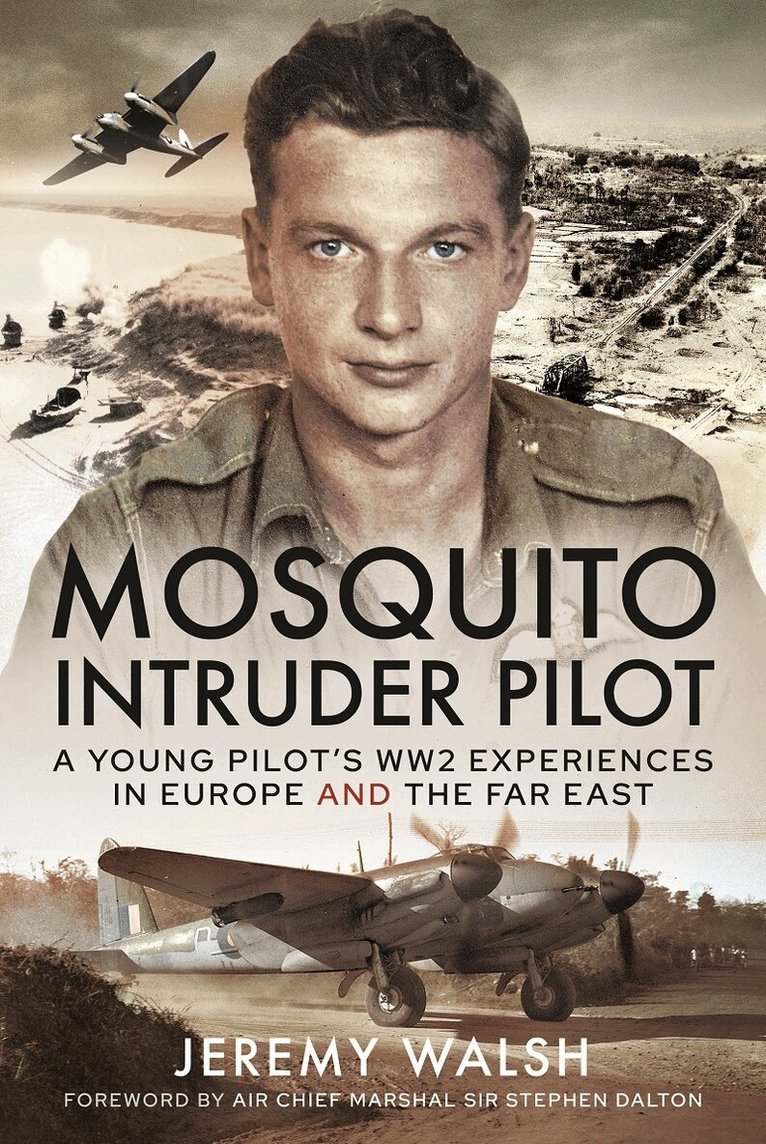
Mosquito Intruder Pilot
A Young Pilot s WW2 Experiences in Europe and the Far East
Inbunden, Engelska, 2022
258 kr
Skickas
Ben Walsh lied about his age to join the RAF, determined to play his part in the Second World War. He volunteered to be an intruder pilot, flying low level operations in the dark. Initially flying ops in Douglas Boston Intruder IIs, he then converted to the legendary de Havilland Mosquito FB VI. Ben flew ops for three years, starting in the skies over with Europe with 418 (RCAF) Squadron, then ferrying one of the first Mosquito FB VIs to India before flying in the Burma campaign with 27 Squadron (under Wing Commander Nicolson VC) and finally with 45 Squadron.The Mosquito developed problems in the severe climate it encountered in the Far East which resulted in the aircraft being temporarily grounded in November 1944. This saw Ben undertaking thirteen operational sorties in venerable Tiger Moths in the Arakan.Although Ben survived belly landings, crashes, enemy fire and engine failures, the strain of combat operations took its toll on the still-young pilot. He and his navigator asked to be removed from operations, but their request was denied, both being threatened with court martial.By the end of the war when still only 21 years old, Ben was suffering from a nervous condition known as the twitch'. His confidence and health were restored by the young woman who had been his pen friend through the war, who became his wife and the mother of the man who has compiled this dramatic and moving story - Jeremy Walsh.Throughout the war, Ben maintained a Roll of Honour' in his photograph album, memorializing his friends and colleagues who lost their lives. That album forms the backdrop to this important biography, which is based on Ben's own recollections, his logbook and the notes he kept through the war. Mosquito Intruder Pilot is Ben's story.
197 kr
Kommande
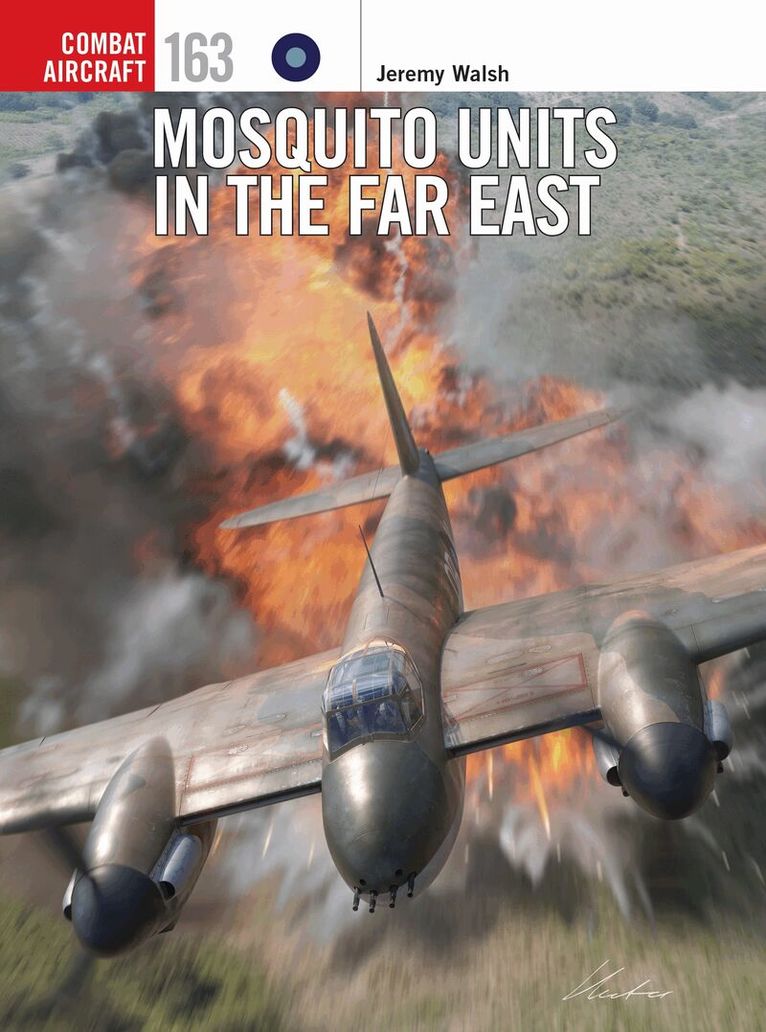
An illustrated history of the remarkable DH 98 Mosquito, from its unusual design and construction through to its pivotal actions the Far East. The RAF and RAAF’s de Havilland DH 98 Mosquito played an important role in forcing the Japanese retreat from Burma and the Far East. Combining innovative composite-wood construction, world-class performance and beautifully balanced handling, the ‘Mossie’ excelled in intruder/strike and long-range photo-reconnaissance roles, despite its vulnerability to the hot, humid climate and challenging weather conditions. Moreover, Mosquito crews undertook their missions with great skill and determination, whether skimming the jungle to attack supply lines, supporting ground attack of artillery emplacements, denying airspace to the Japanese or identifying the enemy’s command centres.In this new study, Mosquito specialist Jeremy Walsh reviews the aircraft’s background, its operational history across both RAF and RAAF squadrons in the Far East and its contribution to Allied success in this often ‘forgotten’ theatre. Accounts from aircrew bring first-hand perspectives to the story, while archive photographs and 21 newly commissioned aircraft profiles detail the aerodynamic efficiency and revolutionary nature of the Mosquito’s design.
Science Perspectives for 3D Spectroscopy
Proceedings of the ESO Workshop held in Garching, Germany, 10-14 October 2005
Inbunden, Engelska, 2007
1 064 kr
Skickas inom 10-15 vardagar
“You will hold in your hands the proceedings of the last conference ever on integral-?eld spectroscopy.” So the daring statement that we, organizers, made at the end of an extremely interesting and busy week of conference in October 2005. Indeed, the quality and diversity of the contributions in this book indicated that integral-?eld spectroscopy had evolved into a mature technique. Future books would not be dedicated to the technique as such but to the science achieved with ‘3D-spectroscopy,’ that is a dedicated book after thisone,assemblingscienceresultsacrosssomany?elds,isunlikelytoappear again (or have you seen a proceeding dedicated to ‘long-lit spectroscopy’ recently?). In a sense this is very encouraging. The idea of this conference was an o?springoftheResearchandTrainingNetwork(RTN)‘Euro3D’sponsoredby the European Commission. The goal of this network was to promote integr- ?eld spectroscopy from an technique for experts to a common user utility for astronomical research. When we ?rst talked about this conference the VLT, for example, was not yet equipped with any integral-?eld spectrograph. We were wondering whether anyone would actually attend the conference in 4 years’ time and would have anything to report upon. We were rewarded for our optimism and very positively surprised about the progress made in the years after that. A progress, of course, driven by theadventofsomanyintegral-?eldspectrographsaroundtheworld,installed on 4m to 8–10m class telescopes. Many of these instruments are referred to in the present book. Yet, this is explicitly not a book dedicated to technical issues,butfocusingonthescience.Thus,thenameoftheconference,Science Perspectives for 3D Spectroscopy.
Science Perspectives for 3D Spectroscopy
Proceedings of the ESO Workshop held in Garching, Germany, 10-14 October 2005
Häftad, Engelska, 2010
1 064 kr
Skickas inom 10-15 vardagar
“You will hold in your hands the proceedings of the last conference ever on integral-?eld spectroscopy.” So the daring statement that we, organizers, made at the end of an extremely interesting and busy week of conference in October 2005. Indeed, the quality and diversity of the contributions in this book indicated that integral-?eld spectroscopy had evolved into a mature technique. Future books would not be dedicated to the technique as such but to the science achieved with ‘3D-spectroscopy,’ that is a dedicated book after thisone,assemblingscienceresultsacrosssomany?elds,isunlikelytoappear again (or have you seen a proceeding dedicated to ‘long-lit spectroscopy’ recently?). In a sense this is very encouraging. The idea of this conference was an o?springoftheResearchandTrainingNetwork(RTN)‘Euro3D’sponsoredby the European Commission. The goal of this network was to promote integr- ?eld spectroscopy from an technique for experts to a common user utility for astronomical research. When we ?rst talked about this conference the VLT, for example, was not yet equipped with any integral-?eld spectrograph. We were wondering whether anyone would actually attend the conference in 4 years’ time and would have anything to report upon. We were rewarded for our optimism and very positively surprised about the progress made in the years after that. A progress, of course, driven by theadventofsomanyintegral-?eldspectrographsaroundtheworld,installed on 4m to 8–10m class telescopes. Many of these instruments are referred to in the present book. Yet, this is explicitly not a book dedicated to technical issues,butfocusingonthescience.Thus,thenameoftheconference,Science Perspectives for 3D Spectroscopy.
Chemical Evolution from Zero to High Redshift
Proceedings of the ESO Workshop Held at Garching, Germany, 14–16 October 1998
Häftad, Engelska, 2014
1 064 kr
Skickas inom 10-15 vardagar
With the new era of 8-10 m telescopes the power to spectroscopically examine the light of fainter and more distant targets has taken a 'photon' leap. It is now becoming routinely possible to obtain high signal-to-noise spectra of very distant objects and to attempt the determination of their abundances. The motivation for a workshop on this topic could be summarized thus: Do we understand enough about chemical abundances at zero redshift to trust any conclusions on chem- ical evolution at high redshift? Given our observational background in gaseous nebulae, we thought at first in terms of a workshop largcly devoted to the inter- stellar medium. However, we were encouraged by Jacqueline Bergeron and Alvio Renzini to pitch the theme much wider. The members of the Scientific Organiz- ing Committee (Francoise Combes, Don Garnett, Guinevere Kauffmann, Claus Leitherer, Danny Lennon, Max Pettini, Peter Shaver, Elena Terlevich and David Tytler), under the chair of John Mathis, made sure that we kept the conference broad in scope. We thank them for their encouragement and advice. Informally the working title for the conference thus became "High and low Z from low to high z" (or Z@O
Science with the VLT
Proceedings of the ESO Workshop Held at Garching, Germany, 28 June – 1 July 1994
Häftad, Engelska, 2013
536 kr
Skickas inom 10-15 vardagar
ESO's new and exciting telescope, the VLT in Chile, will certainly bring a host of new results in optical astronomy for the years to come. This workshop surveys a large variety of possible observations and the needed instrumentation. It is an exciting overview of front research in astronomy rarely published before. The book covers the whole gamut of optical-IR astronomy from the solar system, search for planets in nearby stars, physics of galactic stars and clusters, galactic structure, structure of nearby galaxies, AGN and quasars, clusters of galaxies, to large structure and cosmology. Furthermore it summarizes the two panel discussions.