Jerome Rothenberg – författare
Visar alla böcker från författaren Jerome Rothenberg. Handla med fri frakt och snabb leverans.
17 produkter
17 produkter
Häftad, Engelska, 2017
382 kr
Skickas inom 5-8 vardagar
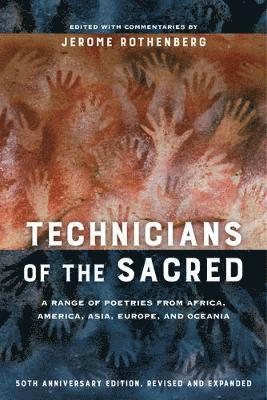
Hailed by Robert Creeley as "both a deeply useful book and an unequivocal delight" and by the LA Times Book Review as one of the hundred most recommended American books of the late 20th century, Jerome Rothenberg's landmark anthology Technicians of the Sacred has educated and inspired generations of poets, artists, musicians, and other readers, exposing them to the multiple possibilities of poetry throughout the world. Juxtaposing "primitive" and archaic works of art from many cultures with each other and with avant-garde and experimental poetry, Jerome Rothenberg contends that literature extends beyond specific temporal and geographic boundaries, while acting as a retort to those who would call that larger humanity into question. A half-century since its original publication, this revised and expanded third edition provides readers with a wealth of newly gathered and translated texts from recently reinvigorated indigenous cultures, bringing the volume into the present and further extending the range and depth of what we recognize and read as poetry.
Häftad, Engelska, 1995
405 kr
Skickas inom 5-8 vardagar
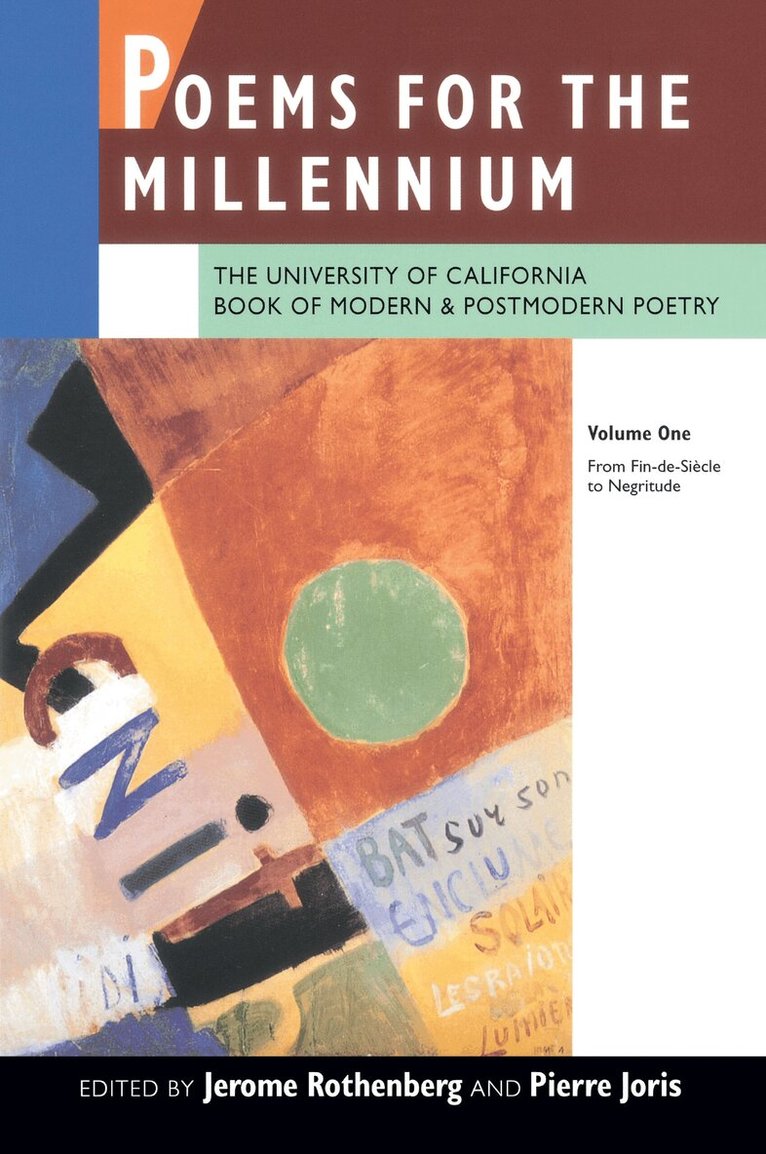
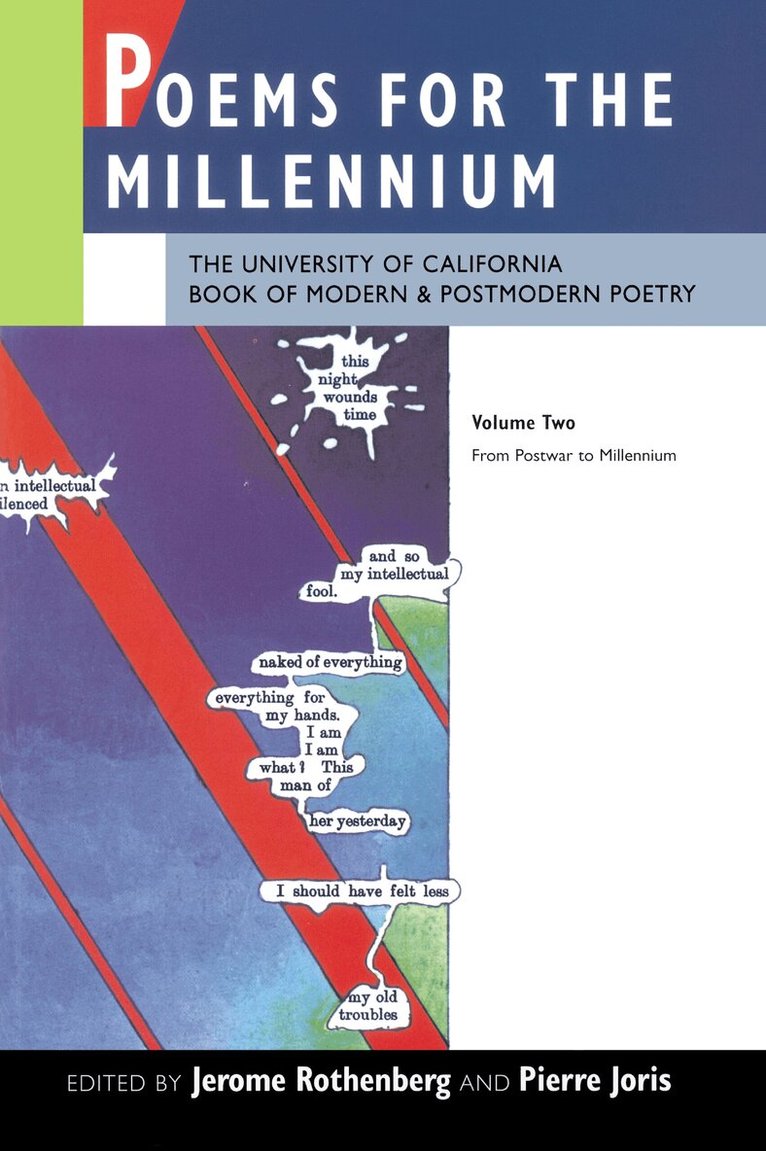
As we come to the end of the century, the entire vista of modern poetry has dramatically changed. "Poems for the Millennium" captures the essence of that change, and unlike any anthology available today, it reveals the revolutionary concepts at the very heart of twentieth-century poetry. International in its coverage, these volumes depart from the established poetic modes that grew out of the nineteenth century and instead bring together the movements that radically altered the ways that art and language express the human condition. The first volume offers three 'galleries' of individual poets - figures such as Mallarme, Stein, Rilke, Tzara, Mayakovsky, Pound, H.D., Vallejo, Artaud, Cesaire, and Tsvetayeva. Included, too, are sections dedicated to some of the most significant pre-World War II movements in poetry and the other arts: Futurism, Expressionism, Dada, Surrealism, Objectivism, and Negritude. The second volume will extend the gathering to the present, forming a synthesizing, global anthology that surpasses other collections in its international scope and experimental range.Poet-editors Jerome Rothenberg and Pierre Joris provide informative and irreverent commentaries throughout. They challenge old truths and propose alternative directions, in the tradition of the revolutionary manifestos that have marked the art and poetry of the twentieth century. The result is both an essential source book for experiencing the full range of this century's poetic possibilities and a powerful statement on the future of poetry in the millennium ahead.
Häftad, Engelska, 1998
405 kr
Skickas inom 5-8 vardagar
As we come to the beginning of a new century, we find that the entire vista of modern poetry has dramatically changed. "Poems for the Millennium" captures the essence of that change, and unlike any anthology available today it reveals the revolutionary concepts at the very heart of contemporary poetry. International in its coverage, these volumes bring together the poets and poetry movements that radically altered the ways that art and language express the human condition. Volume 2 offers a dazzling chronicle of the second 'great awakening' of experimental poetry in the twentieth century. Ranging from the period of World War II through the cold war to the onset of the twenty-first century, this volume presents two 'galleries' of individual poets such as Holan, Olson, Rukeyser, Jabes, Celan, Mac Low, Pasolini, Bachmann, Finlay, Ginsberg, Adonis, Rich, U Tam'si, Baraka, Takahashi, Waldman, and Bei Dao.There are also samplings of local and international movements: the Beats, the Vienna Group, the Cobra poets and artists, the Arabic-language Tammuzi poets, the creators of a new 'Concrete Poetry', the 'postwar poets' of Japan, the Italian Novissimi and Avan-Guardia, the Chinese Misty Poets, and the North American Language Poets. In addition, an extended section is devoted to examples of the 'art of the manifesto' and two smaller groupings of traditional 'oral poets' and of experimenters with machine art and cyberpoetics. Poet-editors Jerome Rothenberg and Pierre Joris provide informative and irreverent commentaries throughout. They challenge old truths and propose alternative directions, in the tradition of the manifestos that have marked the art and poetry of the twentieth century. The result is both an essential resource for experiencing the full range of contemporary poetic possibilities and an arresting statement on the future of poetry in the millennium ahead.
Del 2 - Poets for the Millennium
Maria Sabina
Selections
Häftad, Engelska, 2003
312 kr
Skickas inom 5-8 vardagar
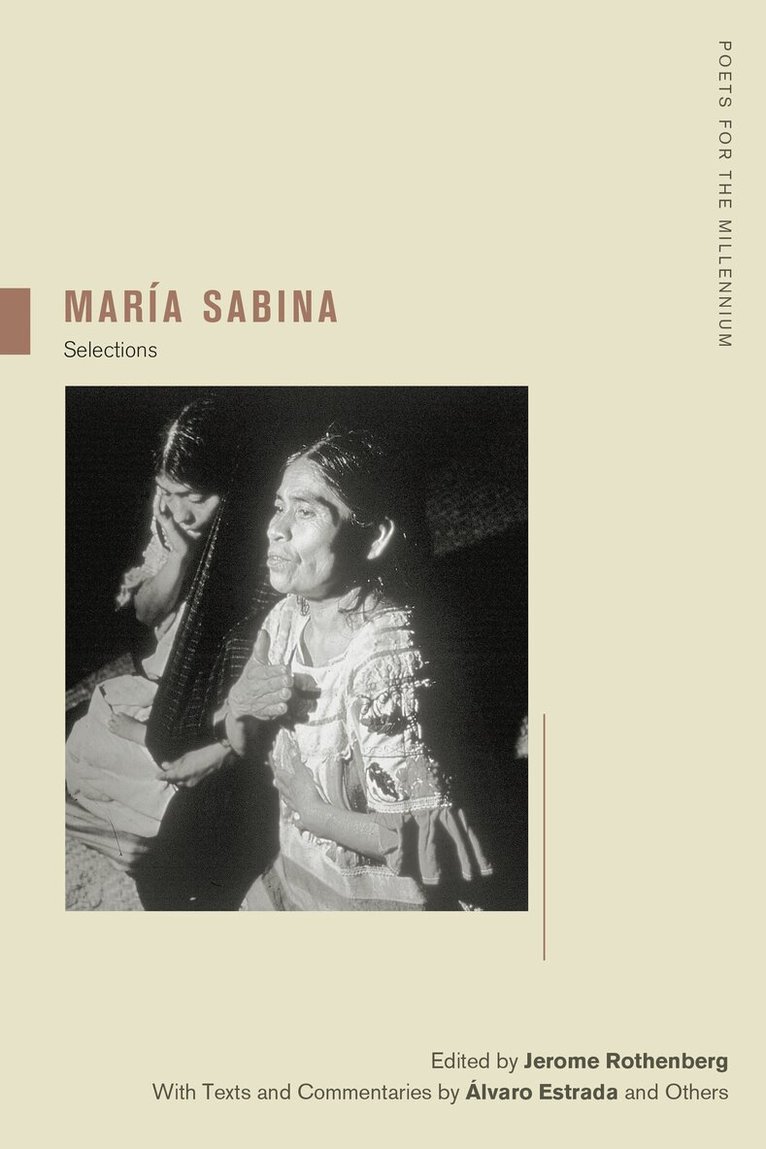
A shaman and visionary - not a poet in any ordinary sense - Maria Sabina lived out her life in the Oaxacan mountain village of Huautla de Jimenez, and yet her words, always sung or spoken, have carried far and wide, a principal instance and a powerful reminder of how poetry can arise in a context far removed from literature as such. Seeking cures through language - with the help of Psilocybe mushrooms, said to be the source of language itself - she was, as Henry Munn describes her, 'a genius [who] emerges from the soil of the communal, religious-therapeutic folk poetry of a native Mexican campesino people'. She may also have been, in the words of the Mexican poet Homero Aridjis, 'the greatest visionary poet in twentieth-century Latin America'. These selections include a generous presentation from Sabina's recorded chants and a complete English translation of her oral autobiography, her vida, as written and arranged in her native language by her fellow Mazatec Alvaro Estrada. Accompanying essays and poems include an introduction to "The Life of Maria Sabina" by Estrada, an early description of a nighttime 'mushroom velada' by the ethnomycologist R.Gordon Wasson, an essay by Henry Munn relating the language of Sabina's chants to those of other Mazatec shamans, and more.
Häftad, Engelska, 2009
414 kr
Skickas inom 5-8 vardagar
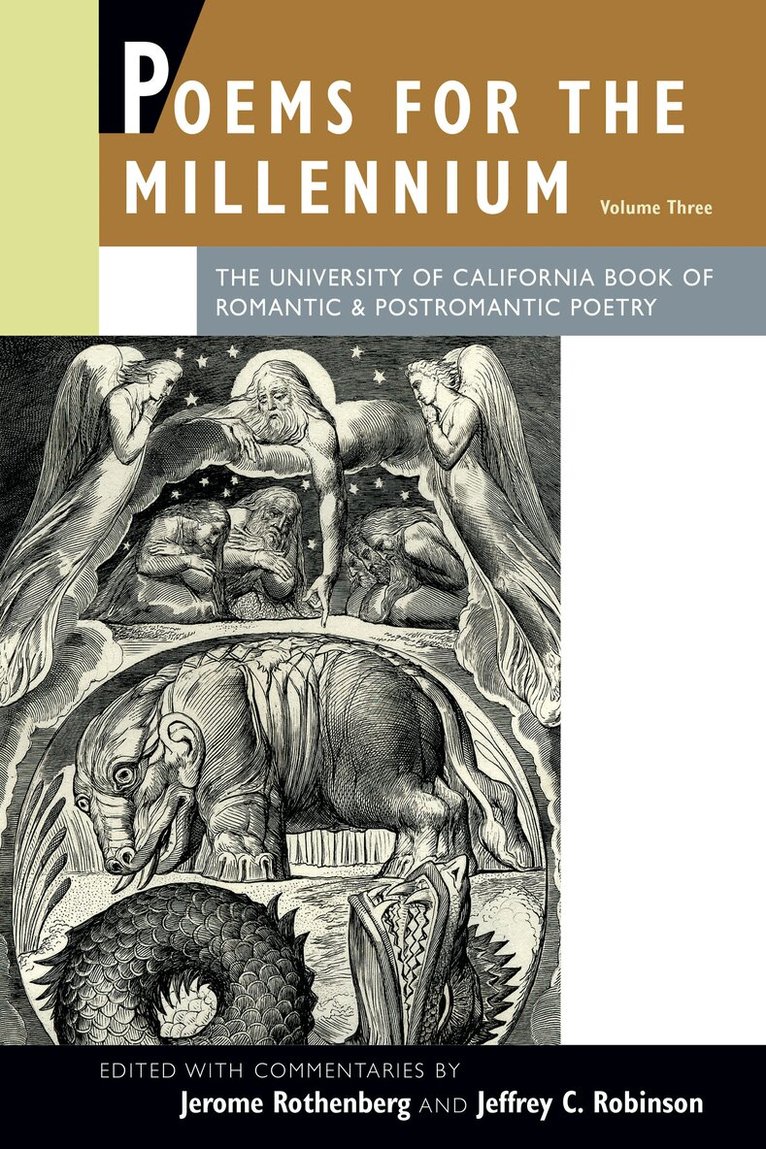
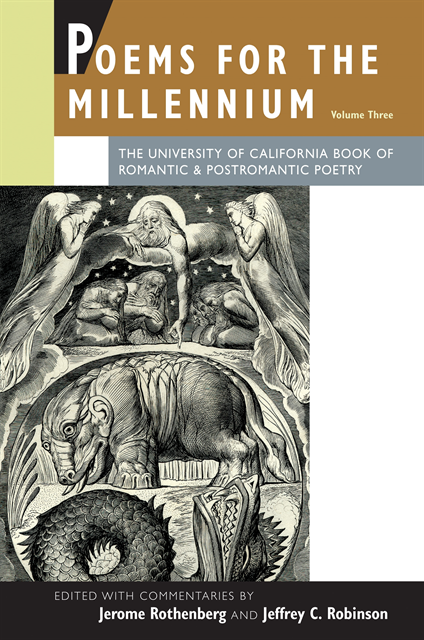
The previous two volumes of this acclaimed anthology set forth a globally decentered revision of twentieth-century poetry from the perspective of its many avant-gardes. Now editors Jerome Rothenberg and Jeffrey C. Robinson bring a radically new interpretation to the poetry of the preceding century, viewing the work of the romantic and post-romantic poets as an international, collective, often utopian enterprise that became the foundation of experimental modernism.Global in its range, volume three gathers selections from the poetry and manifestos of canonical poets, as well as the work of lesser-known but equally radical poets. Defining romanticism as experimental and visionary, Rothenberg and Robinson feature prose poetry, verbal-visual experiments, and sound poetry, along with more familiar forms seen here as if for the first time. The anthology also explores romanticism outside the European orbit and includes ethnopoetic and archaeological works outside the literary mainstream.The range of volume three and its skewing of the traditional canon illuminate the process by which romantics and post- romantics challenged nineteenth-century orthodoxies and propelled poetry to the experiments of a later modernism and avant-gardism.
Inbunden, Engelska, 2017
906 kr
Skickas inom 5-8 vardagar
Hailed by Robert Creeley as "both a deeply useful book and an unequivocal delight" and by the LA Times Book Review as one of the hundred most recommended American books of the late 20th century, Jerome Rothenberg's landmark anthology Technicians of the Sacred has educated and inspired generations of poets, artists, musicians, and other readers, exposing them to the multiple possibilities of poetry throughout the world. Juxtaposing "primitive" and archaic works of art from many cultures with each other and with avant-garde and experimental poetry, Jerome Rothenberg contends that literature extends beyond specific temporal and geographic boundaries, while acting as a retort to those who would call that larger humanity into question. A half-century since its original publication, this revised and expanded third edition provides readers with a wealth of newly gathered and translated texts from recently reinvigorated indigenous cultures, bringing the volume into the present and further extending the range and depth of what we recognize and read as poetry.
Häftad, Engelska, 2016
386 kr
Skickas inom 5-8 vardagar
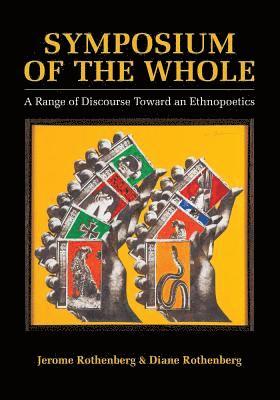
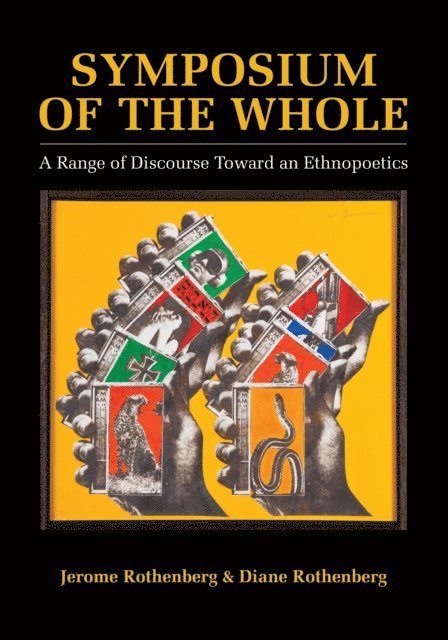
Symposium of the Whole traces a discourse on poetry and culture that has profoundly influenced the art of our time, with precedents going back two centuries and more. Beginning with a reassertion of the complexity of poetry among peoples long labeled "primitive" and "savage," many recent poets have sought to base a new poetics over the fullest range of human cultures. The attempt to define an ethnopoetics has been significantly connected with the most experimental and future-directed side of Romantic and modern poetry, both in the Western world and, increasingly, outside it. As a visionary poetics and as a politics, this complex redefinition of cultural and intellectual values has involved a rarely acknowledged collaboration between poets and scholars, who together have challenged the narrow view of literature that has excluded so many traditions. In this gathering, the Rothenbergs follows the idea of an ethnopoetics from predecessors such as Vico, Blake, Thoreau, and Tzara to more recent essays and manifestos by poets and social thinkers such as Olson, Eliade, Snyder, Turner, and Baraka.The themes range widely, from the divergence of oral and written cultures to the shaman as proto-poet and the reemergence of suppressed and rejected forms and images: the goddess, the trickster, and the "human universe." The book's three ethnographic sections demonstrate how various poetries are structured and composed, how they reflect meaning and worldview, and how they are performed in cultures where all art may be thought of as art-in-motion. Among the poetries discussed are the language of magic; West African drum language and poetry; the Huichol Indian language of reversals; chance operations in African divination poetry; picture-writings and action-writings from Australia and Africa; and American Indian sacred-clown dramas and traditional trickster narratives. The cumulative effect is a new reading of the poetic past and present-in the editors' words, "a changed paradigm of what poetry was or now could come to be."
Inbunden, Engelska, 2024
338 kr
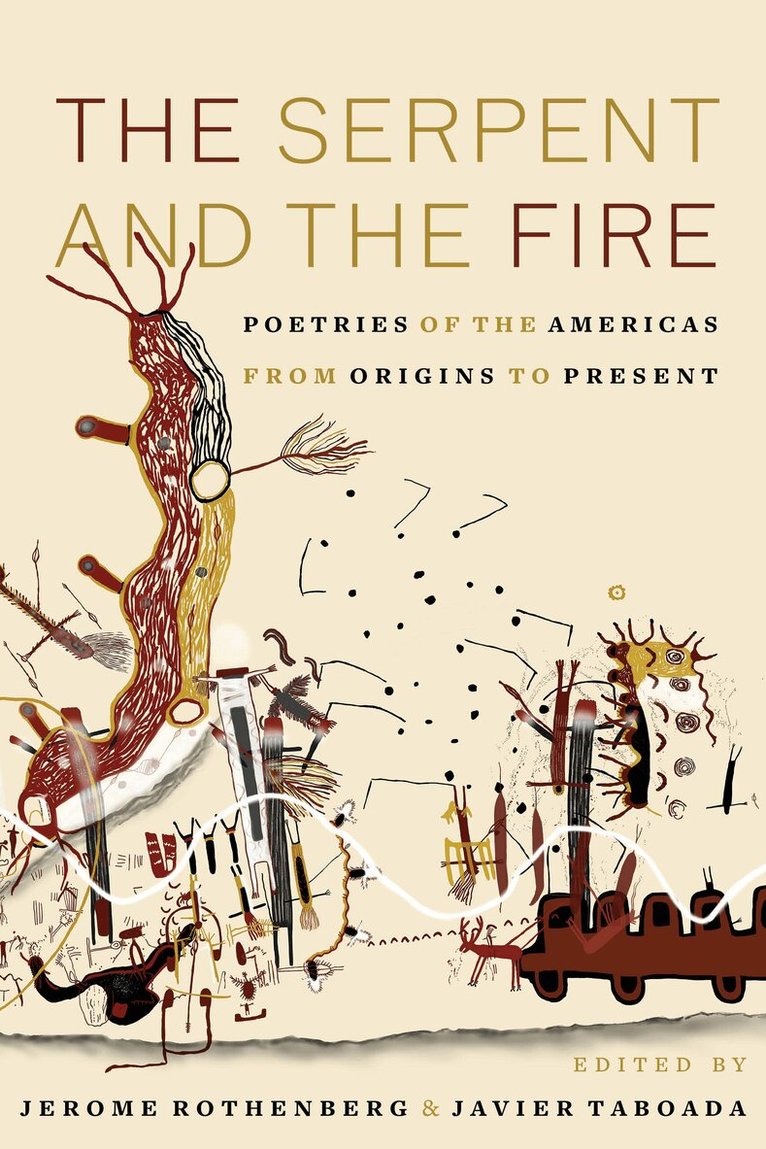
Jerome Rothenberg’s final anthology—an experiment in omnipoetics with Javier Taboada—reaches into the deepest origins of the Americas, north and south, to redefine America and its poetries The Serpent and the Fire breaks out of deeply entrenched models that limit “American” literature to work written in English within the present boundaries of the United States. Editors Jerome Rothenberg and Javier Taboada gather vital pieces from all parts of the Western Hemisphere and the breadth of European and Indigenous languages within: a unique range of cultures and languages going back several millennia, an experiment in what the editors call an American “omnipoetics.” The Serpent and the Fire is divided into four chronological sections—from early pre-Columbian times to the immediately contemporary—and five thematic sections that move freely across languages and shifting geographical boundaries to underscore the complexities, conflicts, contradictions, and continuities of the poetry of the Americas. The book also boasts contextualizing commentaries to connect the poets and poems in dialogue across time and space.
Häftad, Engelska, 1980
65 kr
Skickas inom 11-20 vardagar
Vienna Blood & Other Poems is in some ways the most synthesizing of Jerome Rothenberg’s recent collections, pulling together work from the 1970s that stands apart from Poland/1931 (1974) and A Seneca Journal (1978) yet at the same time continuing the enactment of past and present begun in those books. But where before he chose to restrict his exploration to ancestral Jewish and Amerindian poetries, Rothenberg now takes us on a series of broader journeys through the collapsed landscape of what he calls the ’new wilderness,” evoked as place, as structure, as mind. Written both to be read quietly on the printed page and aloud in performance, the poems in Vienna Blood, though experimental and language-centered, are nevertheless the work of a poet who, by his own admission, is “crazy for content, make no mistake about it.” As if to underscore this point, he has appended brief comments to most of the major sections of the book, in order, as he says, “to give it some context in the way of ’oral tradition’ usually reserved for poetry readings, etc., a little of which I now commit to writing.”
Häftad, Engelska, 2013
279 kr
Skickas inom 5-8 vardagar
Häftad, Engelska, 2010
188 kr
Skickas inom 5-8 vardagar
Häftad, Engelska, 2019
282 kr
Skickas inom 3-6 vardagar
Häftad, Engelska, 2017
230 kr
Skickas inom 5-8 vardagar
Häftad, Engelska, 2000
172 kr
Tillfälligt slut
First published in 1971, this volume brings together a selection of Rothenberg's early groundbreaking work: a wide range of experimental forms, both written and oral, set beside renderings of Native American, Australian, and other primitive songs, as well as the ancestral poems exploring his own origins that look forward to his later poetry.
Häftad, Engelska, 2015
304 kr
Tillfälligt slut
Häftad, Engelska, 2004
228 kr
Tillfälligt slut
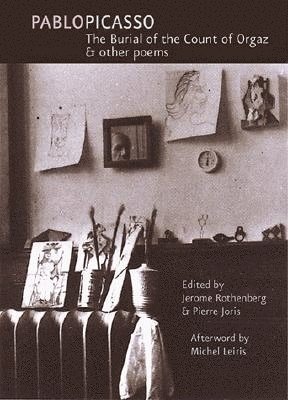
Protean, erotic, scatological and experimental, Picasso's poetry is finally compiled in this essential anthologyPablo Picasso is arguably the most famous and influential artist of the 20th century. What few in the English-speaking world know is that in 1935, at age 54, an emotional crisis caused Picasso to halt all painting and devote himself entirely to poetry. Even after resuming his visual work, Picasso continued to write, in a characteristic torrent, until 1959, leaving a body of prose poems that André Breton praised as “an intimate journal, both of the feelings and the senses, such as has never been kept before.” Similarly struck by the poems' originality, Michel Leiris wrote, “If we must compare him, despite his fierce singularity, in order to try and situate him on the literary map, I see only James Joyce.” Near the end of his life, Picasso himself was quoted as having “told a friend that long after his death his writing would gain recognition and encyclopedias would say: 'Picasso, Pablo Ruiz—Spanish poet who dabbled in painting, drawing and sculpture.'“ For the past five years, poets Jerome Rothenberg and Pierre Joris have overseen a project to translate the majority of this writing into English for the first time. Working from Picasso's original Spanish and French (he wrote in both languages), they enlisted the help of over a dozen contemporary poets in order to mark, as they note in their introduction, “Picasso's entry into our own time.” This is indeed a new Picasso for most of us, or rather, a renewed Picasso: the poems are as protean, erotic, scatological and experimental in form as his visual art has always been described. But amid the ubiquitous posters, t-shirts and tchotchkes, how many of us have truly felt the impact of Picasso's visual work as powerfully as it was perceived in the first half of the 20th century? The poems give us a 21st-century Picasso, free of cliché. Perhaps they will even spark a revival of interest in his “dabblings.”