Jerry D. Leonard - Böcker
Visar alla böcker från författaren Jerry D. Leonard. Handla med fri frakt och snabb leverans.
4 produkter
4 produkter
370 kr
Tillfälligt slut
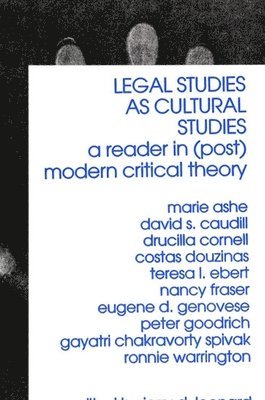
Essays by noted theorists such as Drucilla Cornell, Nancy Fraser, Peter Goodrich, and Gayatri Spivak provide a bridge between critical cultural studies in the humanities and the Critical Legal Studies movement demonstrating the transdisciplinary nature of both fields.This book is an inaugural integration of Contemporary Cultural Studies and Critical Legal Studies that sets the question of "justice" at the fore of postmodern critical theory. Opening with introductory-level discussions of key theoretical models in postmodern thought, the collection culminates in a series of radical critiques of existing modes of cultural and legal theory. Contributors to this volume include David S. Caudill, Marie Ashe, Gayatri Chakravorty Spivak, Nancy Fraser, Costas Douzinas and Ronnie Warrington, Drucilla Cornell, Eugene D. Genovese, Peter Goodrich, Teresa L. Ebert, and Jerry D. Leonard.
169 kr
Skickas inom 5-8 vardagar
169 kr
Skickas inom 5-8 vardagar
Del 19 - Education and Struggle
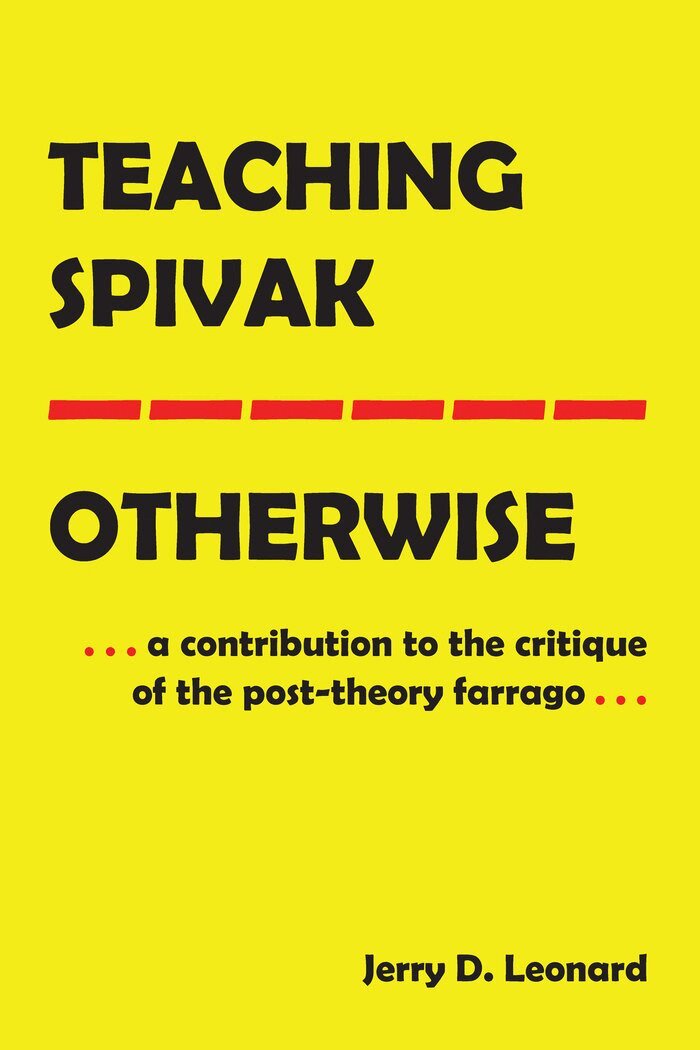
Teaching Spivak—Otherwise
A Contribution to the Critique of the Post-Theory Farrago
Inbunden, Engelska, 2019
1 149 kr
Skickas inom 5-8 vardagar
Grounded in the revolutionary Marxist view that "theory … becomes a material force when it has seized the masses," Teaching Spivak—Otherwise: A Contribution to the Critique of the Post-Theory Farrago activates the practice of critique as a mode of "teaching otherwise" for transformative social change. Taking the post-theory teachings of Gayatri Chakravorty Spivak as its central focus, author Jerry D. Leonard meticulously unpacks Spivak’s fashionably dense writings and "talks." His analyses reveal that what passes for "radical" thought in the dominant humanities is actually a sustained mystification that attempts to erase class struggle and class critique from the realm of knowledge. One of the book’s most significant interventions is its powerful appropriation of "close reading" as a strategy in the broader project of ideology critique. Teaching Spivak—Otherwise does for Spivak what Frederick Engels did for Eugen Dühring and Mao Zedong did for Deng Xiaoping: it teaches the class lesson that Spivak’s thought is a complexly obscured articulation of "new" ruling class ideas in what Lenin called "a farrago of contrasting principles …, an urge to rise verbally to the higher spheres and conceal the conflicts between the historical groups of the population with phrases." This book will be a useful supplementary text for undergraduate and graduate courses in contemporary critical theory and pedagogy.