J.F. Dijksman – författare
Visar alla böcker från författaren J.F. Dijksman. Handla med fri frakt och snabb leverans.
9 produkter
9 produkter
Inbunden, Engelska, 1990
1 619 kr
Skickas inom 10-15 vardagar
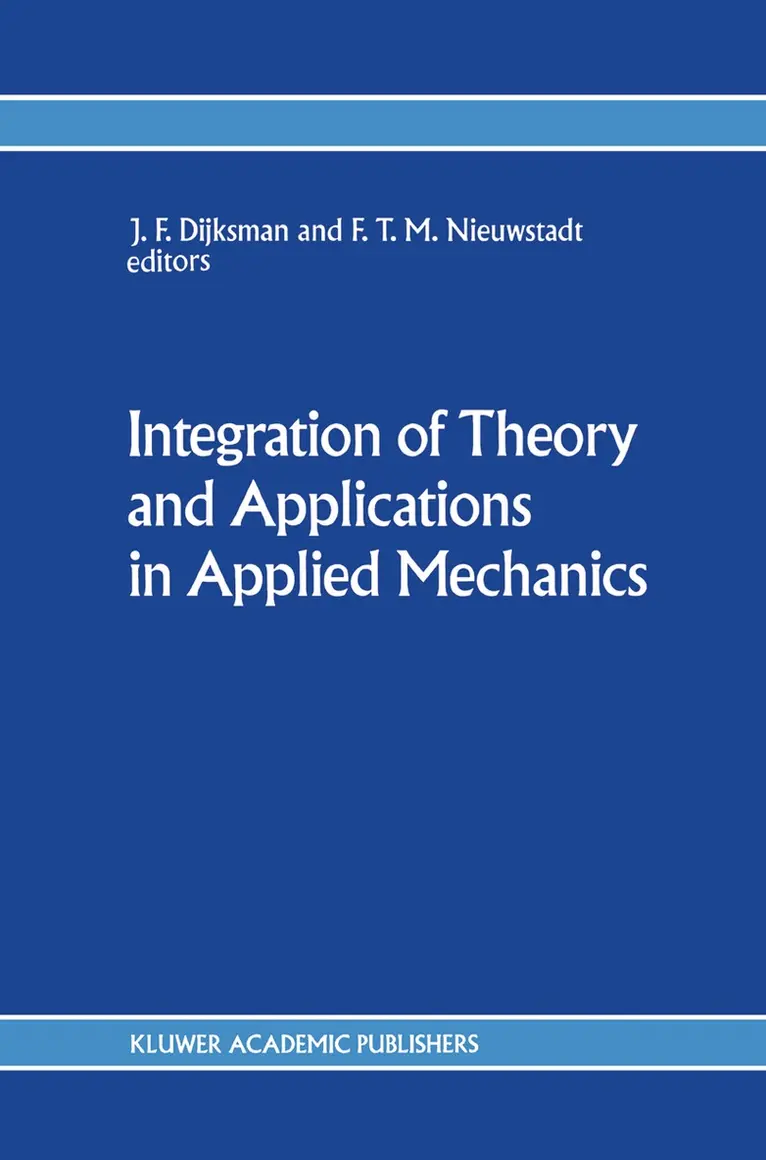
The Department of Applied Mechanics of the Royal Institution of Engineers in the Netherlands (Koninklijk Instituut van Ingenieurs) organised on April 2-4, 1990 the first National Applied Mechanics Congress about the theme: "Integration of Theory and Applications in Applied Mechanics" The idea behind this initiative was to bring together the Applied Mechanics communities in The Netherlands and Belgium and to create an environment in which new developments in the field could be discussed and in which connections to other disciplines could be established. Among an extensive list of possible subjects the following were selected as congress topics: - non-linear material behaviour, - chaos, - mechatronics, - liquid-solid interactions, - mathematics and applied mechanics, - integration of Applied Mechanics and other disciplines. Applied Mechanics comprises both solid mechanics and fluid mechanics. These can be subdivided further into: rheology, plasticity, theory of plates and shells, theory of elasticity, multibody dynamics, dynamics of continuous media, stability of the elastic equilibrium, etc. Applied Mechanics is of tremendous practical significance and it proves its value almost daily in applications such as the calculation of the strength and stiffness of constructions, like e. g.
Inbunden, Engelska, 1993
2 156 kr
Skickas inom 10-15 vardagar
This volume is a compilation of contributions in applied mechanics, dealing with both solid and fluid mechanics. The contributions are based on material presented at the national mechanics congress held in the Netherlands from November 16-18, 1992. The volume covers both theoretical and applied issues, including the following topics: experimental mechanics, how to use modern electronic equipment, optical techniques and software tools to measure strain, stress, displacements and forces in both fluids and solids; the analysis of localized effects on stiffness, strength and stability of structures, like dikes, bridges, roads, and all public works necessary to improve among other things the navigation of canals and rivers.The work also considers the analysis of damage processes in concrete and fibre reinforced polymers and the quest to make such processes accessible by numerical computation; the analysis of localized effects on fluid flow, leading to more understanding of the origin of the different colours of musical tones and human speech, but also to more understanding of the pulsating flow of blood through complicated shaped arteries and drag reduction in turbulent flow through pipes or along walls, as a result of small-sized surface grooves or the addition of a very small amount of polymer to liquids; the investigation of non-linearities in the behaviour of dynamic systems such as manipulators and railway vehicles. Other topics covered include micromechanics and constitutive equations. In order to describe complex material behaviour, understanding of momentum and heat transport on almost the molecular level is needed.This emphasizes the importance of micromechanics in relation to the ultimate strength of composite materials, ranging from fibre reinforced plastics up to very high temperature resistant ceramics, toughened by thin hairlike crystals of exceptional mechanical strength; fluid-structure interactions, such as occur in non-rigid pipelines and artery systems.
Del 28 - Fluid Mechanics and Its Applications
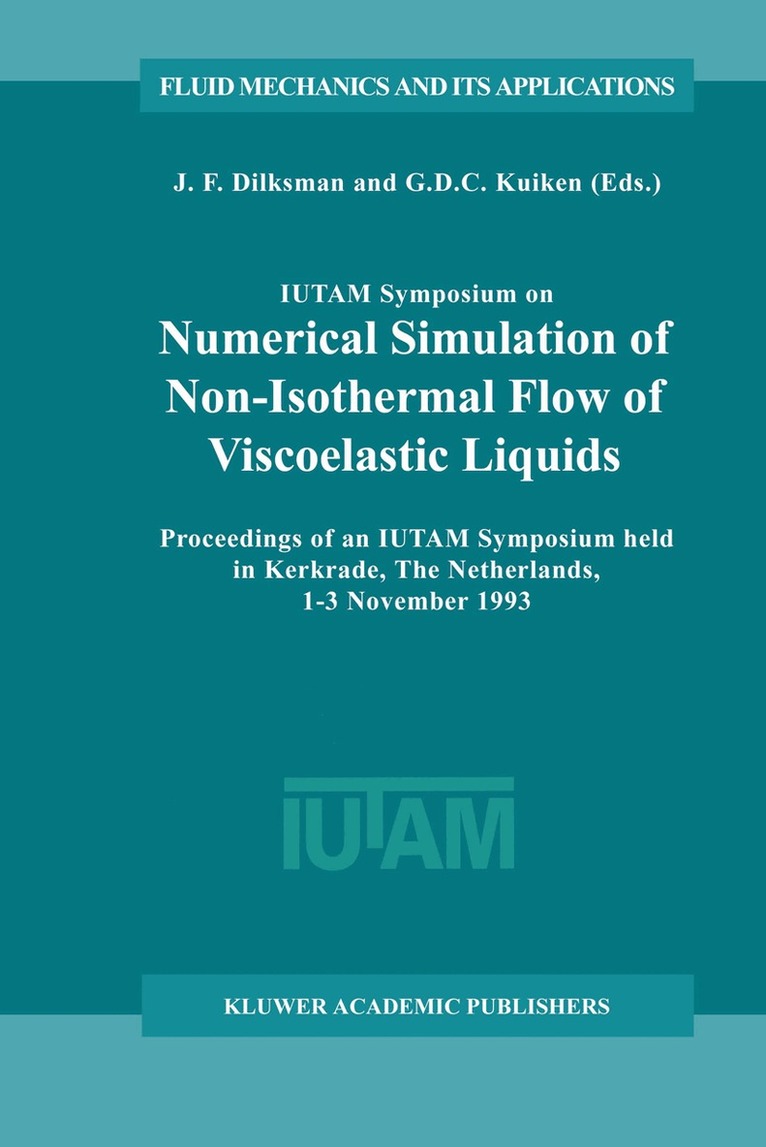
IUTAM Symposium on Numerical Simulation of Non-Isothermal Flow of Viscoelastic Liquids
Proceedings of an IUTAM Symposium held in Kerkrade, The Netherlands, 1–3 November 1993
Inbunden, Engelska, 1995
1 082 kr
Skickas inom 10-15 vardagar
During the last decades a considerable effort has been made on the computation of the isothermal flow of viscoelastic fluids. In fact the activities related to this particular field of non-Newtonian fluid mechanics have focused on the following questions: which type of constitutive equation describes non-Newtonian fluid behaviour; how to measure fluid parameters; and what type of computational scheme leads to reliable, stable and cost-effective computer programs. During the same period, typical non-Newtonian fluid phenomena have been experimentally examined, such as the flow through a "four-to-one" contraction, the flow around a sphere or separation flow, providing fresh challenges for numerical modellers. Apart from momentum transport, however, fluid flow is strongly influenced by heat treansport in most real industrial operations in which non-Newtonian fluids are processed. The IUTAM Symposium on Numerical Simulation of Nonisothermal Flow of Viscoelastic Liquids held at Rolduc Abbey in Kerkrade, the Netherlands, November 1-3 1994, was organized to monitor the state of affairs in regard to the influence of non-isothermal effects on the flow of a viscoelastic liquid.This collection of papers gives an overview of what has been achieved so far in this rapidly emerging field in non-Newtonian fluid mechanics.
E-bok
PDF, Engelska, 20121 977 kr
Läs direkt efter köp
The Department of Applied Mechanics of the Royal Institution of Engineers in the Netherlands (Koninklijk Instituut van Ingenieurs) organised on April 2-4, 1990 the first National Applied Mechanics Congress about the theme: "Integration of Theory and Applications in Applied Mechanics" The idea behind this initiative was to bring together the Applied Mechanics communities in The Netherlands and Belgium and to create an environment in which new developments in the field could be discussed and in which connections to other disciplines could be established. Among an extensive list of possible subjects the following were selected as congress topics: - non-linear material behaviour, - chaos, - mechatronics, - liquid-solid interactions, - mathematics and applied mechanics, - integration of Applied Mechanics and other disciplines. Applied Mechanics comprises both solid mechanics and fluid mechanics. These can be subdivided further into: rheology, plasticity, theory of plates and shells, theory of elasticity, multibody dynamics, dynamics of continuous media, stability of the elastic equilibrium, etc. Applied Mechanics is of tremendous practical significance and it proves its value almost daily in applications such as the calculation of the strength and stiffness of constructions, like e. g.
Häftad, Engelska, 2012
1 073 kr
Skickas inom 10-15 vardagar
During the last decades a considerable effort has been made on the computation of the isothermal flow of viscoelastic fluids. In fact the activities related to this particular field of non-Newtonian fluid mechanics have focused on the following questions: which type of constitutive equation describes non-Newtonian fluid behaviour; how to measure fluid parameters; and what type of computational scheme leads to reliable, stable and cost-effective computer programs. During the same period, typical non-Newtonian fluid phenomena have been experimentally examined, such as the flow through a `four-to-one' contraction, the flow around a sphere or separation flow, providing fresh challenges for numerical modellers. Apart from momentum transport, however, fluid flow is strongly influenced by heat treansport in most real industrial operations in which non-Newtonian fluids are processed. The IUTAM Symposium on `Numerical Simulation of Nonisothermal Flow of Viscoelastic Liquids' held at Rolduc Abbey in Kerkrade, the Netherlands, November 1--3, 1993, was organised to monitor the state of affairs in regard to the influence of nonisothermal effects on the flow of a viscoelastic liquid. The present collection of papers gives an overview of what has been achieved so far. It is a milestone in the rapidly emerging and exciting new field in non-Newtonian fluid mechanics.
Häftad, Engelska, 2012
2 138 kr
Skickas inom 10-15 vardagar
In collaboration with the Contact Group Experimental Mechanics in The Netherlands and under the auspices of the Technological Institute of the Koninklijke Vlaamse Ingenieurs Vereniging (Royal Flemish Society of Engineers), the Department of Ap plied Mechanics of the Koninklijk Instituut van Ingenieurs (Royal Institution of Engineers in The Netherlands) organised the second National Mechanics Congress in The Netherlands, on November 16-18, 1992. About hundred participants from universities and industrial research laboratories in The Netherlands and Belgium discussed topics around the theme: Building Bridges, Integration of Theory and Applications in Applied Mechanics. Building bridges is of course one of the main tasks of a civil engineer, in order to improve the infrastructure of our society. Strength, stiffness and stability have to be guaranteed for a large number of years of service. Localised effects such as shear lag in longitudinal stiffeners, small cracks in concrete structures and effects of corrosion may on the long tenn lead to catastrofic failure of bridges. During the congress J.P. Gailliez presented a talk about the hydraulic ship lifts in the Canal du Centre in south Belgium. Built more than a hundred years ago, the elevators still are in a perfect condition and are recognized now as an industrial archeological monument.
Häftad, Engelska, 2011
1 605 kr
Skickas inom 10-15 vardagar
The Department of Applied Mechanics of the Royal Institution of Engineers in the Netherlands (Koninklijk Instituut van Ingenieurs) organised on April 2-4, 1990 the first National Applied Mechanics Congress about the theme: "Integration of Theory and Applications in Applied Mechanics" The idea behind this initiative was to bring together the Applied Mechanics communities in The Netherlands and Belgium and to create an environment in which new developments in the field could be discussed and in which connections to other disciplines could be established. Among an extensive list of possible subjects the following were selected as congress topics: - non-linear material behaviour, - chaos, - mechatronics, - liquid-solid interactions, - mathematics and applied mechanics, - integration of Applied Mechanics and other disciplines. Applied Mechanics comprises both solid mechanics and fluid mechanics. These can be subdivided further into: rheology, plasticity, theory of plates and shells, theory of elasticity, multibody dynamics, dynamics of continuous media, stability of the elastic equilibrium, etc. Applied Mechanics is of tremendous practical significance and it proves its value almost daily in applications such as the calculation of the strength and stiffness of constructions, like e. g.
E-bok
PDF, Engelska, 20121 367 kr
Läs direkt efter köp
During the last decades a considerable effort has been made on the computation of the isothermal flow of viscoelastic fluids. In fact the activities related to this particular field of non-Newtonian fluid mechanics have focused on the following questions: which type of constitutive equation describes non-Newtonian fluid behaviour; how to measure fluid parameters; and what type of computational scheme leads to reliable, stable and cost-effective computer programs. During the same period, typical non-Newtonian fluid phenomena have been experimentally examined, such as the flow through a `four-to-one'' contraction, the flow around a sphere or separation flow, providing fresh challenges for numerical modellers. Apart from momentum transport, however, fluid flow is strongly influenced by heat treansport in most real industrial operations in which non-Newtonian fluids are processed. The IUTAM Symposium on `Numerical Simulation of Nonisothermal Flow of Viscoelastic Liquids'' held at Rolduc Abbey in Kerkrade, the Netherlands, November 1--3, 1993, was organised to monitor the state of affairs in regard to the influence of nonisothermal effects on the flow of a viscoelastic liquid. The present collection of papers gives an overview of what has been achieved so far. It is a milestone in the rapidly emerging and exciting new field in non-Newtonian fluid mechanics.
E-bok
PDF, Engelska, 20122 685 kr
Läs direkt efter köp
In collaboration with the Contact Group Experimental Mechanics in The Netherlands and under the auspices of the Technological Institute of the Koninklijke Vlaamse Ingenieurs Vereniging (Royal Flemish Society of Engineers), the Department of Ap plied Mechanics of the Koninklijk Instituut van Ingenieurs (Royal Institution of Engineers in The Netherlands) organised the second National Mechanics Congress in The Netherlands, on November 16-18, 1992. About hundred participants from universities and industrial research laboratories in The Netherlands and Belgium discussed topics around the theme: Building Bridges, Integration of Theory and Applications in Applied Mechanics. Building bridges is of course one of the main tasks of a civil engineer, in order to improve the infrastructure of our society. Strength, stiffness and stability have to be guaranteed for a large number of years of service. Localised effects such as shear lag in longitudinal stiffeners, small cracks in concrete structures and effects of corrosion may on the long tenn lead to catastrofic failure of bridges. During the congress J.P. Gailliez presented a talk about the hydraulic ship lifts in the Canal du Centre in south Belgium. Built more than a hundred years ago, the elevators still are in a perfect condition and are recognized now as an industrial archeological monument.