Jianjun Zhu - Böcker
Visar alla böcker från författaren Jianjun Zhu. Handla med fri frakt och snabb leverans.
3 produkter
3 produkter
708 kr
Skickas inom 10-15 vardagar
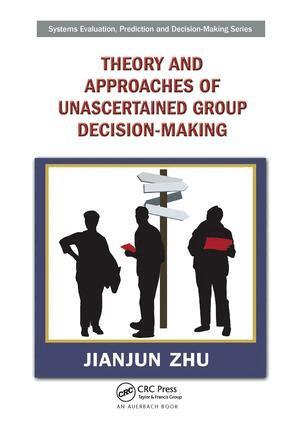
Tackling the question of how to effectively aggregate uncertain preference information in multiple structures given by decision-making groups, Theory and Approaches of Unascertained Group Decision-Making focuses on group aggregation methods based on uncertainty preference information. It expresses the complexity existing in each group decision-making process by employing complex networks and studying various methods of aggregating preference information from various unascertained, time-series based decision-making groups' structures. Written by Jianjun Zhu, director of the Chinese Society for Optimization, Overall Planning, and Economic Mathematics, the book starts by examining case studies of group decision making. It discusses consistency measuring and ranking methods of interval number reciprocal judgment matrix and interval number complementary judgment matrix. Next, it presents an unascertained number preference and a three-point interval number preference. Investigating linguistic preferences, the text provides two consistencies definitions. It considers the aggregating methods of several uncertain preferences as well as the multistage aggregating model of uncertain preference. The final chapter proposes an aggregating model of multistage linguistic information based on TOPSIS. The research in this book is supported by a number of scientific foundations from the People’s Republic of China, including the National Natural Science Foundation of China; the Social Science Foundation of China, Jiangsu Province; and the Soft Science Foundation of China.
1 570 kr
Tillfälligt slut
Tackling the question of how to effectively aggregate uncertain preference information in multiple structures given by decision-making groups, Theory and Approaches of Unascertained Group Decision-Making focuses on group aggregation methods based on uncertainty preference information. It expresses the complexity existing in each group decision-making process by employing complex networks and studying various methods of aggregating preference information from various unascertained, time-series based decision-making groups' structures. Written by Jianjun Zhu, director of the Chinese Society for Optimization, Overall Planning, and Economic Mathematics, the book starts by examining case studies of group decision making. It discusses consistency measuring and ranking methods of interval number reciprocal judgment matrix and interval number complementary judgment matrix. Next, it presents an unascertained number preference and a three-point interval number preference. Investigating linguistic preferences, the text provides two consistencies definitions. It considers the aggregating methods of several uncertain preferences as well as the multistage aggregating model of uncertain preference. The final chapter proposes an aggregating model of multistage linguistic information based on TOPSIS. The research in this book is supported by a number of scientific foundations from the People’s Republic of China, including the National Natural Science Foundation of China; the Social Science Foundation of China, Jiangsu Province; and the Soft Science Foundation of China.
1 204 kr
Skickas inom 3-6 vardagar
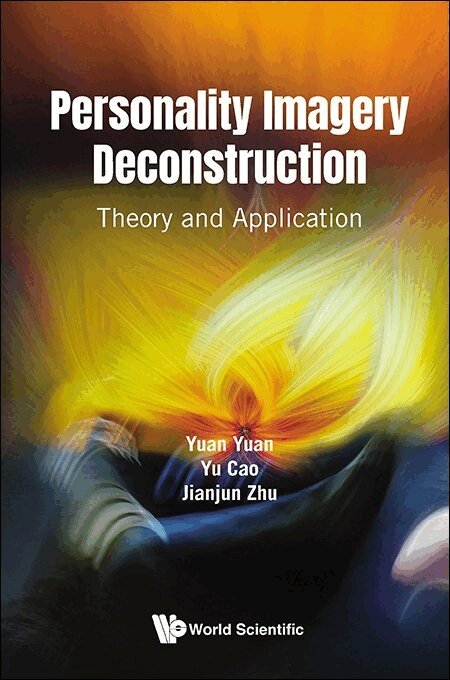
Personality imagery deconstruction is an innovative theory in personality psychology, grounded in Imagery Communication Psychology (ICP). This book offers a comprehensive exploration of the sources of personality imagery, as well as the significance and methods of deconstructing it for practical applications. Inspired by Chinese cultural philosophy, this approach views personality as a system rather than a collection of separate traits. Instead, personality is deconstructed into distinct, independent sub-personalities, each with its own motives, behaviours, and preferences. Through ICP, these sub-personalities emerge in the conscious mind, appearing as individual entities within a broader "community" of the self. By consciously engaging with each sub-personality, individuals can encourage communication and harmony among them. This process allows for the transformation of negative or stagnant sub-personalities, helping to restore vitality and clarity to the overall personality. In essence, personality imagery deconstruction enables personal growth by transforming the inner dynamics of one's mental life.