Jie-Qi Chen – författare
310 kr
Skickas inom 11-20 vardagar
351 kr
Skickas inom 5-8 vardagar
1 146 kr
Skickas inom 11-20 vardagar
417 kr
Skickas inom 5-8 vardagar
1 212 kr
Skickas inom 5-8 vardagar
357 kr
Skickas inom 5-8 vardagar
Effectively assess learning in the most critical years of a child's development
Young children’s learning in preschool and childcare settings sets the foundation for the elementary school years to come. Skills in speaking, listening, reading, math, science, and the arts develop inside everyday instructional routines that teachers and childcare providers make available to children. How can educators be sure of what their children are learning and how to support their progress?
Listening to Learning provides pre-service and in-service teachers and childcare providers working with young learners with an innovative and practical way to assess children’s learning while they are engaged in daily instructional routines. This book offers:
Methods for observing, documenting, and analyzing what and how young children are learningStrategies for monitoring children's progress across various areas, including sciences, arts, mathematics, language arts, and playApproaches for making informed instructional adaptations that address the developmental needs of young learners from diverse home and community settingsA framework that shows how instructional routine activities can be used to bridge classroom assessment with the teaching and learning processWith years of expertise and a thorough analysis of assessment techniques, the authors effectively showcase the power of instructional routines as a tool for understanding and enhancing student learning in these most formative years of development.
2 000 kr
Skickas inom 10-15 vardagar
416 kr
Skickas inom 10-15 vardagar
376 kr
Läs direkt efter köp
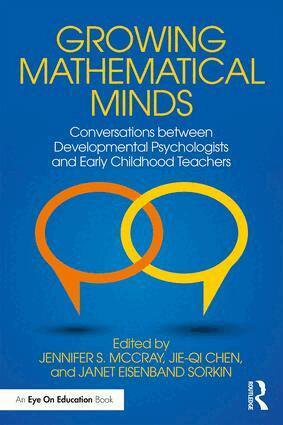
Growing Mathematical Minds is the documentation of an innovative, bi-directional process of connecting research and practice in early childhood mathematics. The book translates research on early mathematics from developmental psychology into terms that are meaningful to teachers and readily applicable in early childhood classrooms. It documents teacher responses, and conveys their thoughts and questions back to representative researchers, who reply in turn. In so doing, this highly useful book creates a conversation, in which researchers and teachers each bring their expertise to bear; their communication about these topics—informed by the thinking, commitment, and experience of both groups—helps us better understand how developmental psychology can improve math teaching, and how math teaching can, in turn, inform developmental science. The book bridges the gap between research and practice, helping teachers to adopt evidence-based practices and apply cutting-edge research findings, and prompting developmental researchers to consider their work within the framework of practice. Growing Mathematical Minds identifies and elucidates research with profound implications for teaching children from three to eight years so they develop foundational math knowledge and skills, positive attitudes toward math, and basic abilities to think mathematically.
376 kr
Läs direkt efter köp
Growing Mathematical Minds is the documentation of an innovative, bi-directional process of connecting research and practice in early childhood mathematics. The book translates research on early mathematics from developmental psychology into terms that are meaningful to teachers and readily applicable in early childhood classrooms. It documents teacher responses, and conveys their thoughts and questions back to representative researchers, who reply in turn. In so doing, this highly useful book creates a conversation, in which researchers and teachers each bring their expertise to bear; their communication about these topics—informed by the thinking, commitment, and experience of both groups—helps us better understand how developmental psychology can improve math teaching, and how math teaching can, in turn, inform developmental science. The book bridges the gap between research and practice, helping teachers to adopt evidence-based practices and apply cutting-edge research findings, and prompting developmental researchers to consider their work within the framework of practice. Growing Mathematical Minds identifies and elucidates research with profound implications for teaching children from three to eight years so they develop foundational math knowledge and skills, positive attitudes toward math, and basic abilities to think mathematically.