Jim Woodcook - Böcker
Visar alla böcker från författaren Jim Woodcook. Handla med fri frakt och snabb leverans.
3 produkter
3 produkter
FM'99 - Formal Methods
World Congress on Formal Methods in the Developement of Computing Systems, Toulouse, France, September 20-24, 1999, Proceedings, Volume I
Häftad, Engelska, 1999
1 096 kr
Skickas inom 10-15 vardagar
This book constitutes, together with its compagnion LNCS 1709, the refereed proceedings of the World Congress on Formal Methods in the Development of Computing Systems, FM'99, held in Toulouse, France in September 1999.The 92 revised full papers presented in the two volumes were carefully reviewed and selected from a total of 259 paper submissions from 35 different countries. Also included are 15 abstracts describing work in progress and industrial applications. The papers are organized in topical sections. Besides five invited papers this volume contains the following sections: integration into the development process; software architecture; European Association for Theoretical Computer Science (EATCS); model checking; the B method; composition and synthesis; telecommunications; security; object-orientation; testing.
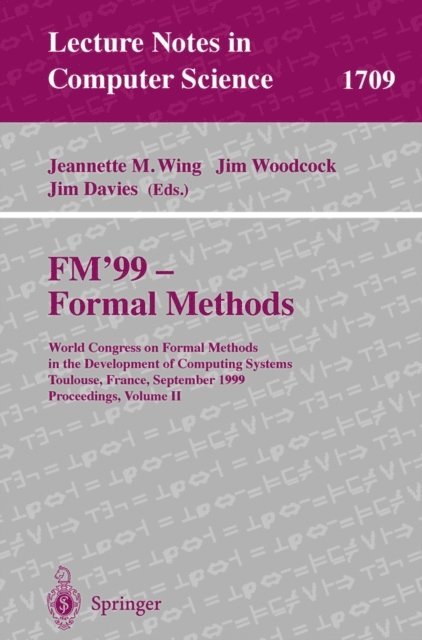
FM'99 - Formal Methods
World Congress on Formal Methods in the Development of Computing Systems, Toulouse, France, September 20-24, 1999 Proceedings, Volume II
Häftad, Engelska, 1999
1 096 kr
Skickas inom 10-15 vardagar
This book constitutes, together with its compagnion LNCS 1708, the refereed proceedings of the World Congress on Formal Methods in the Development of Computing Systems, FM'99, held in Toulouse, France in September 1999. The 92 revised full papers presented in the two volumes were carefully reviewed and selected from a total of 259 paper submissions from 35 different countries. Also included are 15 abstracts describing work in progress and industrial applications. The papers are organized in topical sections. This volume contains the following sections: foundations of system specification (IFIP WG 1.3); European Theory and Practice of Software (ETAPS); program verification; integration of notation and techniques; formal description of programming concepts (IFIP WG 2.2); open information systems; co-design; refinement; safety; OBJ/Cafe OBJ/Maude; Abstract State Machines (ASM) and Algebraic Methods in Software Technology (AMAST); avionics; works-in-progress; industrial experience.
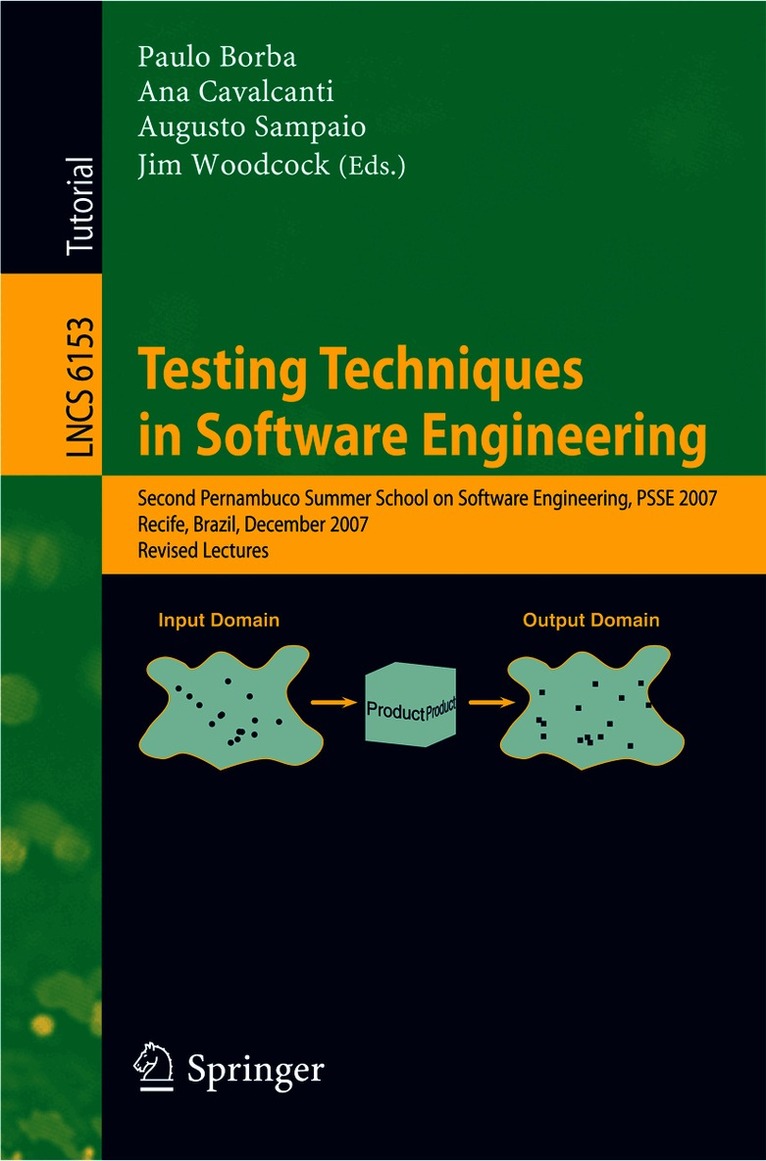
Testing Techniques in Software Engineering
Second Pernambuco Summer School on Software Engineering, PSSE 2007, Recife, Brazil, December 3-7, 2007, Revised Lectures
Häftad, Engelska, 2010
552 kr
Skickas inom 10-15 vardagar
The Pernambuco School on Software Engineering (PSSE) 2007 was the second in a series of events devoted to the study of advanced computer science and to the promotion of international scienti?c collaboration. The main theme in 2007 was testing. Testing is nowadays a key activity for assuring software quality. The summer school and its proceedings were intended to give a detailed tutorial introduction to the scienti?c basis of this activity and its state of the art. Theseproceedingsrecordthecontributionsfromtheinvitedlecturers.Eachof thechaptersistheresultofathoroughrevisionoftheinitialnotesprovidedtothe participants of the school. The revision was inspired by the synergy generated by the opportunity for the lecturers to present and discuss their work among themselves and with the school’s attendees. The editors have tried to produce a coherent view of the topic by harmonizing these contributions, smoothing out di?erences in notation and approach, and providing links between the lectures. We apologize to the authors for any errors introduced by our extensive editing. Although the chapters are linked in severalways, each one is su?ciently se- contained to be read in isolation. Nevertheless, Chap. 1 should be read ?rst by those interested in an introduction to testing. Chapter 1 introduces the terminology adopted in this book. It also provides an overview of the testing process, and of the types (functional, structural, and so on)anddimensions(unit,integration,andsoon)ofthetestingactivity.Themain strategies employed in the central activity of test selection are also discussed. Most of the material presented in this introductory chapter is addressedin more depth in the following chapters.