J.L. Junkins – författare
Visar alla böcker från författaren J.L. Junkins. Handla med fri frakt och snabb leverans.
2 produkter
2 produkter
E-bok
PDF, Engelska, 2012979 kr
Läs direkt efter köp
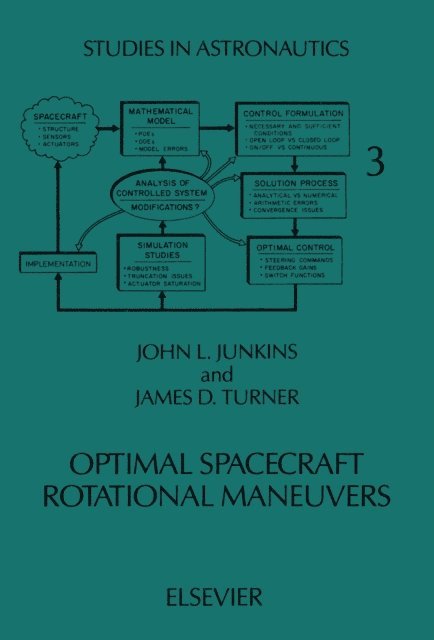
This monograph has grown out of the authors'' recent work directed toward solving a family of problems which arise in maneuvering modern spacecraft. The work ranges from fundamental developments in analytical dynamics and optimal control to a significant collection of example applications. The primary emphasis herein is upon the most central analytical and numerical methods for determining optimal rotational maneuvers of spacecraft. The authors focus especially upon the large angle nonlinear maneuvers, and also consider large rotational maneuvers of flexible vehicles with simultaneous vibration suppression/arrest. Each chapter includes a list of references.The book provides much new material which will be of great interest to practising professionals and advanced graduate students working in the general areas of spacecraft technology, applied mathematics, optimal control theory, and numerical optimization. Chapter 11 in particular presents new information that will be found widely useful for terminal control and tracking maneuvers.
Del 3 - Mechanics: Dynamical Systems
introduction to optimal estimation of dynamical systems
Häftad, Engelska, 2012
540 kr
Skickas inom 10-15 vardagar
This text 1s designed to introduce the fundamentals of esti mation to engineers, scientists, and applied mathematicians. The level of the presentation should be accessible to senior under graduates and should prove especially well-suited as a self study guide for practicing professionals. My primary motivation for writing this book 1s to make a significant contribution toward minimizing the painful process most newcomers must go through in digesting and applying the theory. Thus the treatment 1s intro ductory and essence-oriented rather than comprehensive. While some original material 1s included, the justification for this text lies not in the contribution of dramatic new theoretical re sults, but rather in the degree of success I believe that I have achieved in providing a source from which this material may be learned more efficiently than through study of an existing text or the rather diffuse literature. This work is the outgrowth of the author's mid-1960's en counter with the subject while motivated by practical problems aSSociated with space vehicle orbit determination and estimation of powered rocket trajectories. The text has evolved as lecture notes for short courses and seminars given to professionals at Pr>efaae various private laboratories and government agencies, and during the past six years, in conjunction with engineering courses taught at the University of Virginia. To motivate the reader's thinking, the structure of a typical estimation problem often assumes the following form: • Given a dynamical system, a mathematical model is hypothesized based upon the experience of the investigator.