Joakim Sundnes – författare
Visar alla böcker från författaren Joakim Sundnes. Handla med fri frakt och snabb leverans.
5 produkter
5 produkter
Del 6 - Simula SpringerBriefs on Computing
Introduction to Scientific Programming with Python
Häftad, Engelska, 2020
330 kr
Skickas inom 10-15 vardagar
This open access book offers an initial introduction to programming for scientific and computational applications using the Python programming language. The presentation style is compact and example-based, making it suitable for students and researchers with little or no prior experience in programming. The book uses relevant examples from mathematics and the natural sciences to present programming as a practical toolbox that can quickly enable readers to write their own programs for data processing and mathematical modeling. These tools include file reading, plotting, simple text analysis, and using NumPy for numerical computations, which are fundamental building blocks of all programs in data science and computational science. At the same time, readers are introduced to the fundamental concepts of programming, including variables, functions, loops, classes, and object-oriented programming. Accordingly, the book provides a sound basis for further computer science and programming studies.
Häftad, Engelska, 2023
438 kr
Skickas inom 10-15 vardagar
This open access volume explains the foundations of modern solvers for ordinary differential equations (ODEs). Formulating and solving ODEs is an essential part of mathematical modeling and computational science, and numerous solvers are available in commercial and open source software. However, no single ODE solver is the best choice for every single problem, and choosing the right solver requires fundamental insight into how the solvers work. This book will provide exactly that insight, to enable students and researchers to select the right solver for any ODE problem of interest, or implement their own solvers if needed. The presentation is compact and accessible, and focuses on the large and widely used class of solvers known as Runge-Kutta methods. Explicit and implicit methods are motivated and explained, as well as methods for error control and automatic time step selection, and all the solvers are implemented as a class hierarchy in Python.
Del 1 - Monographs in Computational Science and Engineering
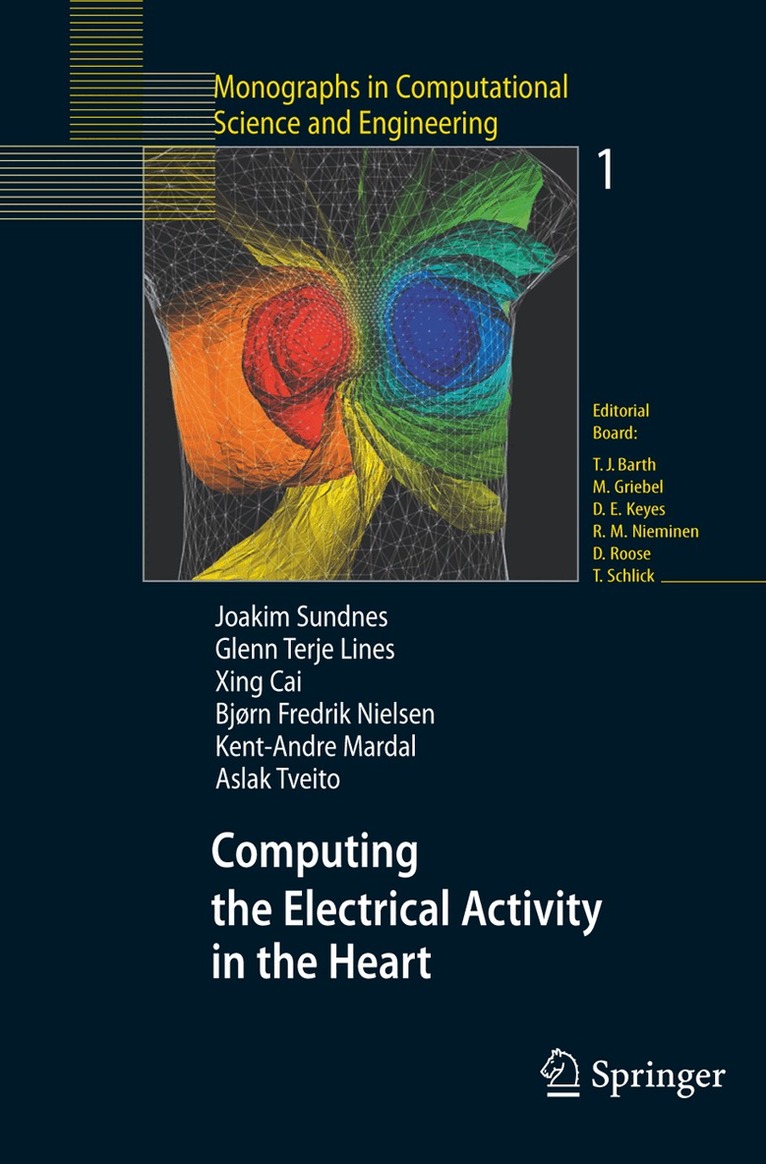
Computing the Electrical Activity in the Heart
Inbunden, Engelska, 2006
1 227 kr
Skickas inom 10-15 vardagar
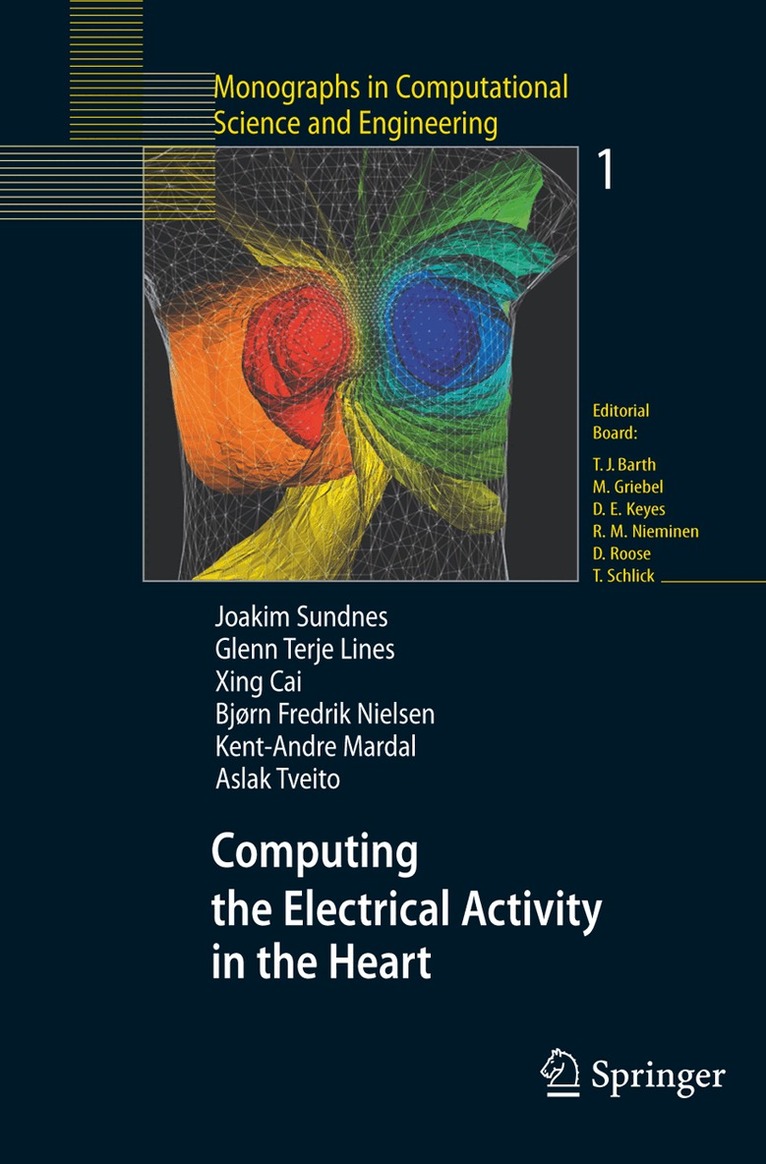
The heart is a fantastic machine; during a normal lifetime it beats about 2.5 billion times and pumps 200.000 tons of blood through an enormous system of vessels extending 160.000 kilometres throughout the body. For centuries, man has tried to understand how the heart works, but there remain many unsolved problems, problems that have captured the attention of thousands of researchers worldwide. There is, for example, a huge amount of research being devoted to the analysis of single heart cells. Other areas of research include trying to understand how it works as a complete muscle, and how blood ows through the heart. The entire process is extremely complex. The history of bioelectricity can be traced back to the late eighteenth century and the experiments of Luigi Galvani. A century later, in 1887, Augustus Wallers managed to measure the electrical signal generated by the heart at the surface of the body [142]. His dog Jimmy earned a place in history by being the rst to have his heart measured in this way; see Figure 1.1. In 1903 Willem Einthoven [34] - veloped the rst commercial device for recording electrocardiograms (ECGs); see Figure 1.2.
E-bok
PDF, Engelska, 20071 622 kr
Läs direkt efter köp
The heart is a fantastic machine; during a normal lifetime it beats about 2.5 billion times and pumps 200.000 tons of blood through an enormous system of vessels extending 160.000 kilometres throughout the body. For centuries, man has tried to understand how the heart works, but there remain many unsolved problems, problems that have captured the attention of thousands of researchers worldwide. There is, for example, a huge amount of research being devoted to the analysis of single heart cells. Other areas of research include trying to understand how it works as a complete muscle, and how blood ows through the heart. The entire process is extremely complex. The history of bioelectricity can be traced back to the late eighteenth century and the experiments of Luigi Galvani. A century later, in 1887, Augustus Wallers managed to measure the electrical signal generated by the heart at the surface of the body [142]. His dog Jimmy earned a place in history by being the rst to have his heart measured in this way; see Figure 1.1. In 1903 Willem Einthoven [34] - veloped the rst commercial device for recording electrocardiograms (ECGs); see Figure 1.2.
Del 1 - Monographs in Computational Science and Engineering
Computing the Electrical Activity in the Heart
Häftad, Engelska, 2010
1 227 kr
Skickas inom 10-15 vardagar
The heart is a fantastic machine; during a normal lifetime it beats about 2.5 billion times and pumps 200.000 tons of blood through an enormous system of vessels extending 160.000 kilometres throughout the body. For centuries, man has tried to understand how the heart works, but there remain many unsolved problems, problems that have captured the attention of thousands of researchers worldwide. There is, for example, a huge amount of research being devoted to the analysis of single heart cells. Other areas of research include trying to understand how it works as a complete muscle, and how blood ows through the heart. The entire process is extremely complex. The history of bioelectricity can be traced back to the late eighteenth century and the experiments of Luigi Galvani. A century later, in 1887, Augustus Wallers managed to measure the electrical signal generated by the heart at the surface of the body [142]. His dog Jimmy earned a place in history by being the rst to have his heart measured in this way; see Figure 1.1. In 1903 Willem Einthoven [34] - veloped the rst commercial device for recording electrocardiograms (ECGs); see Figure 1.2.