Joanna R. Freeland - Böcker
Visar alla böcker från författaren Joanna R. Freeland. Handla med fri frakt och snabb leverans.
4 produkter
4 produkter
1 804 kr
Skickas inom 7-10 vardagar
Molecular Ecology, 2nd Edition provides an accessible introduction to the many diverse aspects of this subject. The book takes a logical and progressive approach to uniting examples from a wide range of taxonomic groups. The straightforward writing style offers in depth analysis whilst making often challenging subjects such as population genetics and phylogenetics highly comprehensible to the reader. The first part of the book introduces the essential underpinnings of molecular ecology and gives a review of genetics and discussion of the molecular markers that are most frequently used in ecological research, and a chapter devoted to the newly emerging field of ecological genomics. The second half of the book covers specific applications of molecular ecology, covering phylogeography, behavioural ecology and conservation genetics.The new edition provides a thoroughly up-to-date introduction to the field, emphasising new types of analyses and including current examples and techniques whilst also retaining the information-rich, highly readable style which set the first edition apart. Incorporates both theoretical and applied perspectivesHighly accessible, user-friendly approach and presentationIncludes self-assessment activities with hypothetical cases based on actual species and realistic data setsUses case studies to place the theory in contextProvides coverage of population genetics, genomics, phylogeography, behavioural ecology and conservation genetics.
825 kr
Tillfälligt slut
Are we humans destroying the environments in which we live, or is environmental change inevitable and natural? How has the relationship between human societies and environments changed since pre-history? Will human population growth outpace the available resources of land and water? Is global warming and climate change already out of control? What can economic and political models tell us about international development? Changing Environments takes a broad, interdisciplinary approach to such questions, drawing on ideas from science, technology, social science and humanities to examine how and why environments change as a result of natural and human-mediated processes. It draws on examples from around the world, and includes consideration of:* the scales of time and space over which changes in our environments occur* the effects on environments that arise from human use of the resources of energy, land, water and the atmosphere* the role of technology and economics in shaping human actions on our environments* the use and limitations of different models for thinking about environmental changeThe book is part of a series entitled Environment: Change, Contest and Response that forms a large part of an Open University course on environmental matters. The other books in the series are: Making Sense of Environmental IssuesContesting EnvironmentsEnvironmental responses
702 kr
Skickas inom 7-10 vardagar
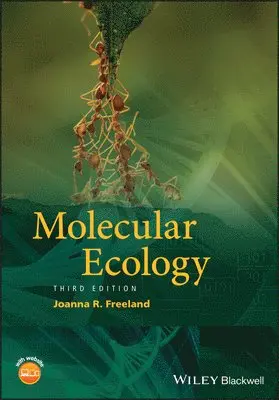
A fully updated guide to the increasingly prevalent use of molecular data in ecological studiesMolecular ecology is concerned with how molecular biology and population genetics may help us to better understand aspects of ecology and evolution including local adaptation, dispersal across landscapes, phylogeography, behavioral ecology, and conservation biology. As the technology driving genetic science has advanced, so too has this fast-moving and innovative discipline, providing important insights into virtually all taxonomic groups. This third edition of Molecular Ecology takes account of the breakthroughs achieved in recent years to give readers a thorough and up-to-date account of the field as it is today. New topics covered in this book include next-generation sequencing, metabarcoding, environmental DNA (eDNA) assays, and epigenetics. As one of molecular ecology’s leading figures, author Joanna Freeland also provides those new to the area with a full grounding in its fundamental concepts and principles. This important text: Is presented in an accessible, user-friendly mannerOffers a comprehensive introduction to molecular ecologyHas been revised to reflect the field’s most recent studies and research developmentsIncludes new chapters covering topics such as landscape genetics, metabarcoding, and community geneticsRich in insights that will benefit anyone interested in the ecology and evolution of natural populations, Molecular Ecology is an ideal guide for all students and professionals who wish to learn more about this exciting field.
820 kr
Kommande
Apply molecular genetics to ecology, conservation, and evolutionary questions Advances in genetic technology continue to reshape how ecologists study local adaptation, dispersal, phylogeography, behavioural ecology, and conservation biology. Now in its Fourth Edition, Molecular Ecology: Applying Genetics to Ecology, Biodiversity, Conservation, and Behaviour by Joanna R. Freeland provides an updated account of how molecular biology and population genetics illuminate ecological and evolutionary processes across virtually all taxonomic groups. This edition incorporates recent references and research developments to reflect the current state of the discipline. Coverage spans environmental change and genetic diversity, landscape genetics, taxonomic classification of communities and prey items, the evolutionary processes associated with invasive species and hybrids, and the evolution of mating systems. Examples and case studies have been selected specifically to engage upper-level undergraduate students with relevant, accessible applications of molecular data. Readers will also find: Updated coverage reflecting the latest breakthroughs in molecular ecology research methods and analytical approaches across diverse taxonomic groups Targeted case studies and examples selected to connect molecular genetic concepts with real-world ecological and conservation questions Applications of population genetics principles for understanding dispersal, gene flow, and connectivity among natural populations Discussions of how environmental change influences genetic diversity within and among populations of plants and animals Accessible presentations of phylogeography, behavioural ecology, and the genetic underpinnings of biological invasions and adaptation Molecular Ecology serves advanced undergraduate students in molecular ecology and ecological genetics courses, as well as postgraduate students seeking foundational background reading. By connecting molecular genetic data directly to ecological and evolutionary questions, this text prepares readers to interpret and apply genetic approaches in research and conservation practice.