Joel E. Cohen - Böcker
Visar alla böcker från författaren Joel E. Cohen. Handla med fri frakt och snabb leverans.
9 produkter
9 produkter
160 kr
Tillfälligt slut
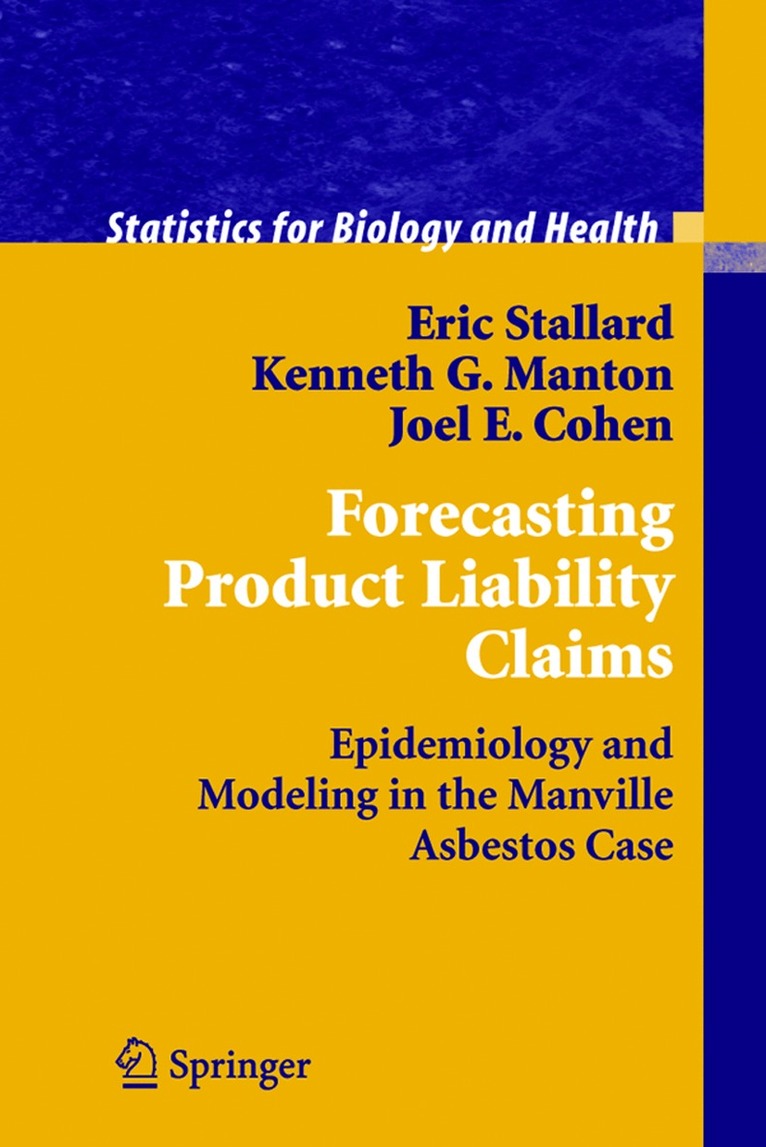
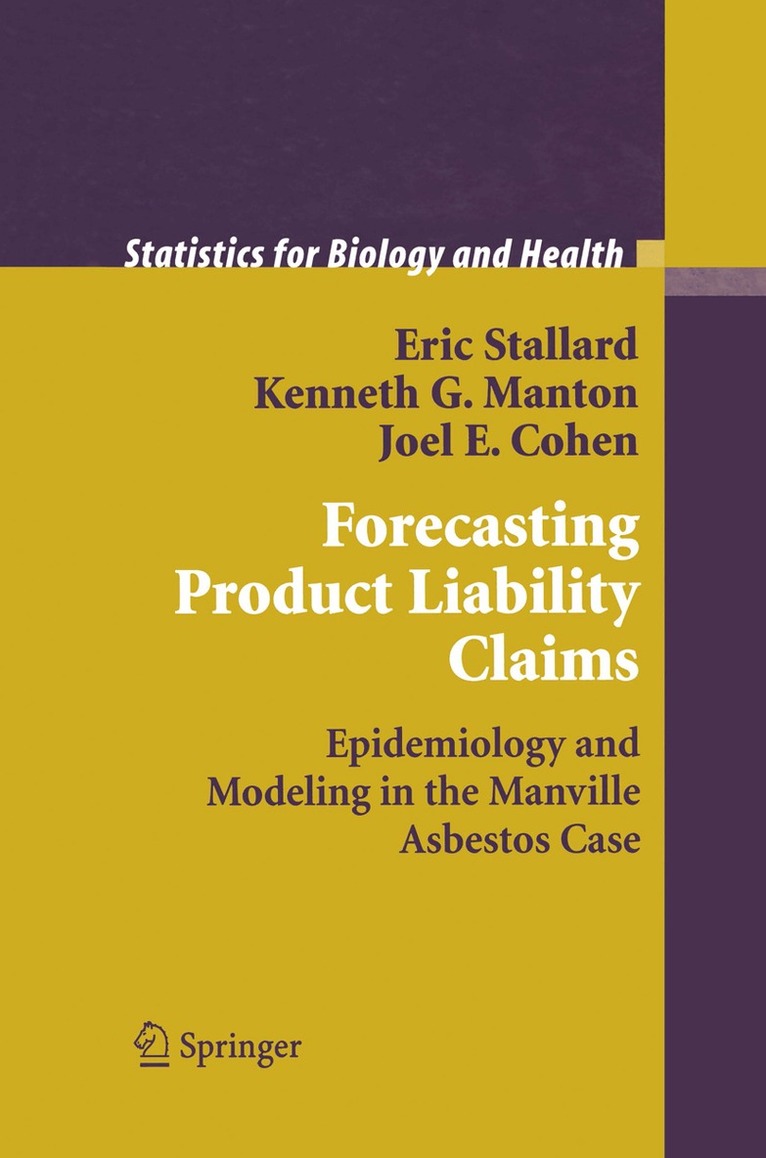
Forecasting Product Liability Claims
Epidemiology and Modeling in the Manville Asbestos Case
Inbunden, Engelska, 2004
1 095 kr
Skickas inom 10-15 vardagar
This volume presents a rigorous account of quantitative forecasting efforts that led to the successful resolution of the Johns-Manville asbestos litigation. This case, taking 12 years to reach settlement, may generate over one million claims at a total nominal value of tens of billions of dollars. The forecasting task, to project the number, timing, and nature of claims for asbestos-related injuries from an unknown number of exposed persons, is a general problem. The models in this volume can be adapted to forecast industry-wide asbestos liability, as well as liability for other products and other insurable or compensable events. The volume illustrates the iterative nature of model building and the uncertainty due to incomplete knowledge of the processes of injury and litigation.The volume is written for actuaries, biostatisticians, demographers, epidemiologists, statisticians and analysts of problems in environmental health, finance, industrial risk, investment, occupational health, and product liability.Although statistics, calculus, and matrix algebra are used, the logic behind the quantitative analysis is explained so that readers without specialized quantitative skills can understand why and how specific methods are used. This volume will be an indispensable reference for lawyers, judges, and all whose work involves these topics.The Honorable Jack B. Weinstein, senior U.S. District Court judge in the Eastern District of New York, commissioned Professor Margaret Berger and the authors of this book as neutral experts in the Manville case. He and Professor Berger are widely known for promoting the use of science in law. His foreword sets the context for this book.Eric Stallard, A.S.A., M.A.A.A., F.C.A., is Research Professor and Associate Director of the Center for Demographic Studies at Duke University. He is a Fellow of the Conference of Consulting Actuaries, a Member of the American Academy of Actuaries, and an Associate of the Society of Actuaries. He chairs the American Academy of Actuaries' State and Federal Long Term Care Task Forces and is an elected member of the Society of Actuaries? Long Term Care Insurance Section Council.His research interests include modeling and forecasting for medical demography and health/long-term care actuarial practice. He won the 1996 National Institute on Aging�s James A. Shannon Director�s Award.Kenneth G. Manton, Ph.D., is Research Professor and Scientific Director of the Center for Demographic Studies, Medical Research Professor in the Department of Community and Family Medicine, and Senior Fellow of the Center for the Study of Aging and Human Development, at Duke University. His research interests include human aging, mortality, and chronic disease. He won the 1990 Mindel C. Sheps Award in Mathematical Demography of the Population Association of America, the 1991 Allied-Signal Inc. Achievement Award in Aging administered by the Johns Hopkins Center on Aging, and the 2000 M. Irene Ferrer Award of the Partnership for Women�s Health at Columbia University.Joel E. Cohen, Ph.D., Dr. P.H., heads the Laboratory of Populations, at Rockefeller and Columbia Universities.His awards include: MacArthur Foundation Prize Fellow, Guggenheim Fellow, Tyler World Prize for Environmental Achievement, Mercer Award of the Ecological Society of America, Sheps Award of the Population Association of America, Nordberg Prize of the Population Council, Soper Prize of the Pan American Health Organization, and Distinguished Statistical Ecologist Award of the Sixth International Congress of Ecology. He serves on the national governing boards of the National Academy of Sciences, the National Research Council, the American Academy of Arts and Sciences, and the Nature Conservancy.
381 kr
Skickas inom 5-8 vardagar
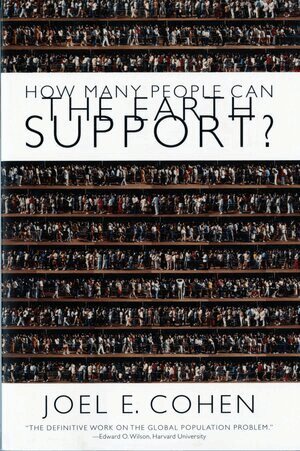
With the world population now at 5.7 billion, and increasing by about 90 million per year, we have clearly entered a zone where we can see, and may well encounter, limits on the human carrying capacity of the Earth. In this penetrating analysis of one of the most crucial questions of our time, a leading scholar in the field reviews the history of world population growth and appraises what can be known about its future.
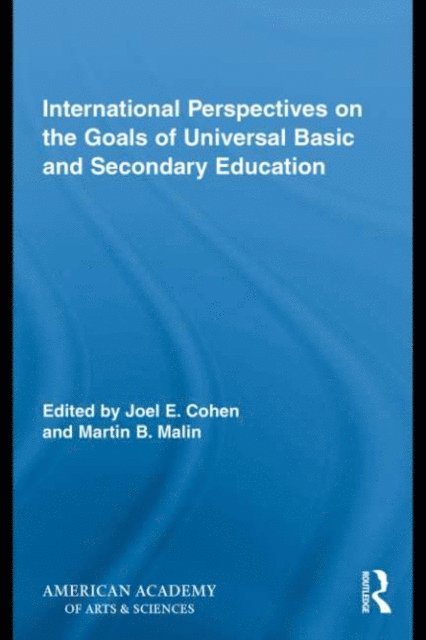
International Perspectives on the Goals of Universal Basic and Secondary Education
Häftad, Engelska, 2012
771 kr
Skickas inom 10-15 vardagar
Although universal schooling has been adopted as a goal by international organizations, bilateral aid agencies, national governments, and non-profit organizations, little sustained international attention has been devoted to the purposes or goals of universal education. What is universal primary and secondary education intended to accomplish? This book, which grew out of a project of the American Academy of Arts & Sciences, offers views from Asia, Africa, Europe, North America and South America on the purposes of universal education while considering diverse cultures, religions, and professions. It is the first book in which renowned authors from around the world have proposed, considered, and debated goals of basic and secondary education, engaging in a constructive dialogue on one of the most pressing issues facing education today.
International Perspectives on the Goals of Universal Basic and Secondary Education
Inbunden, Engelska, 2009
2 225 kr
Skickas inom 10-15 vardagar
Although universal schooling has been adopted as a goal by international organizations, bilateral aid agencies, national governments, and non-profit organizations, little sustained international attention has been devoted to the purposes or goals of universal education. What is universal primary and secondary education intended to accomplish? This book, which grew out of a project of the American Academy of Arts & Sciences, offers views from Asia, Africa, Europe, North America and South America on the purposes of universal education while considering diverse cultures, religions, and professions. It is the first book in which renowned authors from around the world have proposed, considered, and debated goals of basic and secondary education, engaging in a constructive dialogue on one of the most pressing issues facing education today.
541 kr
Skickas inom 7-10 vardagar
What is the minimum dimension of a niche space necessary to represent the overlaps among observed niches? This book presents a new technique for obtaining a partial answer to this elementary question about niche space. The author bases his technique on a relation between the combinatorial structure of food webs and the mathematical theory of interval graphs. Professor Cohen collects more than thirty food webs from the ecological literature and analyzes their statistical and combinatorial properties in detail. As a result, he is able to generalize: within habitats of a certain limited physical and temporal heterogeneity, the overlaps among niches, along their trophic (feeding) dimensions, can be represented in a one-dimensional niche space far more often than would be expected by chance alone and perhaps always. This compatibility has not previously been noticed. It indicates that real food webs fall in a small subset of the mathematically possible food webs. Professor Cohen discusses other apparently new features of real food webs, including the constant ratio of the number of kinds of prey to the number of kinds of predators in food webs that describe a community.In conclusion he discusses possible extensions and limitations of his results and suggests directions for future research.
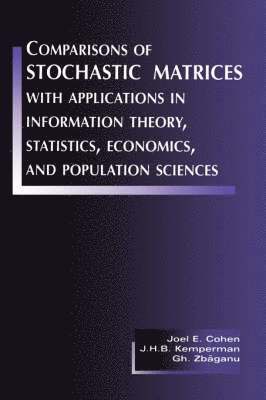
Comparisons of Stochastic Matrices with Applications in Information Theory, Statistics, Economics and Population Sciences
Inbunden, Engelska, 1998
1 069 kr
Skickas inom 10-15 vardagar
The focus of this monograph is on generalizing the notion of variation in a set of numbers to variation in a set of probability distributions. The authors collect some known ways of comparing stochastic matrices in the context of information theory, statistics, economics, and population sciences. They then generalize these comparisons, introduce new comparisons, and establish the relations of implication or equivalence among sixteen of these comparisons. Some of the possible implications among these comparisons remain open questions. The results in this book establish a new field of investigation for both mathematicians and scientific users interested in the variations among multiple probability distributions.The work is divided into two parts. The first deals with finite stochastic matrices, which may be interpreted as collections of discrete probability distributions. The first part is presented in a fairly elementary mathematical setting. The introduction provides sketches of applications of concepts and methods to discrete memory-less channels in information theory, to the design and comparison of experiments in statistics, to the measurement of inequality in economics, and to various analytical problems in population genetics, ecology, and demography. Part two is more general and entails more difficult analysis involving Markov kernels. Here, many results of the first part are placed in a more general setting, as required in more sophisticated applications.A great strength of this text is the resulting connections among ideas from diverse fields: mathematics, statistics, economics, and population biology. In providing this array of new tools and concepts, the work will appeal to the practitioner. At the same time, it will serve as an excellent resource for self-study of for a graduate seminar course, as well as a stimulus to further research.
Forecasting Product Liability Claims
Epidemiology and Modeling in the Manville Asbestos Case
Häftad, Engelska, 2010
1 101 kr
Skickas inom 10-15 vardagar
I write this foreword for two reasons: first, to acknowledge the gratitude of our court system to scientists willing to lend their talents to forensic tasks, and of myself, in particular, for the pathbreaking work of Eric Stallard, Kenneth G. Manton, and Joel E. Cohen in the Manville Asbestos Case; and second, because their work suggests both great strength and utility in their statisti cally based design and its limitations in predicting events strongly affected by political and social choices that are difficult to foretell as well as by de mographic and epidemiologic factors that can be prophesied with somewhat more confidence - at least in the short term. It is by now almost axiomatic that almost every important litigation in the United States requires experts to help judges and juries arrive at an under standing of the case sufficient to permit a sensible resolution within the flexible scope of our rules of law. The Supreme Court has laid down useful rough cri teria for the courts in assessing the capability of proffered experts beginning 1 with the Daubert line of cases. It has also allowed the courts to appoint ex 2 perts to supplement those designated by the parties. Dr. Joel E. Cohen and Professor Margaret E. Berger were appointed by me in the Manville asbestos cases pursuant to Rule 706 of the Federal Rules of Evidence to help project future claims. Discovery provisions have improved utilization of experts by 3 requiring advance reports and depositions.
538 kr
Skickas inom 10-15 vardagar
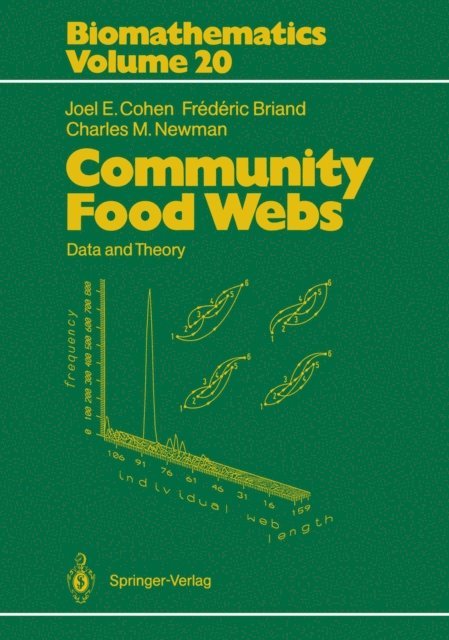
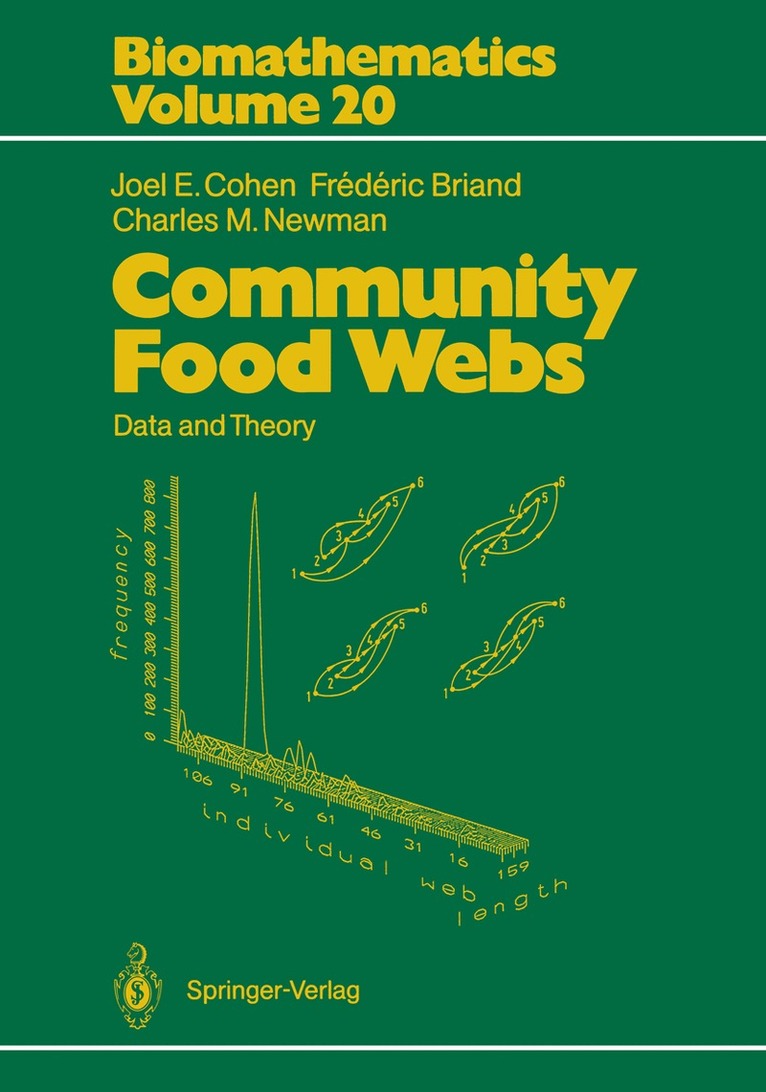
Food webs hold a central place in ecology. They describe which organisms feed on which others in natural habitats. This book describes recently discovered empirical regularities in real food webs: it proposes a novel theory unifying many of these regularities, as well as extensive empirical data. After a general introduction, reviewing the empirical and theoretical discoveries about food webs, the second portion of the book shows that community food webs obey several striking phenomenological regularities. Some of these unify, regardless of habitat. Others differentiate, showing that habitat significantly influences structure. The third portion of the book presents a theoretical analysis of some of the unifying empirical regularities. The fourth portion of the book presents 113 community food webs. Collected from scattered sources and carefully edited, they are the empirical basis for the results in the volume. The largest available set of data on community food webs provides a valuable foundation for future studies of community food webs. The book is intended for graduate students, teachers and researchers primarily in ecology. The theoretical portions of the book provide materials useful to teachers of applied combinatorics, in particular, random graphs. Researchers in random graphs will find here unsolved mathematical problems.