Joel L. Sussman – författare
Visar alla böcker från författaren Joel L. Sussman. Handla med fri frakt och snabb leverans.
5 produkter
5 produkter
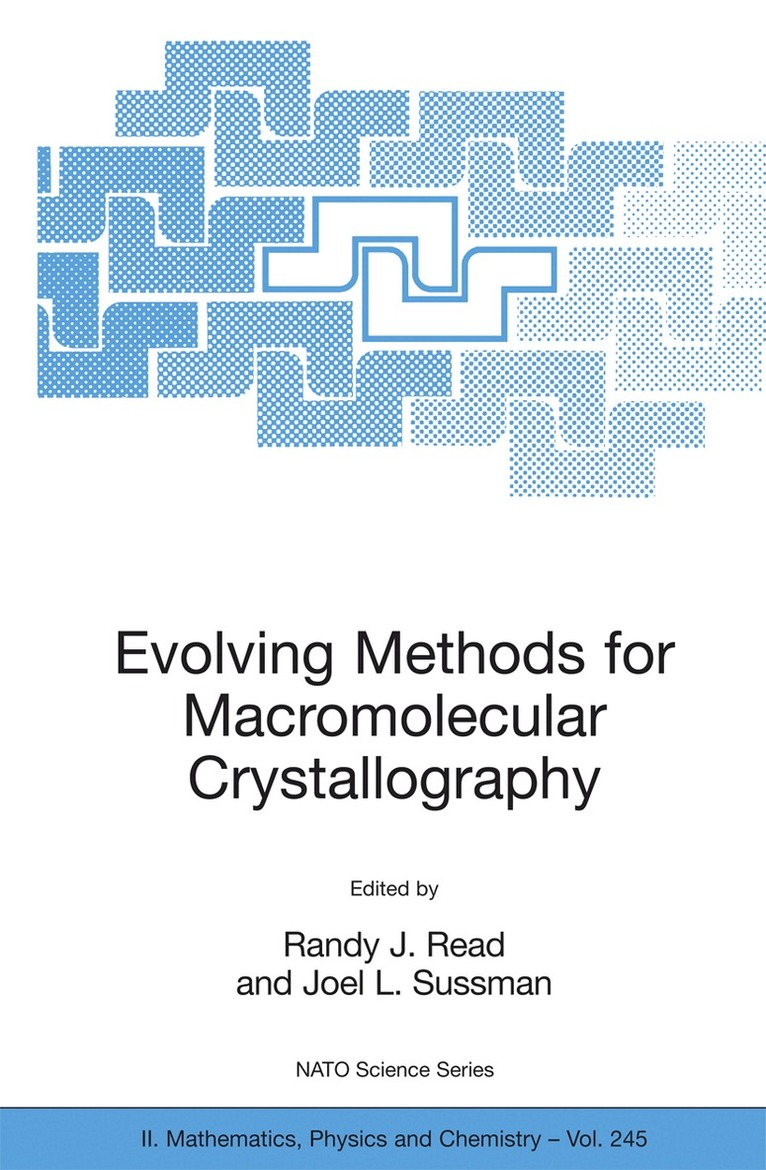
Evolving Methods for Macromolecular Crystallography
The Structural Path to the Understanding of the Mechanism of Action of CBRN Agents
Inbunden, Engelska, 2007
1 589 kr
Skickas inom 10-15 vardagar
This volume comprises papers presented at the 2005 edition of the “Crystallography of Molecular Biology” courses that have been held since 1976 at the Ettore Majorana Centre for Scientific Culture in Erice, Italy. This series of courses is renowned for bringing leaders in the field of macromo- cular crystallography together with highly motivated students, in a beautiful and intimate location that encourages people to interact. The warm and informal atmosphere at these Erice conferences, especially these on cryst- lography, has helped to foster long-term scientific interactions and new int- national friendships that have often lasted for the lifetime of the scientists. The course was financed by NATO as an Advanced Study Institute and by the European Commission as a EuroSummerSchool. The papers span the breadth of material presented in the course, which emphasized the practical aspects of modern macromolecular crystallography and its applications. One must start with crystals: Bergfors showed how to improve initial crystals through seeding, while Byrne discussed the difficult problem of crystallizing membrane proteins. The collection of optimal diffraction data requires both careful preparation of cryo-cooled crystals (Garman) and proper processing of the diffraction images (Leslie). To obtain images of electron density, one needs estimates of the phases of the diffracted spots. Sheldrick presented the background to the sing- wavelength anomalous diffraction (SAD) method, which has been gaining popularity, and McCoy discussed the basis of modern maximum likelihood methods for treating information in experimental phasing.
Evolving Methods for Macromolecular Crystallography
The Structural Path to the Understanding of the Mechanism of Action of CBRN Agents
Häftad, Engelska, 2007
1 589 kr
Skickas inom 10-15 vardagar
This volume comprises papers presented at the 2005 edition of the “Crystallography of Molecular Biology” courses that have been held since 1976 at the Ettore Majorana Centre for Scientific Culture in Erice, Italy. This series of courses is renowned for bringing leaders in the field of macromo- cular crystallography together with highly motivated students, in a beautiful and intimate location that encourages people to interact. The warm and informal atmosphere at these Erice conferences, especially these on cryst- lography, has helped to foster long-term scientific interactions and new int- national friendships that have often lasted for the lifetime of the scientists. The course was financed by NATO as an Advanced Study Institute and by the European Commission as a EuroSummerSchool. The papers span the breadth of material presented in the course, which emphasized the practical aspects of modern macromolecular crystallography and its applications. One must start with crystals: Bergfors showed how to improve initial crystals through seeding, while Byrne discussed the difficult problem of crystallizing membrane proteins. The collection of optimal diffraction data requires both careful preparation of cryo-cooled crystals (Garman) and proper processing of the diffraction images (Leslie). To obtain images of electron density, one needs estimates of the phases of the diffracted spots. Sheldrick presented the background to the sing- wavelength anomalous diffraction (SAD) method, which has been gaining popularity, and McCoy discussed the basis of modern maximum likelihood methods for treating information in experimental phasing.
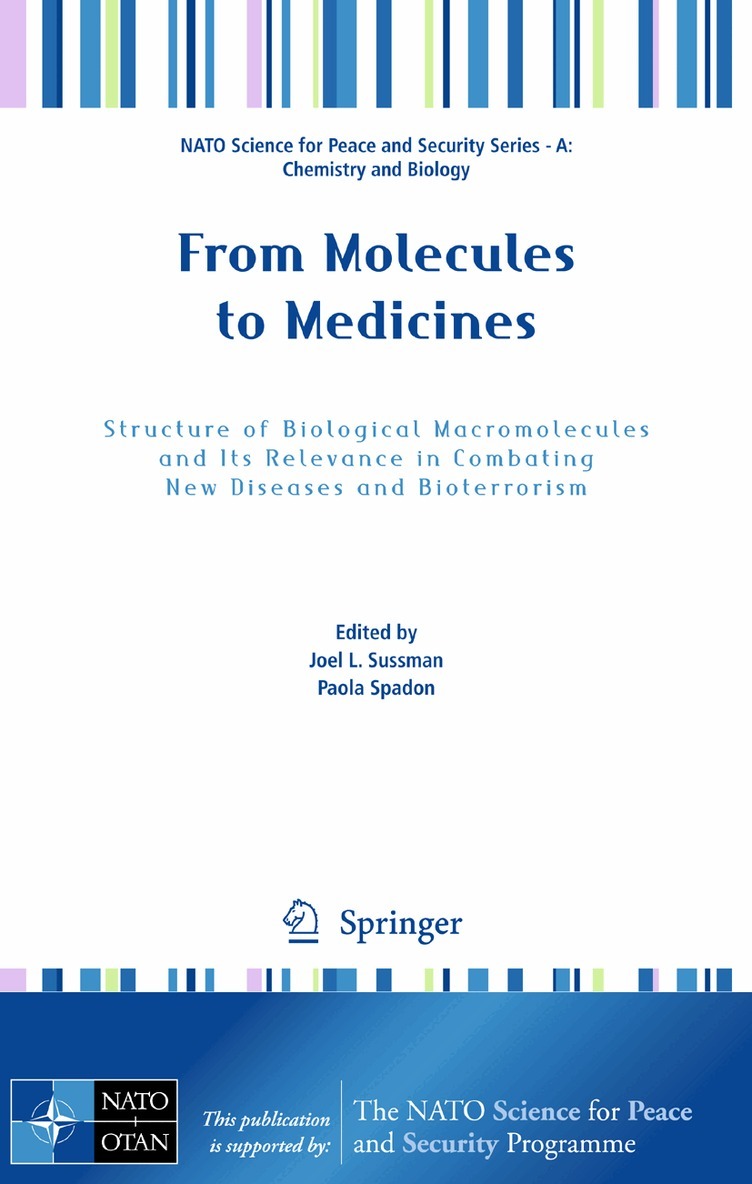
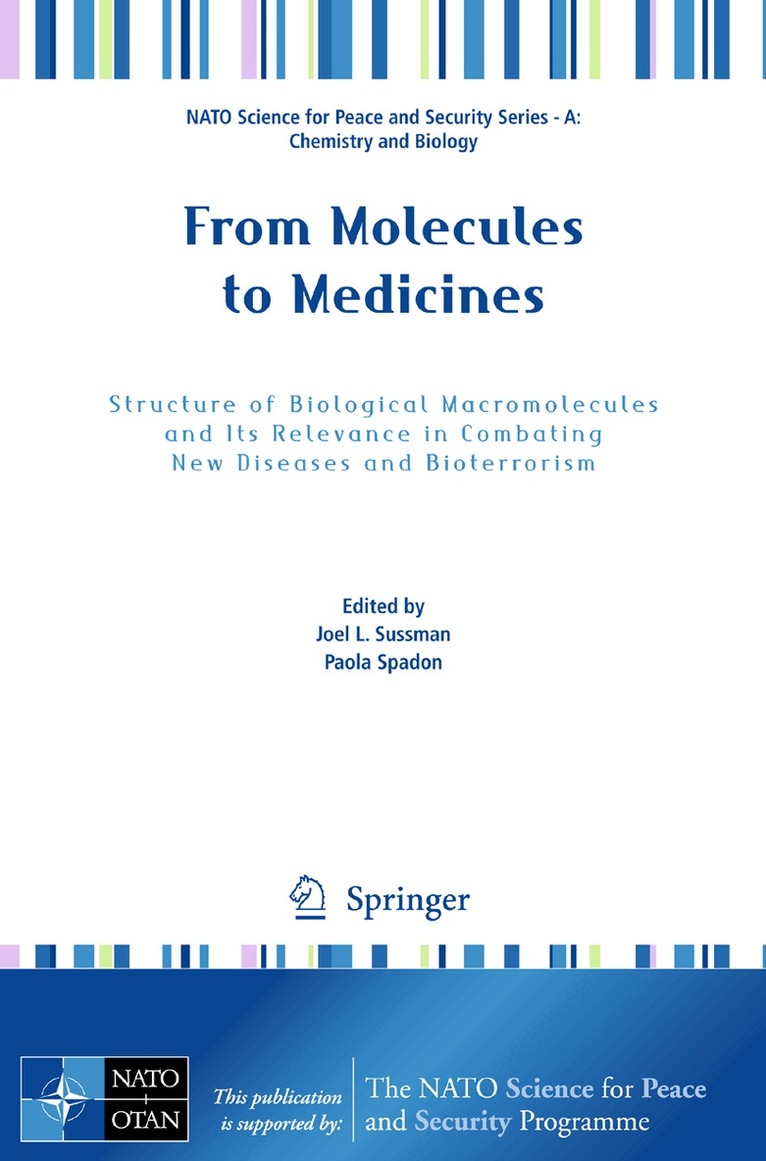
From Molecules to Medicines
Structure of Biological Macromolecules and Its Relevance in Combating New Diseases and Bioterrorism
Inbunden, Engelska, 2009
1 094 kr
Skickas inom 10-15 vardagar
This volume comprises papers presented at the 40th Erice Course "From Molecules to Medicine: Structure of Biological Macromolecules and Its Relevance in Combating New Diseases and Bioterrorism", May 29 to June 8, 2008. The papers span the breadth of material presented, which emp- size the practical aspects of modern macromolecular crystallography and its applications to medicine. Topics addressed span from the selection of targets, through to structure determination, interpretation and exploitation. A particular theme that emerges is the dependence of modern structural science on multiple experimental and computational techniques. It is both the development of these techniques and their integration that will take us forward in the future. The NATO ASI directors worked alongside, and offer deep gratitude to Prof. Sir Tom Blundell, Director of the International School of Crystal- graphy, Dr Colin Groom, Dr Neera Borkakoti, Dr John Irwin and Prof. Lodovico Riva di Sanseverino, who were in turn supported by a number of local facilitators. The course was financed by NATO as an Advanced Study Institute.Additional support was given by the European Crystallographic Association, the International Union of Biochemistry and Molecular Biology, the Int- national Union of Crystallography, the University of Bologna, AstraZeneca, Roche, Merck & Co., Boehringer Ingelheim, Bruker Corporation, Douglas Instruments, Informa UK, the Department of Pharmaceutical Chemistry, TTP Lab Tech, University of California at San Francisco. Joel L. Sussman and Paola Spadon
From Molecules to Medicines
Structure of Biological Macromolecules and Its Relevance in Combating New Diseases and Bioterrorism
Häftad, Engelska, 2009
1 094 kr
Skickas inom 10-15 vardagar
This volume comprises papers presented at the 40th Erice Course "From Molecules to Medicine: Structure of Biological Macromolecules and Its Relevance in Combating New Diseases and Bioterrorism", May 29 to June 8, 2008. The papers span the breadth of material presented, which emp- size the practical aspects of modern macromolecular crystallography and its applications to medicine. Topics addressed span from the selection of targets, through to structure determination, interpretation and exploitation. A particular theme that emerges is the dependence of modern structural science on multiple experimental and computational techniques. It is both the development of these techniques and their integration that will take us forward in the future. The NATO ASI directors worked alongside, and offer deep gratitude to Prof. Sir Tom Blundell, Director of the International School of Crystal- graphy, Dr Colin Groom, Dr Neera Borkakoti, Dr John Irwin and Prof. Lodovico Riva di Sanseverino, who were in turn supported by a number of local facilitators. The course was financed by NATO as an Advanced Study Institute.Additional support was given by the European Crystallographic Association, the International Union of Biochemistry and Molecular Biology, the Int- national Union of Crystallography, the University of Bologna, AstraZeneca, Roche, Merck & Co., Boehringer Ingelheim, Bruker Corporation, Douglas Instruments, Informa UK, the Department of Pharmaceutical Chemistry, TTP Lab Tech, University of California at San Francisco. Joel L. Sussman and Paola Spadon
3 387 kr
Skickas inom 5-8 vardagar
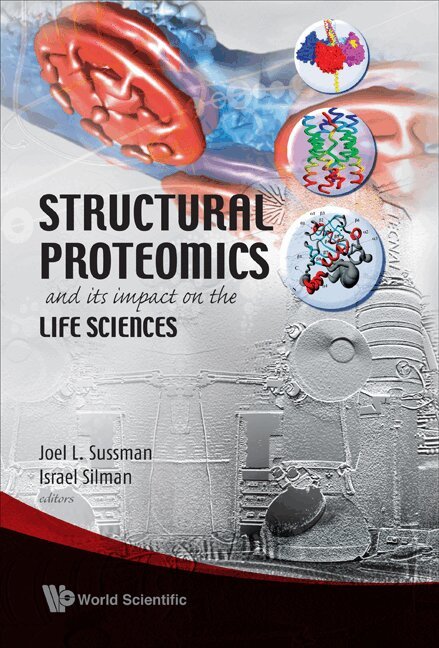
The role played by structural proteomics in the first decade of the 21st century is equivalent to that played by the Human Genome Project in the last decade of the 20th century. The development of high-throughput technologies that permit the solution of hundreds of 3D structures of individual proteins, protein-protein complexes and protein-drug complexes, just by one laboratory in a single year, will provide a knowledge base which will change the face of structural biology. This will have an immediate influence on medicinal chemistry and molecular pharmacology, as well as an increasing impact on such disciplines as neurobiology, developmental biology, immunology and molecular medicine.This book presents a state-of-the-art overview of the structural proteomics field, ranging from policy issues related to funding and goals, through the high-throughput procedures for protein production, to the solution of the structures of proteins and higher-order entities, via a multidisciplinary approach involving molecular biology, X-ray crystallography, NMR and electron microscopy, as well as bioinformatics analysis. This is the first book to provide such a comprehensive coverage of a rapidly evolving field.