Joel M. Cooper - Böcker
2 636 kr
Skickas inom 3-6 vardagar
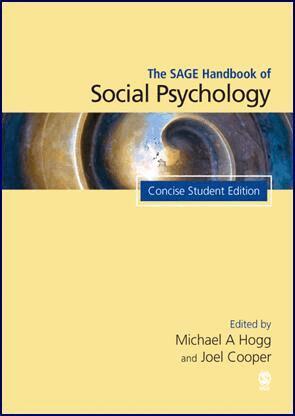
This is a comprehensive, scholarly, and up-to-date survey of the field of social psychology for the new millennium - a single 656 page Handbook containing 23 chapters by leading researchers from around the world. It is a state-of-the-art text with an eye to the future, in which rich integrative chapters are thorough analytic reviews. The chapters fall into five sections that reflect the scope of social psychology as a global scientific endeavour: history and nature of social psychology; individual processes, interpersonal processes; processes within groups, and intergroup processes and society.
The book is edited by Michael A Hogg and Joel Cooper, with Dominic Abrams, Elliot Aronson and Shelley Taylor acting as advisory editors.
The main features and benefits of this book include: single volume; international coverage of social psychology; international line-up of authors; basic and applied research are integrated within chapters, not exiled to the end of the book; traditional emphasis on individual and interpersonal processes is balanced with full emphasis on the study of group processes and intergroup relations; chapters on language and social psychology, culture and self.
3 186 kr
Skickas inom 3-6 vardagar
- Professor Russell H. Fazio, Ohio State University
Why is it that people who smoke continue to do so knowing how bad it is for them? What drives people to committing adultery even though they inherently believe this is wrong? What's the outcome of this contradiction in the mind?
Cognitive dissonance has been an important and influential theory since Leon Festinger published his classic work in 1957. It is known by every social psychologist, most psychologists of any stripe, and the lay public, making its way into such mainstream publications as The New York Times with increasing frequency and accuracy. Ultimately, dissonance has become one of the most popularly known expressions of social psychological insights, making its way into the literature in consumer, health and economic behavior, and has become a frequently used explanation of political behavior in the popular press and magazines.
In marking the 50th anniversary of the theory's inception, Joel Cooper - arguably the scholar most associated with dissonance research in the past few decades - has presented a beautiful, modern and comprehensive analysis of the state of dissonance theory. This book charts the progress of dissonance theory, assessing its impact not only within our understanding of psychology but in everyday experiences as well. It should be important reading for students in social psychology, either undergraduate or graduate, but equally relevant to a host of other readers who need to understand or share the same passions for appreciating the significance of cognitive dissonance in the human psyche.
1 063 kr
Skickas inom 3-6 vardagar
- Professor Russell H. Fazio, Ohio State University
Why is it that people who smoke continue to do so knowing how bad it is for them? What drives people to committing adultery even though they inherently believe this is wrong? What's the outcome of this contradiction in the mind?
Cognitive dissonance has been an important and influential theory since Leon Festinger published his classic work in 1957. It is known by every social psychologist, most psychologists of any stripe, and the lay public, making its way into such mainstream publications as The New York Times with increasing frequency and accuracy. Ultimately, dissonance has become one of the most popularly known expressions of social psychological insights, making its way into the literature in consumer, health and economic behavior, and has become a frequently used explanation of political behavior in the popular press and magazines.
In marking the 50th anniversary of the theory's inception, Joel Cooper - arguably the scholar most associated with dissonance research in the past few decades - has presented a beautiful, modern and comprehensive analysis of the state of dissonance theory. This book charts the progress of dissonance theory, assessing its impact not only within our understanding of psychology but in everyday experiences as well. It should be important reading for students in social psychology, either undergraduate or graduate, but equally relevant to a host of other readers who need to understand or share the same passions for appreciating the significance of cognitive dissonance in the human psyche.
1 370 kr
Skickas inom 3-6 vardagar
In response to market demand, The SAGE Handbook of Social Psychology: Concise Student Edition has been published and represents a slimmer (16 chapters in total), more course focused and student-friendly volume. The editors and authors have also updated all references, provided chapter introductions and summaries and a new Preface outlining the benefits of using the Handbook as an upper level teaching resource. It will prove indispensable reading for all upper level and graduate students studying social psychology.