Johan A K Suykens - Böcker
Visar alla böcker från författaren Johan A K Suykens. Handla med fri frakt och snabb leverans.
2 produkter
2 produkter
1 587 kr
Skickas inom 3-6 vardagar
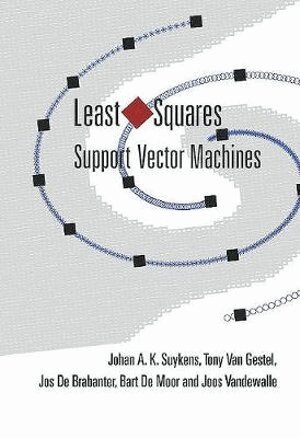
This book focuses on Least Squares Support Vector Machines (LS-SVMs) which are reformulations to standard SVMs. LS-SVMs are closely related to regularization networks and Gaussian processes but additionally emphasize and exploit primal-dual interpretations from optimization theory. The authors explain the natural links between LS-SVM classifiers and kernel Fisher discriminant analysis. Bayesian inference of LS-SVM models is discussed, together with methods for imposing sparseness and employing robust statistics.The framework is further extended towards unsupervised learning by considering PCA analysis and its kernel version as a one-class modelling problem. This leads to new primal-dual support vector machine formulations for kernel PCA and kernel CCA analysis. Furthermore, LS-SVM formulations are given for recurrent networks and control. In general, support vector machines may pose heavy computational challenges for large data sets. For this purpose, a method of fixed size LS-SVM is proposed where the estimation is done in the primal space in relation to a Nyström sampling with active selection of support vectors. The methods are illustrated with several examples.
Del 50 - World Scientific Series on Nonlinear Science Series A
Cellular Neural Networks, Multi-scroll Chaos And Synchronization
Inbunden, Engelska, 2005
1 459 kr
Tillfälligt slut
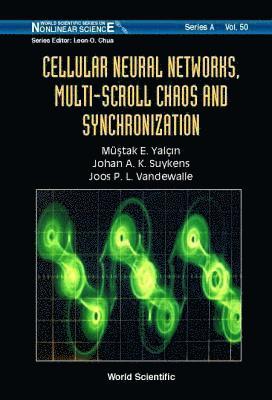
For engineering applications that are based on nonlinear phenomena, novel information processing systems require new methodologies and design principles. This perspective is the basis of the three cornerstones of this book: cellular neural networks, chaos and synchronization. Cellular neural networks and their universal machine implementations offer a well-established platform for processing spatial-temporal patterns and wave computing. Multi-scroll circuits are generalizations to the original Chua's circuit, leading to chip implementable circuits with increasingly complex attractors. Several applications make use of synchronization techniques for nonlinear systems. A systematic overview is given for Lur'e representable systems with global synchronization criteria for master-slave and mutual synchronization, robust synchronization, H∞ synchronization, time-delayed systems and impulsive synchronization.