Johanna Hood – författare
2 269 kr
Skickas inom 10-15 vardagar
700 kr
Skickas inom 10-15 vardagar
849 kr
Läs direkt efter köp
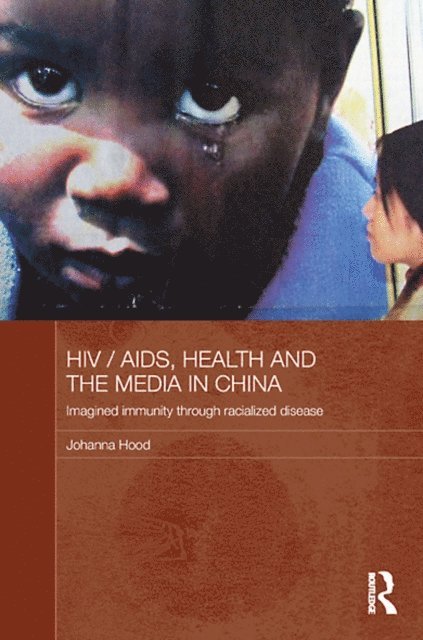
HIV/AIDS is an increasingly serious problem in China, with an increasing number of new cases every year. As a result, HIV organizations have boomed, with both state and non-governmental organisations responding to the threat with campaigns to increase public awareness of the disease, utilising the media as the primary tool to reshape citizens’ understandings and views of HIV/AIDS. This book explores how HIV/AIDS is portrayed in China’s media. It argues that, despite increasing education campaigns, media coverage and social and academic openness towards HIV/AIDS, many Chinese of the majority Han ethnic group regard infection as a distant possibility, believing themselves to be immune and infection a problem only for certain non-Han ethnic groups with perceived lower moral standards, in particular black Africans. The book explores how HIV/AIDS is reported, analysing the language used in constructing and encoding the health narrative, its subjects, and ideas about the disease. It demonstrates how China’s media frequently employs negative events to present the most extreme possibilities of poverty, danger, disasters and disease, with black Africa portrayed as an antiquated, distant and socioculturally and politically backward place, uniquely unsuitable for the containment of disease, in contrast with the progressive, scientifically sophisticated and morally upstanding Chinese. It argues that this discourse has had the effect of distancing many Chinese from the perceived possibility of infection, thus compromising the effectiveness of public health campaigns on HIV/AIDs. It suggests that the key to combating the spread of the disease lies in challenging the racialised narratives through which the disease is portrayed in China’s media, rather than simply by aiming to educate greater numbers of people.
849 kr
Läs direkt efter köp
HIV/AIDS is an increasingly serious problem in China, with an increasing number of new cases every year. As a result, HIV organizations have boomed, with both state and non-governmental organisations responding to the threat with campaigns to increase public awareness of the disease, utilising the media as the primary tool to reshape citizens’ understandings and views of HIV/AIDS. This book explores how HIV/AIDS is portrayed in China’s media. It argues that, despite increasing education campaigns, media coverage and social and academic openness towards HIV/AIDS, many Chinese of the majority Han ethnic group regard infection as a distant possibility, believing themselves to be immune and infection a problem only for certain non-Han ethnic groups with perceived lower moral standards, in particular black Africans. The book explores how HIV/AIDS is reported, analysing the language used in constructing and encoding the health narrative, its subjects, and ideas about the disease. It demonstrates how China’s media frequently employs negative events to present the most extreme possibilities of poverty, danger, disasters and disease, with black Africa portrayed as an antiquated, distant and socioculturally and politically backward place, uniquely unsuitable for the containment of disease, in contrast with the progressive, scientifically sophisticated and morally upstanding Chinese. It argues that this discourse has had the effect of distancing many Chinese from the perceived possibility of infection, thus compromising the effectiveness of public health campaigns on HIV/AIDs. It suggests that the key to combating the spread of the disease lies in challenging the racialised narratives through which the disease is portrayed in China’s media, rather than simply by aiming to educate greater numbers of people.
3 653 kr
Skickas inom 5-8 vardagar
855 kr
Läs direkt efter köp
Organised around five key concerns (social security and welfare; emerging issues and actors, including gender issues, NGOs, and philanthropy; gaps; and future challenges, such as population ageing and environmental pressures) chapters draw on original case-based research from diverse disciplines and perspectives, engage existing literature and further key debates. Key historical insights into welfare provision in the Chinese context serve as a starting point with the remaining chapters combining a review of the literature with original case studies. The book offers novel empirical research and includes topics often not discussed in the literature on welfare in China, including: mental health, highly educated rural-to-urban migrants, NGOs as welfare providers, China''s overseas welfare aid, environmental challenges and welfare, amongst others.
This comprehensive and multidisciplinary Handbook will be of immense value to researchers and scholars in the fields of China Studies, social policy, the welfare state, politics and related areas. Accessible to a non-specialist audience interested in China''s welfare development and welfare states more broadly, it will also serve as a useful resource for undergraduates.
Contributors Include: E. Baum, M. Blaxland, O. Bruun, B. Carrillo, J. Chen, S. Cook, X.-y. Dong, T.D. DuBois, M.W. Frazier, K.R. Fisher, R. Hasmath, T. Hesketh, J. Hood, J.Y.J. Hsu, H. Jia, E. Jeffreys, P.I. Kadetz, B. Li, Y. Li, J. Liu, S.-h. Liu, Y. Liu, A.W. MacDonald, A. Saich, X. Shang, D.J. Solinger, K. Suda, Y. Zeng, J. Zhao, Z. Zhao