Johanna Leithoff – författare
Visar alla böcker från författaren . Handla med fri frakt och snabb leverans.
2 produkter
2 produkter
E-bok
PDF, Tyska, 2021560 kr
Läs direkt efter köp
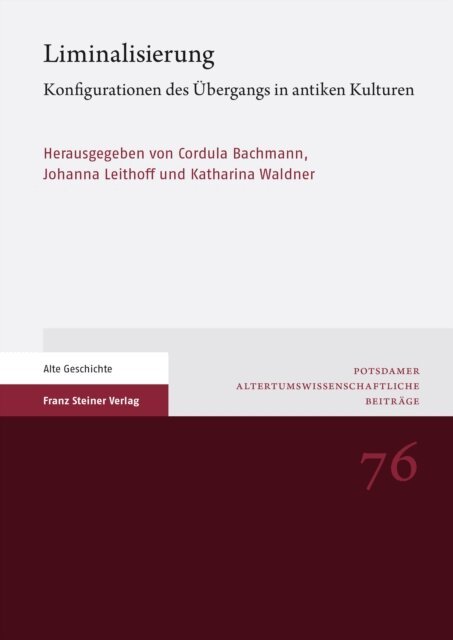
Welche Prozesse, Praktiken und Medien ermoglichten es antiken Gesellschaften, Grenzen und Ubergange zu definieren und zu reflektieren? Wie wurden sie sichtbar und wahrnehmbar, und somit auch verhandelbar gemacht? Mit welchen Mitteln wurden Ubergange konstruiert?Als Weiterentwicklung des von Victor W. Turner kulturwissenschaftlich etablierten Begriffs der Liminalitat betont der Begriff der Liminalisierung das Prozesshafte von Grenzziehungen und -u berschreitungen. Er lenkt so den Blick auf die kulturellen und sozialen Dynamiken der Herstellung, Wahrnehmung und Verhandlung von Ubergangszustanden und Schwellenbereichen. Die Autorinnen und Autoren untersuchen in ihren Beitragen, die vom Klassischen Griechenland bis in die Spatantike reichen, sowohl konkret raumliche als auch soziale und kategoriale Ubergange und Schwellen in verschiedenen Textgattungen antiker Kulturen.
E-bok
PDF, Tyska, 2014662 kr
Läs direkt efter köp
After Nero''s death and the following civil wars in 68-69 A.D., it was the victor Vespasian, who re-established stability and continuity. What set him apart from his Julio-Claudian predecessors was his origin from a municipal family and his status as a normal member of the senatorial order until his revolt. In this context the legitimisation and presentation of his new position of power was vital for him. The question therefore is how Vespasian and his sons, who succeeded him and came to power under very different circumstances, used the past for their own purposes. This study concentrates on these references to the past with a view to three main aspects: gaining power, which meant dealing with the pretenders of the civil wars on the one and presenting the victory over the Jewish Rebels on the other hand; consolidating the principate, which focuses on the relation between senators and the princeps and the impact of this process on the creation of the ''republican'' idea; last, shaping the principate, which concentrates on the role-model-character of the Julio-Claudian principes for Vespasian, Titus, and Domitian.