Johannes Lehmann - Böcker
Visar alla böcker från författaren Johannes Lehmann. Handla med fri frakt och snabb leverans.
7 produkter
7 produkter
1 855 kr
Tillfälligt slut
Biochar Systems for Smallholders in Developing Countries
Leveraging Current Knowledge and Exploring Future Potential for Climate-Smart Agriculture
Häftad, Engelska, 2014
274 kr
Skickas inom 10-15 vardagar
Biochar is the carbon-rich organic matter that remains after heating biomass under minimization of oxygen during a process called pyrolysis. Its relevance to deforestation, agricultural resilience, and energy production, particularly in developing countries, makes it an important issue. This report offers a review of what is known about opportunities and risks of biochar systems. Its aim is to provide a state of the art overview of current knowledge regarding biochar science. In that sense the report also offers a reconciling view on different scientific opinions about biochar providing an overall account that shows the various perspectives of its science and application. This includes soil and agricultural impacts of biochar, climate change impacts, social impacts, and competing uses of biomass.The report aims to contextualize the current scientific knowledge in order to put it at use to address the development- climate change nexus, including social and environmental sustainability. The report is organized as follows: chapter one offers some introductory comments and notes the increasing interest in biochar both from a scientific as well as from a practitioner’s point of view; chapter two gives further background on biochar, describing its characteristics and outlining the way in which biochar systems function. Chapter three then considers the opportunities and risks of biochar systems, chapter four presents a typology of biochar systems emerging in practice, particularly in the developing world.New, International Organization for Standardization (ISO) 14040-based life-cycle assessments of the net climate change impact and the net economic profitability of three biochar systems with data collected from relatively advanced biochar projects were conducted for this report and are presented in chapter five, providing a novel understanding of the full life-cycle impacts of these known biochar systems. Chapter six investigates various aspects of technology adoption, including barriers to implementing promising systems, focusing on economics, carbon market access, and sociocultural barriers.Finally, the status of knowledge regarding biochar systems is interpreted in chapter seven to determine potential implications for future involvement in biochar research, policy, and project formulation.
1 186 kr
Skickas inom 10-15 vardagar
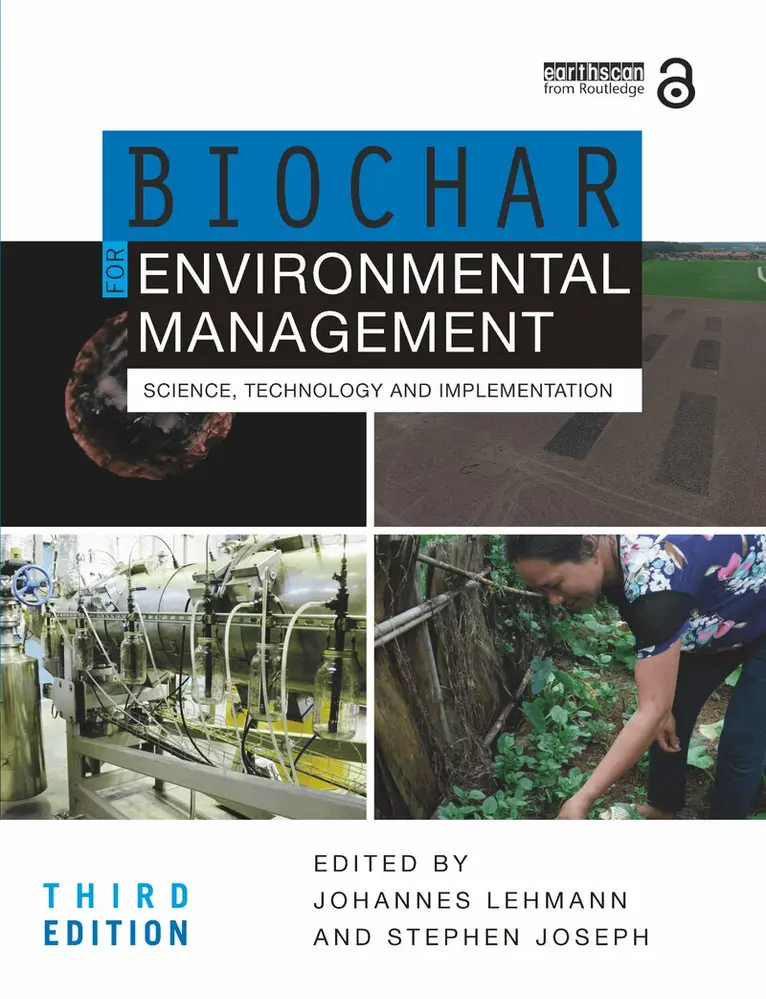
Fully revised and updated for its third edition, this book presents the definitive compilation of current knowledge on all aspects of biochar.Research on biochar continues to accelerate as its importance for soil health, climate change mitigation and adoption, and the circular economy becomes more widely acknowledged. This book not only reviews recent advances made in our understanding of biochar properties, behavior, and effects in agriculture, environmental management, and material production, but specifically develops fundamental principles and frameworks of biochar science and application. This third edition has been fully revised and updated to reflect recent developments and growing trends, with important coverage of the application of biochar outside of its traditional soil-based uses, the commercialization of biochar, and its incorporation into policy. This includes brand new chapters on the role of biochar-based materials for environmental remediation, building construction, and animal feed, and a greater discussion of biochar's role in the circular economy, climate change mitigation, and sustainable development. Overall, this book provides a systematic, comprehensive, and global examination of biochar. Written by an international team of academics and professionals, it addresses its uses, production, and management and its broader potential for mitigating climate change and driving forward sustainable development.Edited by two leading figures in the field, Biochar for Environmental Management is essential reading for students, scholars, practitioners, and policymakers interested in biochar and the role it can play in environmental sustainability and global sustainable development.Chapter 16 of this book is freely available as a downloadable Open Access PDF at http://www.taylorfrancis.com under a Creative Commons Attribution-Non Commercial-No Derivatives (CC-BY-NC-ND) 4.0 license.
3 532 kr
Skickas inom 10-15 vardagar
Amazonian Dark Earths are not only a testament to the vanished civilizations of the Amazon Basin, but may provide the answer to how the large, sophisticated societies were able to sustain intensive agriculture in an environment with mostly infertile soils. Locally known as Terra Preta de Indio or Indian black earth, these anomalous soils are even today fertile and highly productive. Though clearly associated with pre-European settlements questions remain whether the Dark Earths were intentionally produced or merely a by-product of habitation activities. This publication provides a comprehensive review of our current understanding of these fascinating soils: their origin, properties, and management through time. These new and multidisciplinary perspectives by leading experts on Amazonian Dark Earths may pave the way for the next revolution of soil management in the humid tropics.
2 101 kr
Skickas inom 10-15 vardagar
Amazonian soils are almost universally thought of as extremely forbidding. However, it is now clear that complex societies with large, sedentary populations were present for over a millennium before European contact. Associated with these are tracts of anomalously fertile, dark soils termed ‘terra preta’ or dark earths. These soils are presently an important agricultural resource within Amazonia and provide a model for developing long-term future sustainability of food production in tropical environments. The late Dutch soil scientist Wim Sombroek (1934-2003) was instrumental in bringing the significance of these soils to the attention of the world over four decades ago.Wim saw not only the possibilities of improving the lives of small holders throughout the world with simple carbon based soil technologies, but was an early proponent of the positive synergies also achieved in regards to carbon sequestration and global climatic change abatement. Wim’s vision was to form a multidisciplinary group whose members maintained the ideal of open collaboration toward the attainment of shared goals. Always encouraged and often shaped by Wim, this free association of international scholars termed the “Terra Preta Nova” Group came together in 2001 and has flourished. This effort has been defined by enormous productivity. Wim who is never far from any of our minds and hearts, would have loved to share the great experience of seeing the fruits of his vision as demonstrated in this volume.
3 429 kr
Skickas inom 10-15 vardagar
Amazonian Dark Earths are not only a testament to the vanished civilizations of the Amazon Basin, but may provide the answer to how the large, sophisticated societies were able to sustain intensive agriculture in an environment with mostly infertile soils. Locally known as Terra Preta de Indio or Indian black earth, these anomalous soils are even today fertile and highly productive. Though clearly associated with pre-European settlements questions remain whether the Dark Earths were intentionally produced or merely a by-product of habitation activities. This publication provides a comprehensive review of our current understanding of these fascinating soils: their origin, properties, and management through time. These new and multidisciplinary perspectives by leading experts on Amazonian Dark Earths may pave the way for the next revolution of soil management in the humid tropics.
2 101 kr
Skickas inom 10-15 vardagar
Amazonian soils are almost universally thought of as extremely forbidding. However, it is now clear that complex societies with large, sedentary populations were present for over a millennium before European contact. Associated with these are tracts of anomalously fertile, dark soils termed ‘terra preta’ or dark earths. These soils are presently an important agricultural resource within Amazonia and provide a model for developing long-term future sustainability of food production in tropical environments. The late Dutch soil scientist Wim Sombroek (1934-2003) was instrumental in bringing the significance of these soils to the attention of the world over four decades ago.Wim saw not only the possibilities of improving the lives of small holders throughout the world with simple carbon based soil technologies, but was an early proponent of the positive synergies also achieved in regards to carbon sequestration and global climatic change abatement. Wim’s vision was to form a multidisciplinary group whose members maintained the ideal of open collaboration toward the attainment of shared goals. Always encouraged and often shaped by Wim, this free association of international scholars termed the “Terra Preta Nova” Group came together in 2001 and has flourished. This effort has been defined by enormous productivity. Wim who is never far from any of our minds and hearts, would have loved to share the great experience of seeing the fruits of his vision as demonstrated in this volume.