Johannes Mursell – författare
Visar alla böcker från författaren . Handla med fri frakt och snabb leverans.
3 produkter
3 produkter
Inbunden, Engelska, 2026
4 327 kr
Kommande
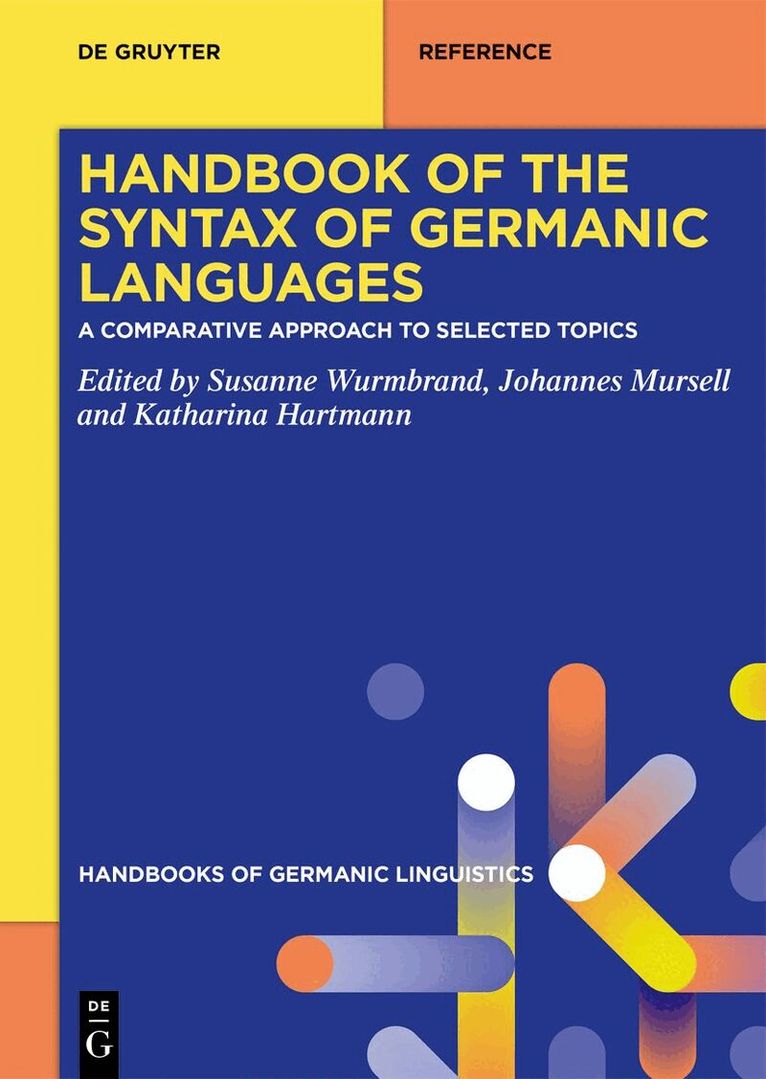
This handbook provides an empirically well-founded, strongly comparative overview and reference source for selected broad topics in Germanic syntax, adopting a comparative perspective that systematically combines detailed empirical investigation with theoretical synthesis across the Germanic languages. The volume brings together 26 chapters by leading international scholars and addresses six central domains of Germanic syntax: the nominal domain, the prepositional domain, anaphoric elements and binding, scrambling and object shift, verb second, and syntactic peripheries. Within each domain, comprehensive empirical surveys of individual Germanic languages are complemented by overarching comparative chapters that synthesize the empirical findings and situate them within current theoretical research.The handbook is designed both as a reference work and as a resource for future research. Its distinctive structure enables readers to access up-to-date descriptions of key syntactic phenomena while also engaging with broader comparative and theoretical questions. By combining extensive empirical coverage, comparative analysis, and theoretical reflection, this volume offers a unique contribution to the field and an indispensable resource for scholars and students of Germanic linguistics, syntax, and comparative language research.
Inbunden, Engelska, 2020
669 kr
Skickas
Del 268 - Linguistik Aktuell/Linguistics Today
Syntax of Information-Structural Agreement
Inbunden, Engelska, 2021
1 275 kr
Skickas
In this research monograph, Johannes Mursell discusses the syntactic impact of information-structural features on agreement. So far, the syntactic contribution of this type of feature has mostly been reduced to movement of topics or foci clause-initial position. Here, the author looks at a different phenomenon, syntactic agreement, and how this process can be dependent on information-structural properties. Based partly on original fieldwork from a typologically diverse set of languages, including Tagalog, Swahili, and Lavukaleve, it is argued that for most areas for which information-structural features have been discussed, it is possible to find cases where these features influence phi-feature agreement. The analysis is then extended to cases of Association with Focus, which does not involve phi-features but can still be accounted for with agreement of information-structural features. The book achieves two main goals: first it provides a uniform analysis for different constructions in unrelated languages. Second, it also gives a new argument that information-structural features should be treated as genuine syntactic features.