John Arthos – författare
616 kr
Skickas inom 3-6 vardagar
2 522 kr
Skickas inom 10-15 vardagar
608 kr
Skickas inom 10-15 vardagar
716 kr
Läs direkt efter köp
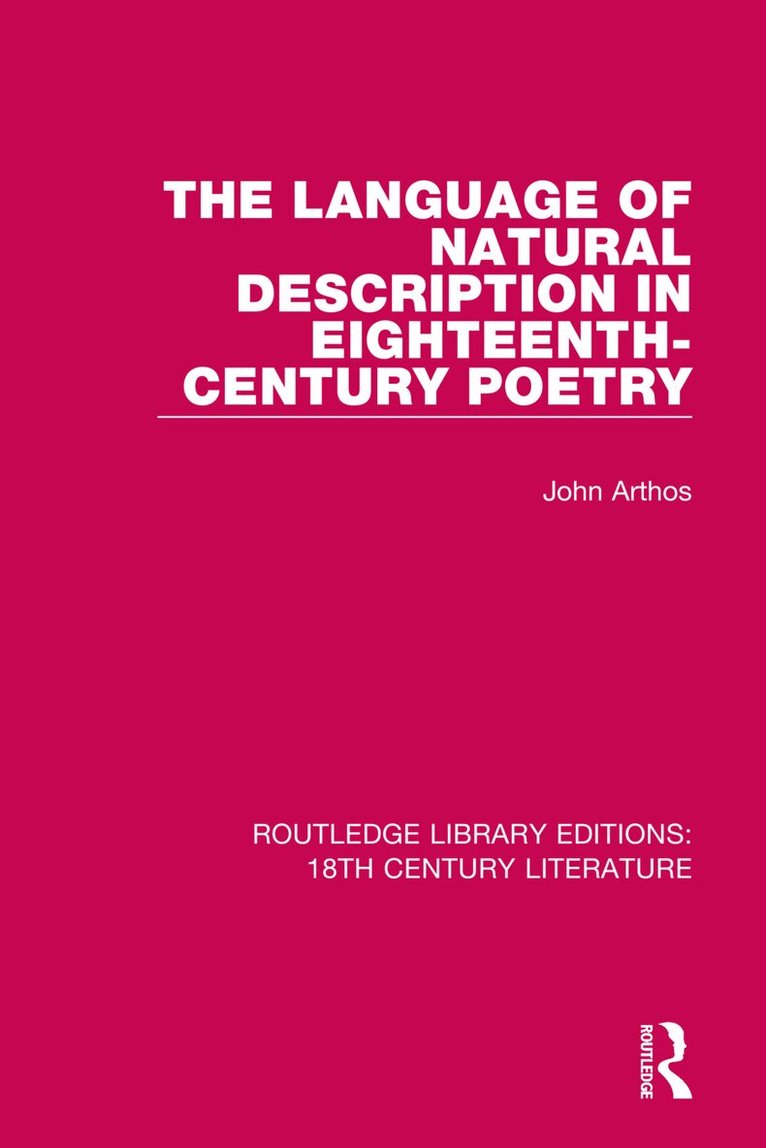
Originally published in 1949, this title was written in order to help establish a better understanding of the ‘stock diction’ of eighteenth-century English poetry, and, in particular, of the diction commonly used in the description of nature. The language characteristic of so much of the poetry of this period had been severely criticized for a long time. But in the twenty or thirty years prior to publication some effort had been made to review the subject and the problem. However, several questions still remained unanswered, and more exhaustive analysis needed to be undertaken. This volume was an effort to provide answers for some of these questions and to begin the analysis that was required.
690 kr
Läs direkt efter köp
Originally published in 1949, this title was written in order to help establish a better understanding of the ‘stock diction’ of eighteenth-century English poetry, and, in particular, of the diction commonly used in the description of nature. The language characteristic of so much of the poetry of this period had been severely criticized for a long time. But in the twenty or thirty years prior to publication some effort had been made to review the subject and the problem. However, several questions still remained unanswered, and more exhaustive analysis needed to be undertaken. This volume was an effort to provide answers for some of these questions and to begin the analysis that was required.
1 370 kr
Skickas inom 10-15 vardagar
527 kr
Skickas inom 10-15 vardagar
1 516 kr
Skickas inom 10-15 vardagar
527 kr
Skickas inom 10-15 vardagar
989 kr
Läs direkt efter köp
Originally published in 1956, this scholarly study of Spenser’s poetry shows how the conceptions of his earlier work in complaints, visions and pastorals were of continuing importance to the development of The Faerie Queene. Following on from Bishop Hurd’s Letters on Chivalry and Romance, John Arthos discusses the congeniality of romance and allegory. The form and substance of Spenser’s lyrical and meditative poetry were combined with his interest in romances to govern the progress of the great work, and in the Mutabilitie Cantos they assert a dominant emphasis. In continuing many of the features characteristic of medieval romances, in taking up the innovations of Boiardo and Ariosto, and in giving expression to a view of life and especially of love that had not been made before in romantic literature, Spenser set himself a framework of so many and such complex interests that he failed to construct in The Faerie Queene the unity one might expect after reading the letter to Raleigh. The author believes that Tasso’s theories provide the terms that explain how Spenser meant to effect the unity of his poem, and that they also explain why the Mutabilitie Cantos belong to a radically different conception. Acknowledging that the allegories in Spenser’s work are obscure or unevenly developed John Arthos’ book maintains the idea that romance and allegory were integrally conceived in the Poem.
998 kr
Läs direkt efter köp
Originally published in 1956, this scholarly study of Spenser’s poetry shows how the conceptions of his earlier work in complaints, visions and pastorals were of continuing importance to the development of The Faerie Queene. Following on from Bishop Hurd’s Letters on Chivalry and Romance, John Arthos discusses the congeniality of romance and allegory. The form and substance of Spenser’s lyrical and meditative poetry were combined with his interest in romances to govern the progress of the great work, and in the Mutabilitie Cantos they assert a dominant emphasis. In continuing many of the features characteristic of medieval romances, in taking up the innovations of Boiardo and Ariosto, and in giving expression to a view of life and especially of love that had not been made before in romantic literature, Spenser set himself a framework of so many and such complex interests that he failed to construct in The Faerie Queene the unity one might expect after reading the letter to Raleigh. The author believes that Tasso’s theories provide the terms that explain how Spenser meant to effect the unity of his poem, and that they also explain why the Mutabilitie Cantos belong to a radically different conception. Acknowledging that the allegories in Spenser’s work are obscure or unevenly developed John Arthos’ book maintains the idea that romance and allegory were integrally conceived in the Poem.
989 kr
Läs direkt efter köp
Originally published in 1963, this is a study of the greatness of Dante, Michelangelo and Milton, and of the differences in the power and effect of their work. This book shows how differing philosophical commitments help explain differences in the character of their greatness. The ancient treatise On the Sublime provides the starting point for these studies and in an introductory essay the author examines Longinus’ obligations to Platonic and Stoic philosophy. In the essays which relate the critical doctrines of Dante, Michelangelo and Milton to philosophy, he shows how far their thought accords with Longinus’ and to what degree they depend upon the same philosophic traditions. The final emphasis, however, is upon the relation of their ideas to the distinctive elements of their greatness.
989 kr
Läs direkt efter köp
Originally published in 1963, this is a study of the greatness of Dante, Michelangelo and Milton, and of the differences in the power and effect of their work. This book shows how differing philosophical commitments help explain differences in the character of their greatness. The ancient treatise On the Sublime provides the starting point for these studies and in an introductory essay the author examines Longinus’ obligations to Platonic and Stoic philosophy. In the essays which relate the critical doctrines of Dante, Michelangelo and Milton to philosophy, he shows how far their thought accords with Longinus’ and to what degree they depend upon the same philosophic traditions. The final emphasis, however, is upon the relation of their ideas to the distinctive elements of their greatness.
1 673 kr
Skickas inom 10-15 vardagar
497 kr
Läs direkt efter köp
497 kr
Läs direkt efter köp
479 kr
Skickas inom 10-15 vardagar
1 950 kr
Skickas inom 10-15 vardagar
570 kr
Läs direkt efter köp
570 kr
Läs direkt efter köp
548 kr
Skickas inom 10-15 vardagar
645 kr
Läs direkt efter köp
John Arthos discovers and promotes an organic reciprocity between rhetoric as a humanist practice and hermeneutics as a theoretical comportment. Although these two traditions have a long and rewarding collaboration, it is only now that we begin to realize their potential for radically remaking the way we think and speak as social animals. Arthos marries the performative competencies of rhetorical practice with the circularity of hermeneutic understanding in a way that redefines the syntax of a humanist education in the twenty-first century. As a counter to the linear, technical rationalism that permeates common culture and educational praxis, Speaking Hermeneutically shows how a hermeneutically inflected rhetoric can lead to refashioning habits of thought and speech, the constitution of personal identity, the conventions of social engagement, and the deliberative practices that form the basis of public institutions. Arthos adapts the hermeneutics of Martin Heidegger, Hans-Georg Gadamer, and Paul Ricoeur to a series of classic rhetorical texts and landmark political moments, modeling the revitalized interchange of traditions in a way that will be accessible to scholars and students in both fields of inquiry.