John Bendix - Böcker
Visar alla böcker från författaren John Bendix. Handla med fri frakt och snabb leverans.
5 produkter
5 produkter
1 054 kr
Kommande
Originally published in 1993, Unsettled Affinities was Reinhard Bendix's final work. It has a unique place in his writings, as it continues the themes contained in the two volumes of Embattled Reason and extends them in his consideration of the idea of community. For Bendix, our affinities are personally, socially, and politically unsettled and unsettling. From birth, each person goes through a life-cycle, buffeted by circumstance and uneasily suspended between the risks of individual opportunity and the need for psychological support from others. All of us stand at the intersection of many social groups formed by the family, social clubs, occupation, or given by the ethnic and national affiliation into which we are born. Bendix perceived these psychological and social groups as a source of strength as well as the source of the particularist drives that ultimately aim to serve universalist aspirations. It is in this series of paradoxes that political tasks arise: how to deal with the scarcity of goods and the inequality of life changes.Unsettled Affinities explores the ethical paradoxes of personal affiliation, social universalism, and political unity in Western civilization. The work is divided into three parts: an initial, personal reflection on the author's emigration from Hitler's Germany; an extended examination of the social definitions of community in Western civilization; and a consideration of politics, civil society, and the legitimation, of power. In the social and political sections, special attention is given to Germany. The consideration of Germany in the post-Communist world was not completed. Using notes, letters, and lectures, John Bendix, the author's son, has provided an epilogue that gives indications of the direction Reinhard Bendix's thought was heading, and Rudolf von Thadden has contributed an appropriate final thought in his "Endangered Affiliations."

2 289 kr
Skickas inom 10-15 vardagar
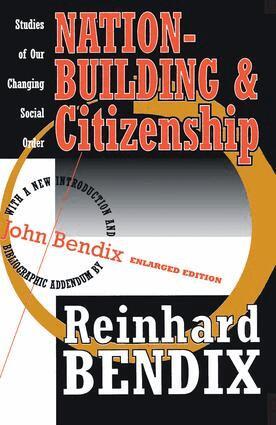
Nation-Building and Citizenship examines how states and civil societies interact in their formation of a new political community. Reinhard Bendix directs our attention to relations established between individual and state during nation-building. While the development of citizenship and the interplay between tradition and modernity are important in this process of social and political change, his key theme is the examination of authority patterns.Bendix explores in depth the possibilities of an alternative approach to the neo-evolutionary orientation many social scientists take in their analyses of the underdeveloped areas of the world. The subjects he discusses include transformations of Western European societies since medieval times, extension of citizenship to the lower classes, bureaucratization in the nation-state, private and public authority in Western Europe and Russia, aristocracies and development in Germany and Japan, and the development of public authority in India's political community. The book concludes with a reconsideration of ideas widely held about tradition, modernity, and modernization.In a new introduction, John Bendix writes that what continues to make this book relevant is not only what it can tell us about past and present nation-building, including the transformations of the 1980s and 1990s, but its more general messages about the nature of social and political transformations. Nation-Building and Citizenship is a necessary addition to the libraries of political scientists, sociologists, historians, and scholars of comparative studies.
174 kr
Skickas inom 5-8 vardagar
698 kr
Skickas inom 10-15 vardagar
Nation-Building and Citizenship examines how states and civil societies interact in their formation of a new political community. Reinhard Bendix directs our attention to relations established between individual and state during nation-building. While the development of citizenship and the interplay between tradition and modernity are important in this process of social and political change, his key theme is the examination of authority patterns.Bendix explores in depth the possibilities of an alternative approach to the neo-evolutionary orientation many social scientists take in their analyses of the underdeveloped areas of the world. The subjects he discusses include transformations of Western European societies since medieval times, extension of citizenship to the lower classes, bureaucratization in the nation-state, private and public authority in Western Europe and Russia, aristocracies and development in Germany and Japan, and the development of public authority in India's political community. The book concludes with a reconsideration of ideas widely held about tradition, modernity, and modernization.In a new introduction, John Bendix writes that what continues to make this book relevant is not only what it can tell us about past and present nation-building, including the transformations of the 1980s and 1990s, but its more general messages about the nature of social and political transformations. Nation-Building and Citizenship is a necessary addition to the libraries of political scientists, sociologists, historians, and scholars of comparative studies.
372 kr
Skickas inom 11-20 vardagar