John Dillenberger – författare
Visar alla böcker från författaren John Dillenberger. Handla med fri frakt och snabb leverans.
9 produkter
9 produkter
E-bok
Engelska, 1975229 kr
Läs direkt efter köp
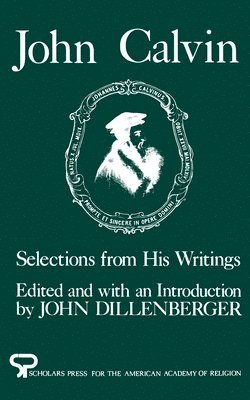
This volume presents texts selected from the full range of John Calvin's writings, including excerpts from commentaries, sermons, letters, catechisms, tracts, broad-based theological works.
Inbunden, Engelska, 1999
969 kr
Skickas inom 7-10 vardagar
This book explores the extent to which artists of sixteenth-century Europe were influenced by ideas of religious reform. Analysing the content of major works by eight prominent artists, noted reformation scholar John Dillenberger argues that these artists' productions provide a fascinating map of the evolution and influence of major theological currents of their time.
E-bok
PDF, Engelska, 1975231 kr
Läs direkt efter köp
This volume presents texts selected from the full range of John Calvin''s writings, including excerpts from commentaries, sermons, letters, catechisms, tracts, broad-based theological works.
E-bok
Engelska, 2011191 kr
Läs direkt efter köp
The development of Martin Luther''s thought was both a symptom and moving force in the transformation of the Middle Ages into the modern world. Geographical discovery, an emerging scientific tradition, and a climate of social change had splintered the unity of medieval Christian culture, and these changes provided the background for Luther''s theological challenge. His new apprehension of Scripture and fresh understanding of man''s relation to God demanded a break with the Church as then constituted and released the powerful impulses that carried the Reformation. Luther''s vigorous, colorful language still retains the excitement it had for thousands of his contemporaries. In this volume, Dr. Dillenberger has made a representative selection from Luther''s extensive writings, and has also provided the reader with a lucid introduction to his thought.From the Trade Paperback edition.
E-bok
Engelska, 2013214 kr
Läs direkt efter köp
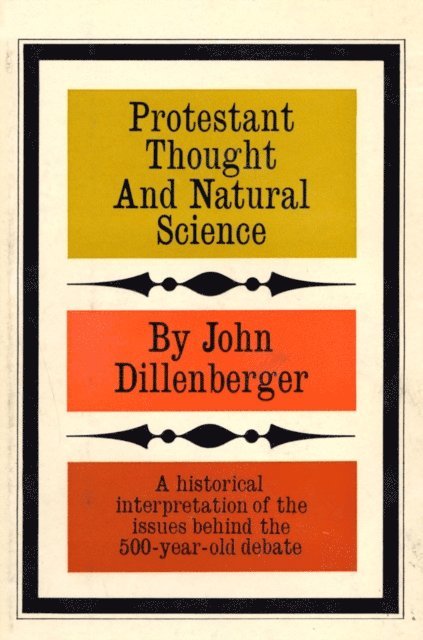
Protestant Thought and Natural Science presents a concise interpretation of the relations between natural scientists and Protestant theologians from the Reformation to the present day. The book penetrates behind the skirmishes to the underlying issues in a manner not achieved before.John Dillenberger’s firsthand knowledge of the source material has enabled him to break through the “science-and-religion” stereotype in an account at once complex and interesting.
Häftad, Engelska, 1975
320 kr
Skickas inom 5-8 vardagar
This volume presents texts selected from the full range of John Calvin's writings, including excerpts from commentaries, sermons, letters, catechisms, tracts, broad-based theological works.
Häftad, Engelska, 2004
319 kr
Skickas inom 5-8 vardagar
E-bok
PDF, Engelska, 2004503 kr
Läs direkt efter köp
For most of history, argues John Dillenberger, the visual arts were, for better or worse, part of the very fabric of the life and thought of the church. But with the Reformation and the Counter-Reformation a major change took place. Protestant rejection of the visual was matched in Roman Catholicism by the reduction of its formative power. While the visual arts dropped out of the lives of Protestant churches, they became a memory rather than a source of ennoblement or power in the Roman Catholic Church. Thus, in different but allied ways, Protestants and Catholics lost the power of the visual. Part art history, part historical theology, and part theological reflection, this book is both an argument and a program for the recovery of the visual arts in the life of the church, for reclaiming seeing as part of religious perception. It offers a theological understanding of the visual and provides a basis upon which the visual arts may again be incorporated into Protestantism and reinvigorated in Roman Catholicism. The first part is devoted to historical reconstruction, exploring those moments in Western history in which the relation between religion and the arts was in ferment. Part 2 is given to contemporary delineation and analysis: of spiritual perceptions in modern American painting and sculpture, of modern church art and architecture, and of the changing views of contemporary theologians toward the visual arts. Citing David Tracy, Karl Rahner, Langdon Gilkey, and others as examples, Dillenberger argues that contemporary theology is moving away from the modern rationalistic understanding of theological analogy to one far closer to the arts. Part 3 is constructive, developing a theological perspective that demands and includes the visual arts, and suggesting ways in which this can be accomplished in pastoral and theological education. The world of art, says Professor Dillenberger, is more aware of the role of religion in the arts than the world of religion is of art. Thus it is time for the church to resume its historic association with the visual arts, albeit in analogous rather than repristinating ways.
E-bok
PDF, Engelska, 2004779 kr
Läs direkt efter köp
How has religion affected the creation and patronage of American art? This is the question explored in 'The Visual Arts and Christianity in America', the most comprehensive treatment of this subject to date. With its 184 illustrations, the volume is a visual and textual survey of both the religious paintings, statuary, and architecture produced in America since colonial times and the attitudes toward such art expressed by the artists, the clergy, and the religious press. By means of a multifaceted approach that includes investigation of biographical, journalistic, art historical, as well as religious literature, a broad range of art objects and buildings are carefully placed in their social and intellectual context. Part One presents the colonial backdrop, both English and Spanish, against which and out of which the ensuing developments in American art and religious life took shape. Part Two treats nineteenth-century views of art and architecture, focusing on the views held by the clergy and conveyed in religious journals as well as the religious views of the artists and architects themselves. In Part Three, devoted to art in private and public life, major issues emerge that will remain as such into the twentieth century: the relation between nature and history, the place of art in civil religion, and the presence or absence of explicit biblical themes. The fourth and entirely new portion of the book, devoted to the twentieth century, examines the continuities and discontinuities in style and content between nineteenth- and twentieth-century art in relation to spiritual and religious perceptions.