John Durham Peters - Böcker
Visar alla böcker från författaren John Durham Peters. Handla med fri frakt och snabb leverans.
9 produkter
9 produkter
188 kr
Skickas inom 7-10 vardagar
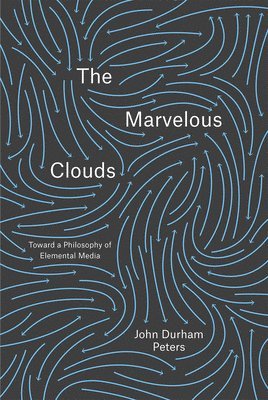
When we speak of clouds these days, it is as likely that we mean data clouds or network clouds as cumulus or stratus. In their sharing of the term, both kinds of clouds reveal an essential truth: that the natural world and the technological world are not so distinct. In The Marvelous Clouds, John Durham Peters argues that though we often think of media as environments, the reverse is just as true environments are media. Peters defines media expansively as elements that compose the human world. Drawing from ideas implicit in media philosophy, Peters argues that media are more than carriers of messages: they are the very infrastructures combining nature and culture that allow human life to thrive. Through an encyclopedic array of examples from the oceans to the skies, The Marvelous Clouds reveals the long prehistory of so-called new media. Digital media, Peters argues, are an extension of early practices tied to the establishment of civilization such as mastering fire, building calendars, reading the stars, creating language, and establishing religions.New media do not take us into uncharted waters, but rather confront us with the deepest and oldest questions of society and ecology: how to manage the relations people have with themselves, others, and the natural world. A wide-ranging meditation on the many means we have employed to cope with the struggles of existence from navigation to farming, meteorology to Google The Marvelous Clouds shows how media lie at the very heart of our interactions with the world around us. Peters's book will not only change how we think about media but provide a new appreciation for the day-to-day foundations of life on earth that we so often take for granted.
315 kr
Skickas inom 7-10 vardagar
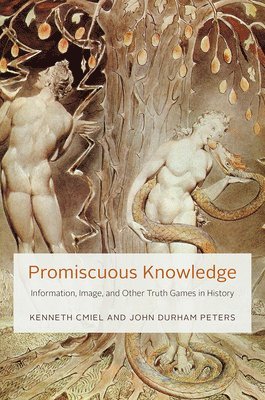
Sergey Brin, a cofounder of Google, once compared the perfect search engine to the "mind of God." As the modern face of promiscuous knowledge, however, Google's divine omniscience traffics indifferently in news, maps, weather, and porn. This book, begun by the late Kenneth Cmiel and completed by his close friend John Durham Peters, provides a genealogy of the information age from its early origins up to the reign of Google. It examines how we think about fact, image, and knowledge, centering on the different ways that claims of truth are complicated when they pass to a larger public. To explore these ideas, Cmiel and Peters focus on three main time periods--the late nineteenth century, 1925 to 1945, and 1975 to 2000, with constant reference to the present. Cmiel's original text examines the collapse he saw in the growing gulf between politics and aesthetics in postmodern architecture, the distancing of images from everyday life in magical realist cinema, the waning support for national betterment through taxation, and the inability of a single presentational strategy to contain the social whole. Peters brings Cmiel's study into the present moment, providing the backstory to current controversies over filter-bubbles, echo chambers, and "fake news." A hybrid work from two innovative thinkers, Promiscuous Knowledge is an enlightening contribution to our understanding of the internet and the profuse visual culture of our time.
250 kr
Skickas inom 7-10 vardagar
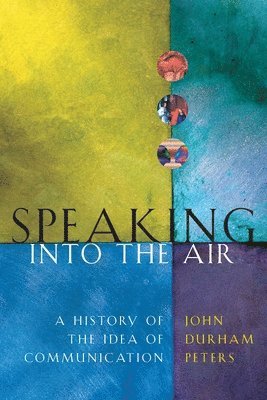
In contemporary debates, communication is variously invoked as a panacea for the problems of both democracy and love, as a dream of a new information society brought about by new technologies, and as a wistful ideal of human relations. How, and why, did communication come to shoulder the load it carries? In John Durham Peters's work, the teachings of Socrates and Jesus, the theology of Saint Augustine, the political philosophy of Locke, and the American tradition from Emerson through William James all become relevant for understanding communication in our age. Peters finds that thinkers across the centuries have struggled with the same questions - how we can hope for contact with others, what has become of human beings in increasingly technological times, how new modes of communication have altered the ways the world is imagined and how we relate to others - and he weaves intellectual history and communications history together. The book traces the yearning for contact not only through philosophy and literature but also by exploring the cultural reception of communication technologies from the telegraph to the radio.The history of communication, Peters shows, is not a triumphant progress toward global harmony but rather a collection of uncanny devices that conjure angels, spirits and alien intelligences. His is an account of a complex concept that has both shaped us and been shaped by us.
235 kr
Skickas inom 7-10 vardagar
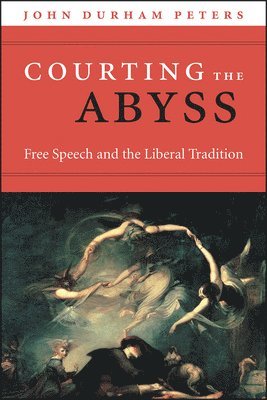
Courting the Abyss updates the philosophy of free expression for a world that is very different from the one in which it originated. The notion that a free society should allow Klansmen, neo-Nazis, sundry extremists, and pornographers to spread their doctrines as freely as everyone else has come increasingly under fire. At the same time, in the wake of 9/11, the Right and the Left continue to wage war over the utility of an absolute vision of free speech in a time of increased national security. Courting the Abyss revisits the tangled history of free speech, finding resolutions to these debates hidden at the very roots of the liberal tradition. A mesmerizing account of the role of public communication in the Anglo-American world, Courting the Abyss shows that liberty's earliest advocates recognized its fraternal relationship with wickedness and evil. While we understand freedom of expression to mean "anything goes," John Durham Peters asks why its advocates so often celebrate a sojourn in hell and the overcoming of suffering. He directs us to such well-known sources as the prose and poetry of John Milton and the political and philosophical theory of John Locke, Adam Smith, John Stuart Mill, and Oliver Wendell Holmes Jr., as well as lesser-known sources such as the theology of Paul of Tarsus. In various ways they all, he shows, envisioned an attitude of self-mastery or self-transcendence as a response to the inevitable dangers of free speech, a troubled legacy that continues to inform ruling norms about knowledge, ethical responsibility, and democracy today. A world of gigabytes, undiminished religious passion, and relentless scientific discovery calls for a fresh account of liberty that recognizes its risk and its splendor. Instead of celebrating noxious doctrine as proof of society's robustness, Courting the Abyss invites us to rethink public communication today by looking more deeply into the unfathomable mystery of liberty and evil.
1 833 kr
Skickas inom 10-15 vardagar
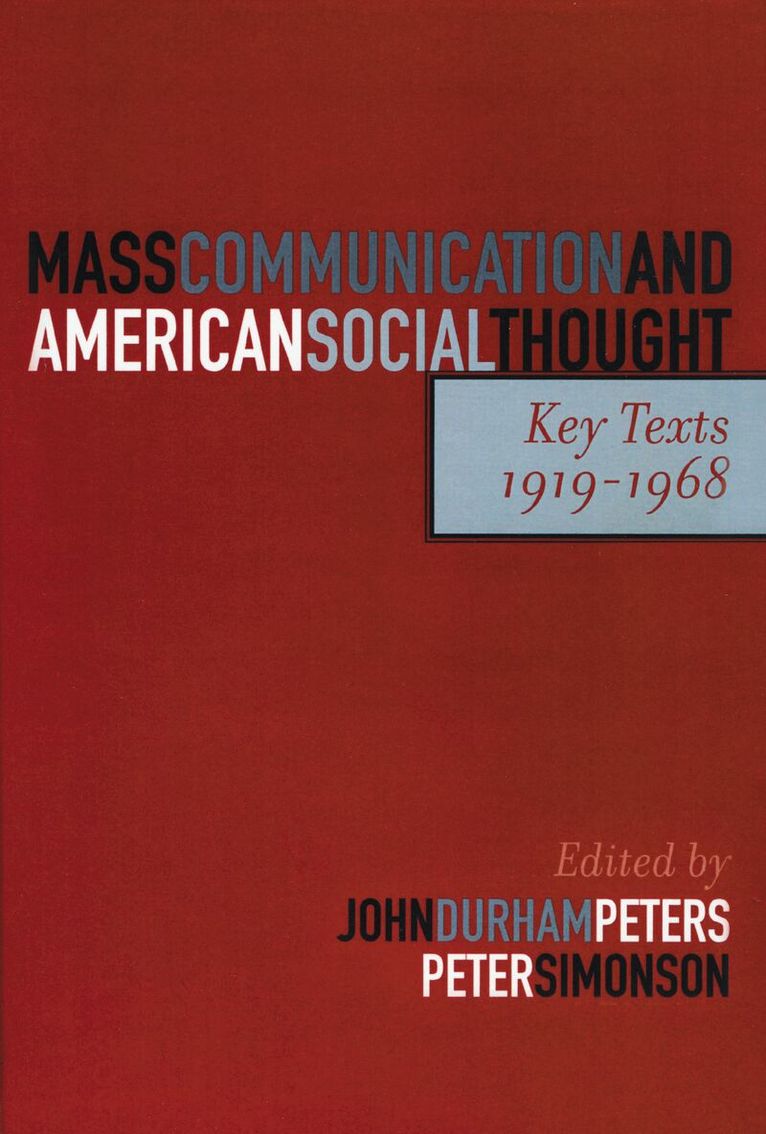
This anthology of hard-to-find primary documents provides a solid overview of the foundations of American media studies. Focusing on mass communication and society and how this research fits into larger patterns of social thought, this valuable collection features key texts covering the media studies traditions of the Chicago school, the effects tradition, the critical theory of the Frankfurt school, and mass society theory. Where possible, articles are reproduced in their entirety to preserve the historical flavor and texture of the original works. Topics include popular theater, yellow journalism, cinema, books, public relations, political and military propaganda, advertising, opinion polling, photography, the avant-garde, popular magazines, comics, the urban press, radio drama, soap opera, popular music, and television drama and news. This text is ideal for upper-level courses in mass communication and media theory, media and society, mass communication effects, and mass media history.
1 409 kr
Skickas inom 5-8 vardagar
This anthology of hard-to-find primary documents provides a solid overview of the foundations of American media studies. Focusing on mass communication and society and how this research fits into larger patterns of social thought, this valuable collection features key texts covering the media studies traditions of the Chicago school, the effects tradition, the critical theory of the Frankfurt school, and mass society theory. Where possible, articles are reproduced in their entirety to preserve the historical flavor and texture of the original works. Topics include popular theater, yellow journalism, cinema, books, public relations, political and military propaganda, advertising, opinion polling, photography, the avant-garde, popular magazines, comics, the urban press, radio drama, soap opera, popular music, and television drama and news. This text is ideal for upper-level courses in mass communication and media theory, media and society, mass communication effects, and mass media history.
Canonic Texts in Media Research
Are There Any? Should There Be? How About These?
Inbunden, Engelska, 2002
944 kr
Skickas inom 5-8 vardagar
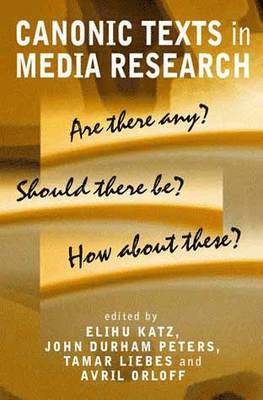
ARE THERE ANY? Many of us have our own canonic texts – the kind that won't go away. We tell them that their time has passed, that it's embarrassing they're still around, but they turn up repeatedly on our reading lists and in our bibliographies. They inspire us, haunt us, argue with us -- but they won't leave. Typically, we keep them to ourselves. SHOULD THERE BE? Of course there should be, and there's no reason to hidethem. Canons (and saints) should be shared, because they define fields andcommunities. These texts are not simply monuments, however. They are aliveand breathing, standing the test of time by shedding old meanings andassuming new ones. The minimal care they need – occasional brushing off andbulb-changing – is well worth the trouble.HOW ABOUT THESE? The field of media studies is now more than 50 years old,and the contributors to this volume offer their own candidates for canonization. Each of the thirteen essays in the book presents a critical reading of one of these classics and debates its candidacy. You are invited to disagree. The texts are summarized, analysed and re-examined for their contemporary relevance. They are grouped together in schools (Chicago, Columbia, Frankfurt, Toronto, British Cultural Studies) to highlight the different perspectives that characterize the field. This book offers thirteen pairs of shoulders to stand on, the better to see the field of media studies. It will serve as an excellent teaching text for advanced students in communications and media and cultural studies.
Canonic Texts in Media Research
Are There Any? Should There Be? How About These?
Häftad, Engelska, 2002
257 kr
Skickas inom 7-10 vardagar
ARE THERE ANY? Many of us have our own canonic texts – the kind that won't go away. We tell them that their time has passed, that it's embarrassing they're still around, but they turn up repeatedly on our reading lists and in our bibliographies. They inspire us, haunt us, argue with us -- but they won't leave. Typically, we keep them to ourselves. SHOULD THERE BE? Of course there should be, and there's no reason to hidethem. Canons (and saints) should be shared, because they define fields andcommunities. These texts are not simply monuments, however. They are aliveand breathing, standing the test of time by shedding old meanings andassuming new ones. The minimal care they need – occasional brushing off andbulb-changing – is well worth the trouble.HOW ABOUT THESE? The field of media studies is now more than 50 years old,and the contributors to this volume offer their own candidates for canonization. Each of the thirteen essays in the book presents a critical reading of one of these classics and debates its candidacy. You are invited to disagree. The texts are summarized, analysed and re-examined for their contemporary relevance. They are grouped together in schools (Chicago, Columbia, Frankfurt, Toronto, British Cultural Studies) to highlight the different perspectives that characterize the field. This book offers thirteen pairs of shoulders to stand on, the better to see the field of media studies. It will serve as an excellent teaching text for advanced students in communications and media and cultural studies.
194 kr
Skickas inom 10-15 vardagar
How are human actions shaped by the materiality of media? Contemporary media leads us more than ever to an ‘acting at a distance,’ an acting entangled with the materiality of communication and the mediality of transmission. This book explores this crucial phenomenon thereby introducing urgent questions of human interaction, the binding and breaking of time and space, and the entanglement of the material and the immaterial. Three vivid inquiries deal with histories and theories of mediality and materiality: John Durham Peters looks at episodes of simultaneity and synchronization. Christina Vagt discusses the agency of computer models against the backdrop of aesthetic theories by Henri Bergson and Hans Blumenberg, and Florian Sprenger discusses early electrical transmissions through copper wire and the temporality of instantaneity.