
John E. Johnson – författare
Visar alla böcker från författaren John E. Johnson. Handla med fri frakt och snabb leverans.
13 produkter
13 produkter
519 kr
Skickas inom 10-15 vardagar
Approaching any task on aging brings a flood of images that are a personal repetition of what has been one of the greatest and most persistent concerns of mankind. Even restricting time to the past decade or so and approaching only the biomedical sciences, one still encounters a flood of information in this relatively young research area. The ories and ideas abound as though each researcher provides one of his own. This might well be expected; aging is an exceedingly complicated series of crossroads involving trails and even superhighways. Each specialist has a peephole (society, body, organ, tissue, cell, or-especially in modern biology-cellular organelles, macromolecules, and even molecules) and the views of the crossroads are obviously different. Hence, the num ber of observations just about equals the number of independent ideas put forward. It is natural to seek from highly specialized knowledge a fundamental understand ing of aging through the modern research trends in biology that focus on events at the cellular, subcellular, macromolecular, and molecular levels. The ultimate clues must lie there-with one serious complication: There are numerous cell types in any body and each cell type is a very complex machine of its own. Additionally, there are potential repercussions in that different cells, tissues, and even molecules have effects on one another. This is indeed a confusing situation, and one for which we must seek reliable answers, provided that we can take a step back and provide a generalized view.
550 kr
Skickas inom 10-15 vardagar
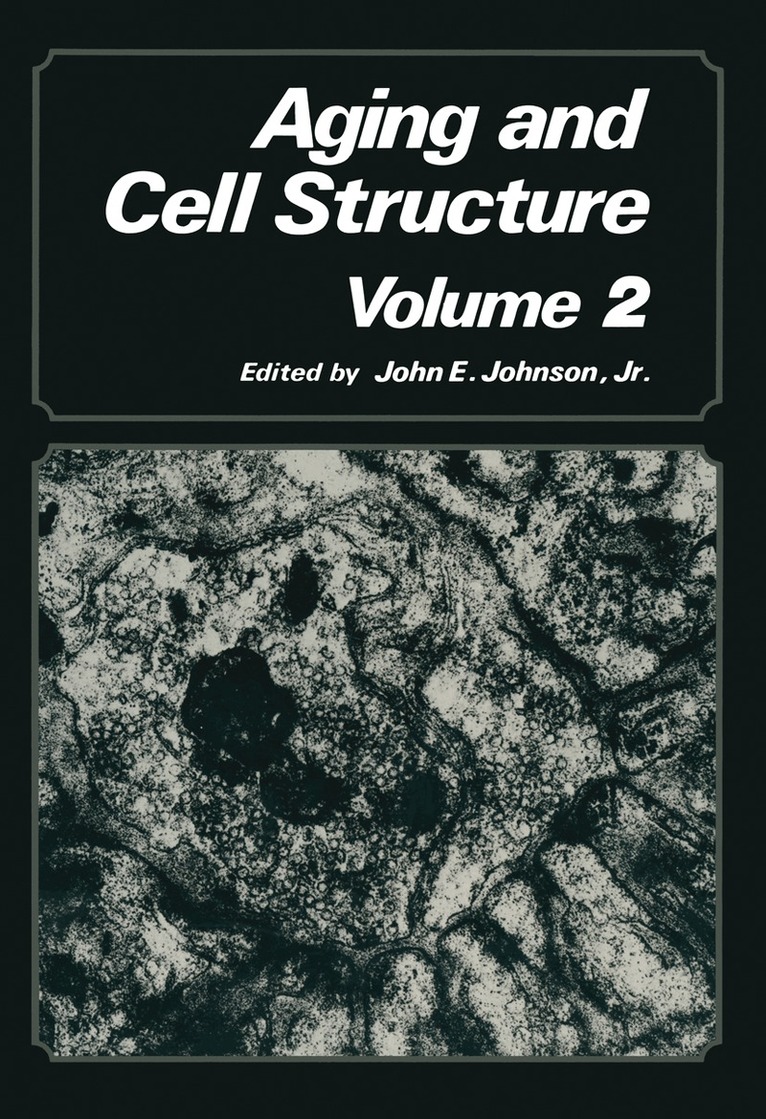
Although thousands of articles and hundreds of books on aging have been published, only a small percentage of this material has dealt with anatomy, particularly at the fine structural level. It was with this in mind that Aging and Cell Structure was conceived. Volume 1 of Aging and Cell Structure was published in 1981 and represented a current compilation of information, concentrating at the electron microscopic level, on morphological changes which occur in cells and tissues as they age. The present volume completes the two-volume set. While Volume 1 highlighted structural changes occurring in the aging nervous system, Volume 2 centers its efforts on studies of in vitro aging. Chapters on other subjects are included as well. These include age-related changes seen in neuromuscular junctions, oral tissues, and the pancreas. Although these two volumes represent a very small part of the published infor mation on experimental gerontology, their approach is rather unique because they focus on anatomy, perhaps the most basic of all the biomedical sciences. Because many dif ferent tissue types are examined, we begin to see recurrent, definitive patterns in the aging cell which may not be fully apparent from studies taking one cell type at a time. This becomes even more evident in the present volume where changes seen in popula tions of cells grown in culture-isolated from hormones or nervous impulses from other body areas-are found to be similar to those changes found in vivo.

211 kr
Skickas inom 5-8 vardagar

258 kr
Skickas inom 5-8 vardagar

266 kr
Skickas inom 3-6 vardagar

1 637 kr
Skickas inom 10-15 vardagar
The means by which non-enveloped viruses penetrate cellular membranes during cell entry remain poorly defined. Recent findings indicate several members of this group share a common mechanism of membrane penetration in which the virus particle undergoes programmed conformational changes, leading to capsid disassembly and release of small membrane-interacting peptides. A complete understanding of host cell entry by this minimal system will help elucidate the mechanisms of non-enveloped virus membrane penetration in general

1 637 kr
Skickas inom 10-15 vardagar
The means by which non-enveloped viruses penetrate cellular membranes during cell entry remain poorly defined. Recent findings indicate several members of this group share a common mechanism of membrane penetration in which the virus particle undergoes programmed conformational changes, leading to capsid disassembly and release of small membrane-interacting peptides. A complete understanding of host cell entry by this minimal system will help elucidate the mechanisms of non-enveloped virus membrane penetration in general

220 kr
Skickas inom 5-8 vardagar

213 kr
Skickas inom 5-8 vardagar

206 kr
Skickas inom 5-8 vardagar

317 kr
Skickas inom 5-8 vardagar

327 kr
Skickas inom 5-8 vardagar

328 kr
Skickas inom 5-8 vardagar