John E. Moerlins - Böcker
Visar alla böcker från författaren John E. Moerlins. Handla med fri frakt och snabb leverans.
3 produkter
3 produkter
Transboundary Water Resources: A Foundation for Regional Stability in Central Asia
Inbunden, Engelska, 2007
2 117 kr
Skickas inom 10-15 vardagar
“Human history becomes more and more a race between education and catastrophe.”H. G. WellsDespite a growing awareness of the importance of freshwater, human actions continue to degrade the freshwater ecosystems upon which we depend. Most regions of the world face serious impending problems related to the availability and efficient/equitable distribution of freshwater – these problems become exacerbated when both surface water and groundwater flows between and among multiple countries.As populations grow and the overall demand for water increases, the various and often competing demands for the finite stock of freshwater will increase. These shortages can lead to ecological/resource inefficiencies, economic/industrial problems, degradation of human health, social instability, and even conflict. The Central Asian republics and neighboring countries are currently experiencing these problems - problems that will become exacerbated by global climate change, increasing population and growing demands for water.In response to these growing concerns, on 20-22 June 2006, a NATO-sponsored Advanced Research Workshop (ARW) was organized in Almaty, Kazakhstan entitled, “Facilitating Regional Security in Central Asia through Improved Management of Transboundary Water Basin Resources”. This scientific meeting convened leading environmental experts from Central Asia, the Caucasus and from NATO member countries to address the myriad of issues involving shared freshwater among the countries in this region. Issues involving ecology, law, economics, politics, water policy and integrated water management were discussed and evaluated. Against the backdrop of the widely known Aral Sea problem, these leading experts addressed a wide variety of current and emerging issues related to transboundary water management.
Transboundary Water Resources: A Foundation for Regional Stability in Central Asia
Häftad, Engelska, 2007
2 117 kr
Skickas inom 10-15 vardagar
“Human history becomes more and more a race between education and catastrophe.”H. G. WellsDespite a growing awareness of the importance of freshwater, human actions continue to degrade the freshwater ecosystems upon which we depend. Most regions of the world face serious impending problems related to the availability and efficient/equitable distribution of freshwater – these problems become exacerbated when both surface water and groundwater flows between and among multiple countries.As populations grow and the overall demand for water increases, the various and often competing demands for the finite stock of freshwater will increase. These shortages can lead to ecological/resource inefficiencies, economic/industrial problems, degradation of human health, social instability, and even conflict. The Central Asian republics and neighboring countries are currently experiencing these problems - problems that will become exacerbated by global climate change, increasing population and growing demands for water.In response to these growing concerns, on 20-22 June 2006, a NATO-sponsored Advanced Research Workshop (ARW) was organized in Almaty, Kazakhstan entitled, “Facilitating Regional Security in Central Asia through Improved Management of Transboundary Water Basin Resources”. This scientific meeting convened leading environmental experts from Central Asia, the Caucasus and from NATO member countries to address the myriad of issues involving shared freshwater among the countries in this region. Issues involving ecology, law, economics, politics, water policy and integrated water management were discussed and evaluated. Against the backdrop of the widely known Aral Sea problem, these leading experts addressed a wide variety of current and emerging issues related to transboundary water management.
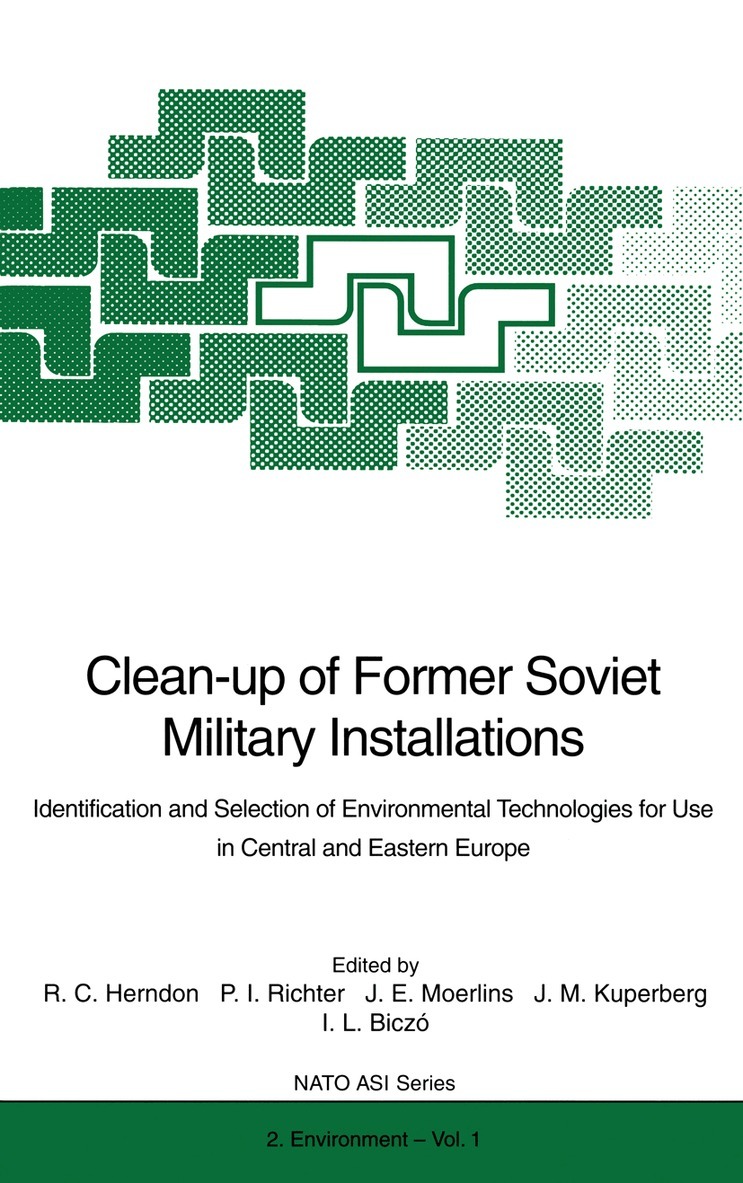
Clean-up of Former Soviet Military Installations
Identification and Selection of Environmental Technologies for Use in Central and Eastern Europe
Häftad, Engelska, 2012
534 kr
Skickas inom 10-15 vardagar
A NATO Advanced Research Workshop (ARW) was conducted on June 21-23, 1994 in Visegnid, Hungary related to the clean-up of former Soviet military installation sites. This ARW included a technical site visit to the Komarom Base Site which is a former Soviet military installation in Hungary. During this three-day ARW, a strategy and set of recommendations were developed for selecting technologies and evaluating remediation as the economic and approaches for these sites. This strategy incorporated such critical issues financial conditions of the region, temporal considerations with regard to the urgency for which remedial actions are needed for these sites, the prioritization of resource allocations for site clean-up using risk-based considerations, and other crucial issues which will affect the implementation of remedial activities in the region. Approximately 40 invited experts, representing a number of different disciplines as well as both NATO and Cooperation Partner countries from the region, participated in this ARW. The types of former Soviet military installations in Central and Eastern Europe include: aircraft bases, fueling areas, maintenance and repair facilities, training grounds, non ammunition storage areas (for lubricants, chemicals, paints, equipment), ammunition storage areas, medical facilities, production facilities, and municipal facilities. Environmental contamination at these sites poses significant human health and environmental risks. Site contaminants include: solvents (e. g. , BTEX), mineral oil hydrocarbons, polycyclic aromatic hydrocarbons (PAHs), chlorinated hydrocarbons, heavy metals, pesticides residues, and polychlorinated biphenyls (PCBs). The primary environmental media adversely affected by these contaminants are soils, ground water andsurface water.