John Gerrard – författare
Visar alla böcker från författaren John Gerrard. Handla med fri frakt och snabb leverans.
8 produkter
8 produkter
Inbunden, Engelska, 2000
2 815 kr
Skickas inom 10-15 vardagar
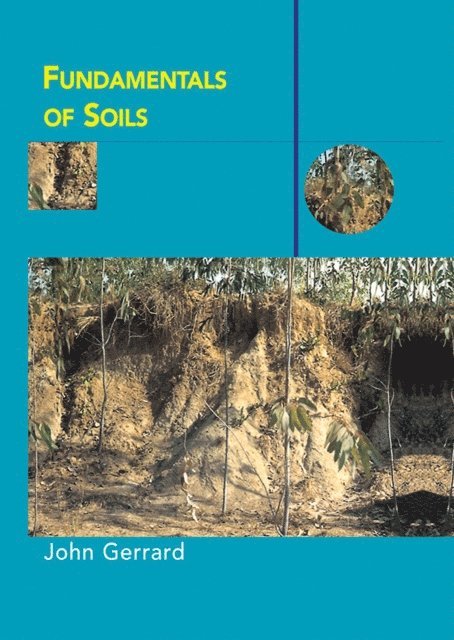
Fundamentals of Soil provides a comprehensive and engaging introduction to soils and the workings of soil systems. This text is the only one of its kind to provide an attractive, lively and accessible introduction to this topic. Featuring learning tools within each chapter, such as summaries, essay questions and guides for further reading, the text is also highly illustrated with useful tables, boxes and figures. Covering all key areas of study at an introductory level, subjects covered include:· Soil properties· Soil processes· Controls on soil formation· Soil classification· World soils· Soil patterns· Soil degradation.
Häftad, Engelska, 2000
751 kr
Skickas inom 10-15 vardagar
Fundamentals of Soil provides a comprehensive and engaging introduction to soils and the workings of soil systems. This text is the only one of its kind to provide an attractive, lively and accessible introduction to this topic. Featuring learning tools within each chapter, such as summaries, essay questions and guides for further reading, the text is also highly illustrated with useful tables, boxes and figures. Covering all key areas of study at an introductory level, subjects covered include:· Soil properties· Soil processes· Controls on soil formation· Soil classification· World soils· Soil patterns· Soil degradation.
Häftad, Engelska, 2018
216 kr
Skickas inom 5-8 vardagar
E-bok
PDF, Engelska, 2014891 kr
Läs direkt efter köp
Fundamentals of Soil provides a comprehensive and engaging introduction to soils and the workings of soil systems. This text is the only one of its kind to provide an attractive, lively and accessible introduction to this topic. Featuring learning tools within each chapter, such as summaries, essay questions and guides for further reading, the text is also highly illustrated with useful tables, boxes and figures. Covering all key areas of study at an introductory level, subjects covered include:· Soil properties· Soil processes· Controls on soil formation· Soil classification· World soils· Soil patterns· Soil degradation.
E-bok
Engelska, 2014860 kr
Läs direkt efter köp
Fundamentals of Soil provides a comprehensive and engaging introduction to soils and the workings of soil systems. This text is the only one of its kind to provide an attractive, lively and accessible introduction to this topic. Featuring learning tools within each chapter, such as summaries, essay questions and guides for further reading, the text is also highly illustrated with useful tables, boxes and figures. Covering all key areas of study at an introductory level, subjects covered include:· Soil properties· Soil processes· Controls on soil formation· Soil classification· World soils· Soil patterns· Soil degradation.
Häftad, Engelska, 2016
176 kr
Skickas inom 5-8 vardagar
E-bok
PDF, Engelska, 2012702 kr
Läs direkt efter köp
Geomorphology can be defined simply as the study of landforms. Landforms are the result of the interaction between what Ritter (1978) has called the driving and resisting forces. The driving forces or processes are the methods by which energy is exerted on earth materials and include both surface, geomorphological or exogenous processes and subsurface, geological or endogenous processes. The resisting forces are the surface materials with their inherent resistances determined by a complex combination of rock properties. Stated in these simple terms it would be expected that both sides of the equation be given equal weight in syntheses of landform evolution. However, this has not been the case. Until about the 1950s, geomorphology was mainly descriptive and concerned with producing time-dependent models of landscape evolution. Although the form of the land was the main focus, there was little detailed mention of process and scant attention to the properties of surface materials. There were, of course, exceptions. In the late 19th century G.K. Gilbert was stressing the equilibrium between landforms and processes. Many hydrologists were examining the detailed workings of river ''systems and drainage basins, culminating in the classic paper of Horton (1945).
Häftad, Engelska, 2012
549 kr
Skickas inom 10-15 vardagar
Geomorphology can be defined simply as the study of landforms. Landforms are the result of the interaction between what Ritter (1978) has called the driving and resisting forces. The driving forces or processes are the methods by which energy is exerted on earth materials and include both surface, geomorphological or exogenous processes and subsurface, geological or endogenous processes. The resisting forces are the surface materials with their inherent resistances determined by a complex combination of rock properties. Stated in these simple terms it would be expected that both sides of the equation be given equal weight in syntheses of landform evolution. However, this has not been the case. Until about the 1950s, geomorphology was mainly descriptive and concerned with producing time-dependent models of landscape evolution. Although the form of the land was the main focus, there was little detailed mention of process and scant attention to the properties of surface materials. There were, of course, exceptions. In the late 19th century G.K. Gilbert was stressing the equilibrium between landforms and processes. Many hydrologists were examining the detailed workings of river 'systems and drainage basins, culminating in the classic paper of Horton (1945).