John Jewkes – författare
Visar alla böcker från författaren John Jewkes. Handla med fri frakt och snabb leverans.
9 produkter
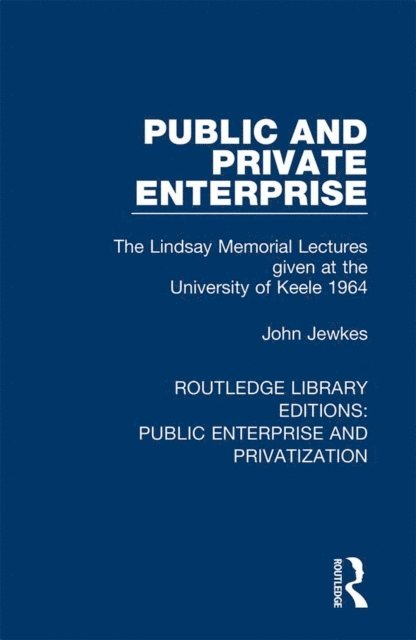
Public and Private Enterprise
The Lindsay Memorial Lectures given at the University of Keele 1964
Av John Jewkes
Inbunden, 2019
1566 kr
Lägg i varukorg
Originally published in 1965, Professor Jewkes re-examines the principles which should determine the dividing line between the role of the State and the field of individual responsibility in economic life. Beginning with a brief account of how the functions of Government at the time had been …
Public and Private Enterprise
The Lindsay Memorial Lectures given at the University of Keele 1964
Av John Jewkes
Häftad, 2021
562 kr
Lägg i varukorg
Originally published in 1965, Professor Jewkes re-examines the principles which should determine the dividing line between the role of the State and the field of individual responsibility in economic life. Beginning with a brief account of how the functions of Government at the time had been …
Sources of Invention
Av John Jewkes, David Sawers m. fl.
Häftad, 1971
321 kr
Lägg i varukorg
The first edition of The Sources of Invention, published in 1958, has been described as "a classic in science policy which has had a very considerable influence on both economists and scientists in Europe and in the United States." The authors set out to study the causes and consequences of …
Public and Private Enterprise
The Lindsay Memorial Lectures given at the University of Keele 1964
Av John Jewkes
E-bok, 2019
641 kr
Lägg i varukorg
Originally published in 1965, Professor Jewkes re-examines the principles which should determine the dividing line between the role of the State and the field of individual responsibility in economic life. Beginning with a brief account of how the functions of Government at the time had been …
Public and Private Enterprise
The Lindsay Memorial Lectures given at the University of Keele 1964
Av John Jewkes
E-bok, 2019
627 kr
Lägg i varukorg
Originally published in 1965, Professor Jewkes re-examines the principles which should determine the dividing line between the role of the State and the field of individual responsibility in economic life. Beginning with a brief account of how the functions of Government at the time had been …
Sources of Invention
Av John Jewkes
E-bok, 1969
1550 kr
Lägg i varukorg
A study of the causes and consequences of industrial innovation through the inventions of the nineteenth and twentieth centuries.
Sources of Invention
Av John Jewkes
Häftad, 1969
1093 kr
Lägg i varukorg
A study of the causes and consequences of industrial innovation through the inventions of the nineteenth and twentieth centuries.
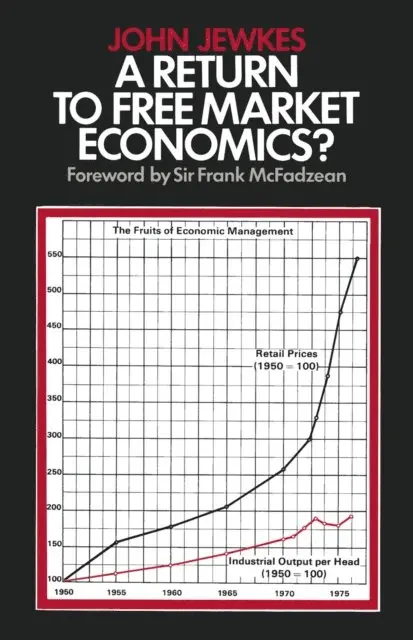
Return to Free Market Economics?
Critical Essays on Government Intervention
Av John Jewkes
E-bok, 1978
208 kr
Lägg i varukorg
Return to Free Market Economics?
Critical Essays on Government Intervention
Av John Jewkes
Häftad, 1978
170 kr
Lägg i varukorg