John Krige - Böcker
Visar alla böcker från författaren John Krige. Handla med fri frakt och snabb leverans.
16 produkter
16 produkter
1 106 kr
Tillfälligt slut
Knowledge matters, and states have a stake in managing its movement to protect a variety of local and national interests. The view that knowledge circulates by itself in a flat world, unimpeded by national boundaries, is a myth. The transnational movement of knowledge is a social accomplishment, requiring negotiation, accommodation, and adaptation to the specificities of local contexts. This volume of essays by historians of science and technology breaks the national framework in which histories are often written. Instead, How Knowledge Moves takes knowledge as its central object, with the goal of unraveling the relationships among people, ideas, and things that arise when they cross national borders. This specialized knowledge is located at multiple sites and moves across borders via a dazzling array of channels, embedded in heads and hands, in artifacts, and in texts. In the United States, it shapes policies for visas, export controls, and nuclear weapons proliferation; in Algeria, it enhances the production of oranges by colonial settlers; in Vietnam, it facilitates the exploitation of a river delta. In India it transforms modes of agricultural production. It implants American values in Latin America. By concentrating on the conditions that allow for knowledge movement, these essays explore travel and exchange in face-to-face encounters and show how border-crossings mobilize extensive bureaucratic technologies.
How Knowledge Moves
Writing the Transnational History of Science and Technology
Häftad, Engelska, 2019
531 kr
Skickas inom 11-20 vardagar
Knowledge matters, and states have a stake in managing its movement to protect a variety of local and national interests. The view that knowledge circulates by itself in a flat world, unimpeded by national boundaries, is a myth. The transnational movement of knowledge is a social accomplishment, requiring negotiation, accommodation, and adaptation to the specificities of local contexts. This volume of essays by historians of science and technology breaks the national framework in which histories are often written. Instead, How Knowledge Moves takes knowledge as its central object, with the goal of unraveling the relationships among people, ideas, and things that arise when they cross national borders. This specialized knowledge is located at multiple sites and moves across borders via a dazzling array of channels, embedded in heads and hands, in artifacts, and in texts. In the United States, it shapes policies for visas, export controls, and nuclear weapons proliferation; in Algeria, it enhances the production of oranges by colonial settlers; in Vietnam, it facilitates the exploitation of a river delta. In India it transforms modes of agricultural production. It implants American values in Latin America. By concentrating on the conditions that allow for knowledge movement, these essays explore travel and exchange in face-to-face encounters and show how border-crossings mobilize extensive bureaucratic technologies.
995 kr
Skickas inom 7-10 vardagar
The first historical study of export control regulations as a tool for the sharing and withholding of knowledge.In this groundbreaking book, Mario Daniels and John Krige set out to show the enormous political relevance that export control regulations have had for American debates about national security, foreign policy, and trade policy since 1945. Indeed, they argue that from the 1940s to today the issue of how to control the transnational movement of information has been central to the thinking and actions of the guardians of the American national security state. The expansion of control over knowledge and know-how is apparent from the increasingly systematic inclusion of universities and research institutions into a system that in the 1950s and 1960s mainly targeted business activities. As this book vividly reveals, classification was not the only—and not even the most important—regulatory instrument that came into being in the postwar era.
337 kr
Skickas inom 7-10 vardagar
The first historical study of export control regulations as a tool for the sharing and withholding of knowledge.In this groundbreaking book, Mario Daniels and John Krige set out to show the enormous political relevance that export control regulations have had for American debates about national security, foreign policy, and trade policy since 1945. Indeed, they argue that from the 1940s to today the issue of how to control the transnational movement of information has been central to the thinking and actions of the guardians of the American national security state. The expansion of control over knowledge and know-how is apparent from the increasingly systematic inclusion of universities and research institutions into a system that in the 1950s and 1960s mainly targeted business activities. As this book vividly reveals, classification was not the only—and not even the most important—regulatory instrument that came into being in the postwar era.
1 119 kr
Skickas inom 7-10 vardagar
A transnational approach to understanding and analyzing knowledge circulation.The contributors to this collection focus on what happens to knowledge and know-how at national borders. Rather than treating it as flowing like currents across them, or diffusing out from center to periphery, they stress the human intervention that shapes how knowledge is processed, mobilized, and repurposed in transnational transactions to serve diverse interests, constraints, and environments. The chapters consider both what knowledge travels and how it travels across borders of varying permeability that impede or facilitate its movement. They look closely at a variety of platforms and objects of knowledge, from tangible commodities—like hybrid wheat seeds, penicillin, Robusta coffee, naval weaponry, seed banks, satellites and high-performance computers—to the more conceptual apparatuses of plant phenotype data and statistics. Moreover, this volume decenters the Global North, tracking how knowledge moves along multiple paths across the borders of Mexico, India, Portugal, Guinea-Bissau, the Soviet Union, China, Angola, Palestine and the West Bank, as well as the United States and the United Kingdom. An important new work of transnational history, this collection recasts the way we understand and analyze knowledge circulation.
378 kr
Skickas inom 7-10 vardagar
A transnational approach to understanding and analyzing knowledge circulation.The contributors to this collection focus on what happens to knowledge and know-how at national borders. Rather than treating it as flowing like currents across them, or diffusing out from center to periphery, they stress the human intervention that shapes how knowledge is processed, mobilized, and repurposed in transnational transactions to serve diverse interests, constraints, and environments. The chapters consider both what knowledge travels and how it travels across borders of varying permeability that impede or facilitate its movement. They look closely at a variety of platforms and objects of knowledge, from tangible commodities—like hybrid wheat seeds, penicillin, Robusta coffee, naval weaponry, seed banks, satellites and high-performance computers—to the more conceptual apparatuses of plant phenotype data and statistics. Moreover, this volume decenters the Global North, tracking how knowledge moves along multiple paths across the borders of Mexico, India, Portugal, Guinea-Bissau, the Soviet Union, China, Angola, Palestine and the West Bank, as well as the United States and the United Kingdom. An important new work of transnational history, this collection recasts the way we understand and analyze knowledge circulation.
745 kr
Tillfälligt slut
Sharing Knowledge, Shaping Europe
US Technological Collaboration and Nonproliferation
Inbunden, Engelska, 2016
314 kr
Tillfälligt slut
717 kr
Skickas inom 5-8 vardagar
290 kr
Tillfälligt slut
1 304 kr
Skickas inom 10-15 vardagar
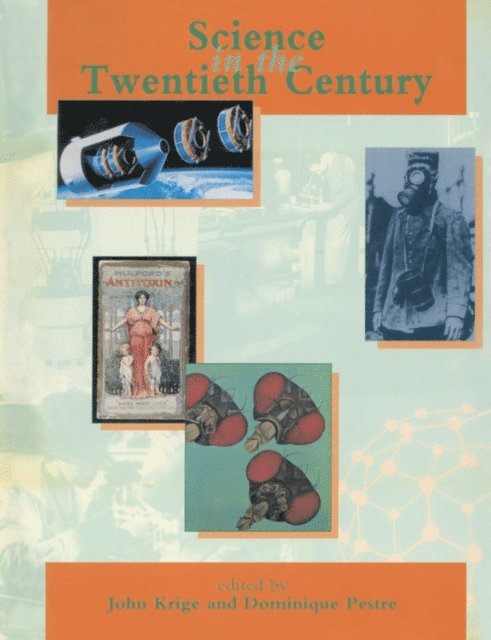
With over forty chapters, written by leading scholars, this comprehensive volume represents the best work in America, Europe and Asia. Geographical diversity of the authors is reflected in the different perspectives devoted to the subject, and all major disciplinary developments are covered.There are also sections concerning the countries that have made the most significant contributions, the relationship between science and industry, the importance of instrumentation, and the cultural influence of scientific modes of thought. Students and professionals will come to appreciate how, and why, science has developed - as with any other human activity, it is subject to the dynamics of society and politics.
1 105 kr
Skickas inom 10-15 vardagar
Since its inception, NASA has participated in over 4,000 international projects, yet historians have almost entirely neglected this remarkable aspect of the agency's work. This groundbreaking work is the first to trace NASA's history in a truly international context, drawing on unprecedented access to agency archives and personnel.
1 215 kr
Skickas inom 10-15 vardagar
Since its inception, NASA has participated in over 4,000 international projects, yet historians have almost entirely neglected this remarkable aspect of the agency's work. This groundbreaking work is the first to trace NASA's history in a truly international context, drawing on unprecedented access to agency archives and personnel.
696 kr
Skickas inom 10-15 vardagar
With over forty chapters, written by leading scholars, this comprehensive volume represents the best work in America, Europe, and Asia. Geographical diversity of the authors is reflected in the different perspectives devoted to the subject, and all major disciplinary developments are covered.There are also sections concerning the countries that have made the most significant contributions, the relationship between science and industry, the importance of instrumentation, and the cultural influence of scientific modes of thought. Students and professionals will come to appreciate how, and why, science has developed - as with any other human activity, it is subject to the dynamics of society and politics.
2 103 kr
Skickas inom 10-15 vardagar
With over forty chapters, written by leading scholars, this comprehensive volume represents the best work in America, Europe and Asia. Geographical diversity of the authors is reflected in the different perspectives devoted to the subject, and all major disciplinary developments are covered.There are also sections concerning the countries that have made the most significant contributions, the relationship between science and industry, the importance of instrumentation, and the cultural influence of scientific modes of thought. Students and professionals will come to appreciate how, and why, science has developed - as with any other human activity, it is subject to the dynamics of society and politics.
3 662 kr
Skickas inom 10-15 vardagar