John Levesque - Böcker
Visar alla böcker från författaren John Levesque. Handla med fri frakt och snabb leverans.
7 produkter
7 produkter
658 kr
Skickas inom 10-15 vardagar
"Ask not what your compiler can do for you, ask what you can do for your compiler."--John Levesque, Director of Cray’s Supercomputing Centers of ExcellenceThe next decade of computationally intense computing lies with more powerful multi/manycore nodes where processors share a large memory space. These nodes will be the building block for systems that range from a single node workstation up to systems approaching the exaflop regime. The node itself will consist of 10’s to 100’s of MIMD (multiple instruction, multiple data) processing units with SIMD (single instruction, multiple data) parallel instructions. Since a standard, affordable memory architecture will not be able to supply the bandwidth required by these cores, new memory organizations will be introduced. These new node architectures will represent a significant challenge to application developers.Programming for Hybrid Multi/Manycore MPP Systems attempts to briefly describe the current state-of-the-art in programming these systems, and proposes an approach for developing a performance-portable application that can effectively utilize all of these systems from a single application. The book starts with a strategy for optimizing an application for multi/manycore architectures. It then looks at the three typical architectures, covering their advantages and disadvantages.The next section of the book explores the other important component of the target—the compiler. The compiler will ultimately convert the input language to executable code on the target, and the book explores how to make the compiler do what we want. The book then talks about gathering runtime statistics from running the application on the important problem sets previously discussed.How best to utilize available memory bandwidth and virtualization is covered next, along with hybridization of a program. The last part of the book includes several major applications, and examines future hardware advancements and how the application developer may prepare for those advancements.
350 kr
Skickas inom 5-8 vardagar
196 kr
Skickas inom 5-8 vardagar
933 kr
Skickas inom 10-15 vardagar
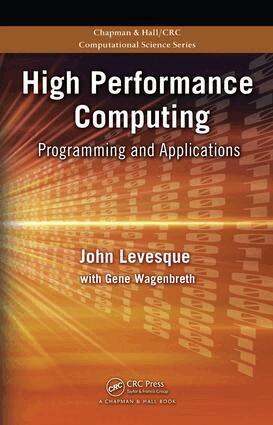
High Performance Computing: Programming and Applications presents techniques that address new performance issues in the programming of high performance computing (HPC) applications. Omitting tedious details, the book discusses hardware architecture concepts and programming techniques that are the most pertinent to application developers for achieving high performance. Even though the text concentrates on C and Fortran, the techniques described can be applied to other languages, such as C++ and Java.Drawing on their experience with chips from AMD and systems, interconnects, and software from Cray Inc., the authors explore the problems that create bottlenecks in attaining good performance. They cover techniques that pertain to each of the three levels of parallelism: Message passing between the nodes Shared memory parallelism on the nodes or the multiple instruction, multiple data (MIMD) units on the acceleratorVectorization on the inner level After discussing architectural and software challenges, the book outlines a strategy for porting and optimizing an existing application to a large massively parallel processor (MPP) system. With a look toward the future, it also introduces the use of general purpose graphics processing units (GPGPUs) for carrying out HPC computations. A companion website at www.hybridmulticoreoptimization.com contains all the examples from the book, along with updated timing results on the latest released processors.
1 480 kr
Skickas inom 10-15 vardagar
High Performance Computing: Programming and Applications presents techniques that address new performance issues in the programming of high performance computing (HPC) applications. Omitting tedious details, the book discusses hardware architecture concepts and programming techniques that are the most pertinent to application developers for achieving high performance. Even though the text concentrates on C and Fortran, the techniques described can be applied to other languages, such as C++ and Java.Drawing on their experience with chips from AMD and systems, interconnects, and software from Cray Inc., the authors explore the problems that create bottlenecks in attaining good performance. They cover techniques that pertain to each of the three levels of parallelism: Message passing between the nodes Shared memory parallelism on the nodes or the multiple instruction, multiple data (MIMD) units on the acceleratorVectorization on the inner level After discussing architectural and software challenges, the book outlines a strategy for porting and optimizing an existing application to a large massively parallel processor (MPP) system. With a look toward the future, it also introduces the use of general purpose graphics processing units (GPGPUs) for carrying out HPC computations. A companion website at www.hybridmulticoreoptimization.com contains all the examples from the book, along with updated timing results on the latest released processors.
359 kr
Skickas inom 3-6 vardagar
1 241 kr
Skickas inom 10-15 vardagar
"Ask not what your compiler can do for you, ask what you can do for your compiler."--John Levesque, Director of Cray’s Supercomputing Centers of ExcellenceThe next decade of computationally intense computing lies with more powerful multi/manycore nodes where processors share a large memory space. These nodes will be the building block for systems that range from a single node workstation up to systems approaching the exaflop regime. The node itself will consist of 10’s to 100’s of MIMD (multiple instruction, multiple data) processing units with SIMD (single instruction, multiple data) parallel instructions. Since a standard, affordable memory architecture will not be able to supply the bandwidth required by these cores, new memory organizations will be introduced. These new node architectures will represent a significant challenge to application developers.Programming for Hybrid Multi/Manycore MPP Systems attempts to briefly describe the current state-of-the-art in programming these systems, and proposes an approach for developing a performance-portable application that can effectively utilize all of these systems from a single application. The book starts with a strategy for optimizing an application for multi/manycore architectures. It then looks at the three typical architectures, covering their advantages and disadvantages.The next section of the book explores the other important component of the target—the compiler. The compiler will ultimately convert the input language to executable code on the target, and the book explores how to make the compiler do what we want. The book then talks about gathering runtime statistics from running the application on the important problem sets previously discussed.How best to utilize available memory bandwidth and virtualization is covered next, along with hybridization of a program. The last part of the book includes several major applications, and examines future hardware advancements and how the application developer may prepare for those advancements.