John M. Flach - Böcker
Visar alla böcker från författaren John M. Flach. Handla med fri frakt och snabb leverans.
8 produkter
8 produkter
738 kr
Skickas inom 10-15 vardagar
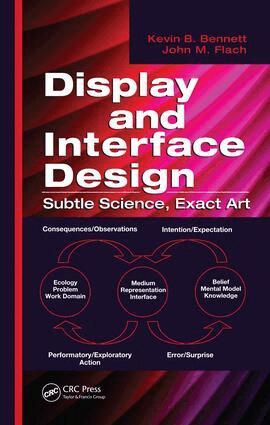
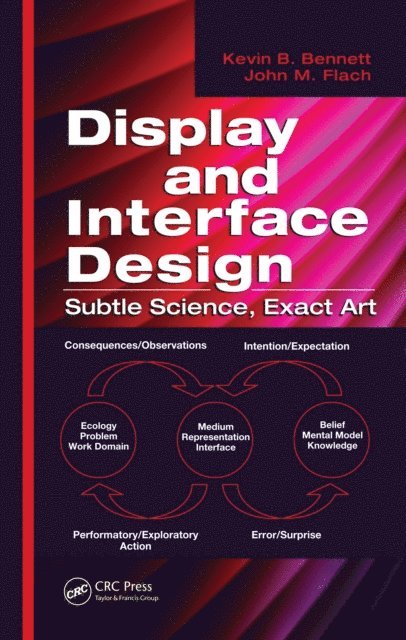
Technological advances in hardware and software provide powerful tools with the potential to design interfaces that are powerful and easy to use. Yet, the frustrations and convoluted "work-arounds" often encountered make it clear that there is substantial room for improvement. Drawn from more than 60 years of combined experience studying, implementing, and teaching about performance in human-technology systems, Display and Interface Design: Subtle Science, Exact Art provides a theoretically-based yet practical guide for ecological display and interface design.Written from the perspective of cognitive systems engineering and ecological interface design, the book delineates how to design interfaces tailored to specific work demands, leverage the powerful perception-action skills of the human, and use powerful interface technologies wisely. This triadic approach (domain, human, interface) to display and interface design stands in sharp contrast to traditional dyadic (human, interface) approaches. The authors describe general principles and specific strategies at length and include concrete examples and extensive design tutorials that illustrate quite clearly how these principles and strategies can be applied. The coverage spans the entire continuum of interfaces that might need to be developed in today's work places. The reason that good interfaces are few and far between is really quite simple: they are extremely difficult to design and build properly. While there are many books available that address display design, most of them focus on aesthetic principles but lack scientific rigor, or are descriptive but not prescriptive. Whether you are exploring the principles of interface design or designing and implementing interfaces, this book elucidates an overarching framework for design that can be applied to the broad spectrum of existing domains.
2 508 kr
Skickas inom 10-15 vardagar
There is a growing consensus in the human factors/ergonomics community that human factors research has had little impact on significant applied problems. Some have suggested that the problem lies in the fact that much HF/E research has been based on the wrong type of psychology, an information processing view of psychology that is reductionistic and context-free. Ecological psychology offers a viable alternative, presenting a richer view of human behavior that is holistic and contextualized. The papers presented in these two volumes show the conceptual impact that ecological psychology can have on HF/E, as well as presenting a number of specific examples illustrating the ecological approach to human-machine systems. It is the first collection of papers that explicitly draws a connection between these two fields. While work in this area is only just beginning, the evidence available suggests that taking an ecological approach to human factors/ergonomics helps bridge the existing gap between basic research and applied problems.
1 304 kr
Skickas inom 10-15 vardagar
There is a growing consensus in the human factors/ergonomics community that human factors research has had little impact on significant applied problems. Some have suggested that the problem lies in the fact that much HF/E research has been based on the wrong type of psychology, an information processing view of psychology that is reductionistic and context-free. Ecological psychology offers a viable alternative, presenting a richer view of human behavior that is holistic and contextualized. The papers presented in these two volumes show the conceptual impact that ecological psychology can have on HF/E, as well as presenting a number of specific examples illustrating the ecological approach to human-machine systems. It is the first collection of papers that explicitly draws a connection between these two fields. While work in this area is only just beginning, the evidence available suggests that taking an ecological approach to human factors/ergonomics helps bridge the existing gap between basic research and applied problems.
1 440 kr
Skickas inom 10-15 vardagar
There is a growing consensus in the human factors/ergonomics community that human factors research has had little impact on significant applied problems. Some have suggested that the problem lies in the fact that much HF/E research has been based on the wrong type of psychology, an information processing view of psychology that is reductionistic and context-free. Ecological psychology offers a viable alternative, presenting a richer view of human behavior that is holistic and contextualized. The papers presented in these two volumes show the conceptual impact that ecological psychology can have on HF/E, as well as presenting a number of specific examples illustrating the ecological approach to human-machine systems. It is the first collection of papers that explicitly draws a connection between these two fields. While work in this area is only just beginning, the evidence available suggests that taking an ecological approach to human factors/ergonomics helps bridge the existing gap between basic research and applied problems.
853 kr
Skickas inom 10-15 vardagar
There is a growing consensus in the human factors/ergonomics community that human factors research has had little impact on significant applied problems. Some have suggested that the problem lies in the fact that much HF/E research has been based on the wrong type of psychology, an information processing view of psychology that is reductionistic and context-free. Ecological psychology offers a viable alternative, presenting a richer view of human behavior that is holistic and contextualized. The papers presented in these two volumes show the conceptual impact that ecological psychology can have on HF/E, as well as presenting a number of specific examples illustrating the ecological approach to human-machine systems. It is the first collection of papers that explicitly draws a connection between these two fields. While work in this area is only just beginning, the evidence available suggests that taking an ecological approach to human factors/ergonomics helps bridge the existing gap between basic research and applied problems.
2 241 kr
Skickas inom 10-15 vardagar
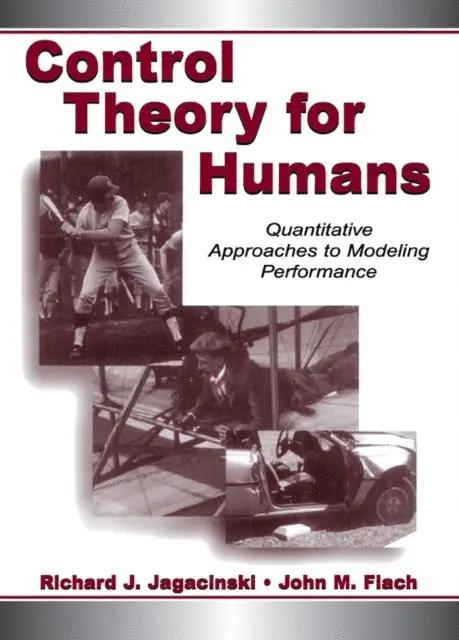
This textbook provides a tutorial introduction to behavioral applications of control theory. Control theory describes the information one should be sensitive to and the pattern of influence that one should exert on a dynamic system in order to achieve a goal. As such, it is applicable to various forms of dynamic behavior. The book primarily deals with manual control (e.g., moving the cursor on a computer screen, lifting an object, hitting a ball, driving a car), both as a substantive area of study and as a useful perspective for approaching control theory. It is the experience of the authors that by imagining themselves as part of a manual control system, students are better able to learn numerous concepts in this field. Topics include varieties of control theory, such as classical, optimal, fuzzy, adaptive, and learning control, as well as perception and decision making in dynamic contexts. The authors also discuss implications of control theory for how experiments can be conducted in the behavioral sciences. In each of these areas they have provided brief essays intended to convey key concepts that enable the reader to more easily pursue additional readings. Behavioral scientists teaching control courses will be very interested in this book.
909 kr
Skickas inom 10-15 vardagar
This textbook provides a tutorial introduction to behavioral applications of control theory. Control theory describes the information one should be sensitive to and the pattern of influence that one should exert on a dynamic system in order to achieve a goal. As such, it is applicable to various forms of dynamic behavior. The book primarily deals with manual control (e.g., moving the cursor on a computer screen, lifting an object, hitting a ball, driving a car), both as a substantive area of study and as a useful perspective for approaching control theory. It is the experience of the authors that by imagining themselves as part of a manual control system, students are better able to learn numerous concepts in this field. Topics include varieties of control theory, such as classical, optimal, fuzzy, adaptive, and learning control, as well as perception and decision making in dynamic contexts. The authors also discuss implications of control theory for how experiments can be conducted in the behavioral sciences. In each of these areas they have provided brief essays intended to convey key concepts that enable the reader to more easily pursue additional readings. Behavioral scientists teaching control courses will be very interested in this book.
2 374 kr
Skickas inom 10-15 vardagar
Technological advances in hardware and software provide powerful tools with the potential to design interfaces that are powerful and easy to use. Yet, the frustrations and convoluted "work-arounds" often encountered make it clear that there is substantial room for improvement. Drawn from more than 60 years of combined experience studying, implementing, and teaching about performance in human-technology systems, Display and Interface Design: Subtle Science, Exact Art provides a theoretically-based yet practical guide for ecological display and interface design.Written from the perspective of cognitive systems engineering and ecological interface design, the book delineates how to design interfaces tailored to specific work demands, leverage the powerful perception-action skills of the human, and use powerful interface technologies wisely. This triadic approach (domain, human, interface) to display and interface design stands in sharp contrast to traditional dyadic (human, interface) approaches. The authors describe general principles and specific strategies at length and include concrete examples and extensive design tutorials that illustrate quite clearly how these principles and strategies can be applied. The coverage spans the entire continuum of interfaces that might need to be developed in today's work places. The reason that good interfaces are few and far between is really quite simple: they are extremely difficult to design and build properly. While there are many books available that address display design, most of them focus on aesthetic principles but lack scientific rigor, or are descriptive but not prescriptive. Whether you are exploring the principles of interface design or designing and implementing interfaces, this book elucidates an overarching framework for design that can be applied to the broad spectrum of existing domains.