John M. Lee – författare
Visar alla böcker från författaren John M. Lee. Handla med fri frakt och snabb leverans.
12 produkter
12 produkter
Del 176 - Graduate Texts in Mathematics
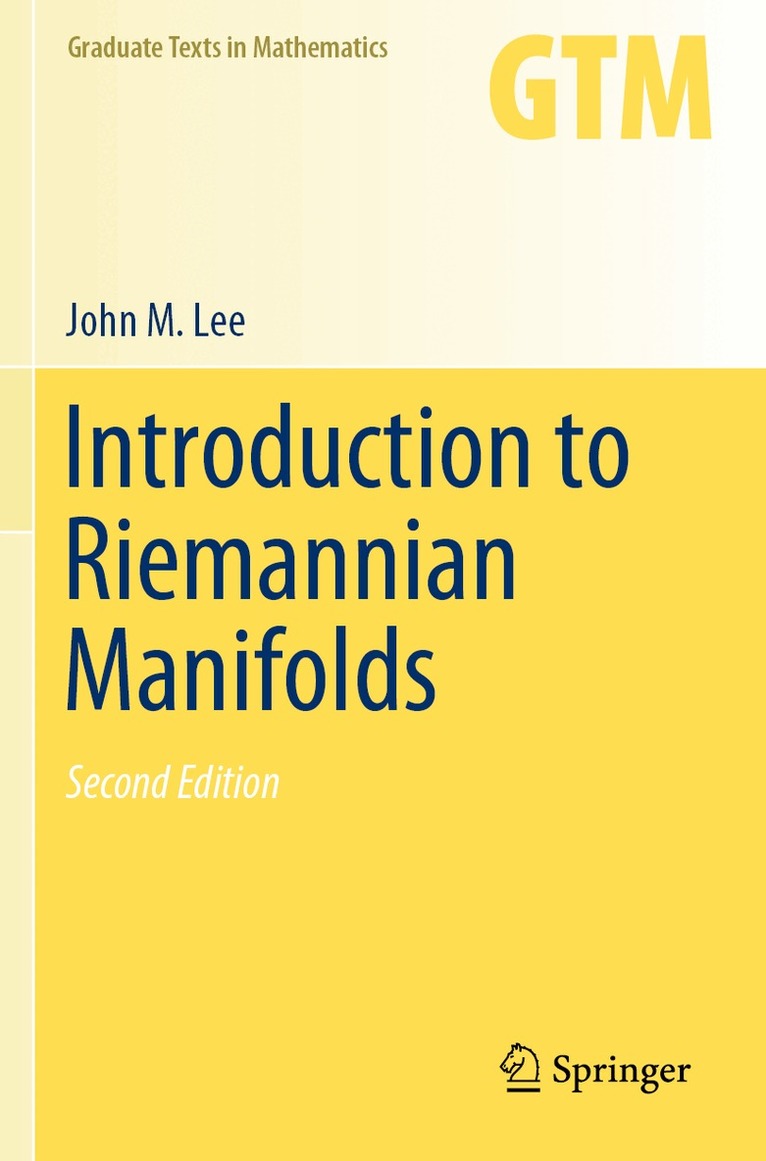
Introduction to Riemannian Manifolds
Häftad, Engelska, 2021
331 kr
Skickas inom 5-8 vardagar
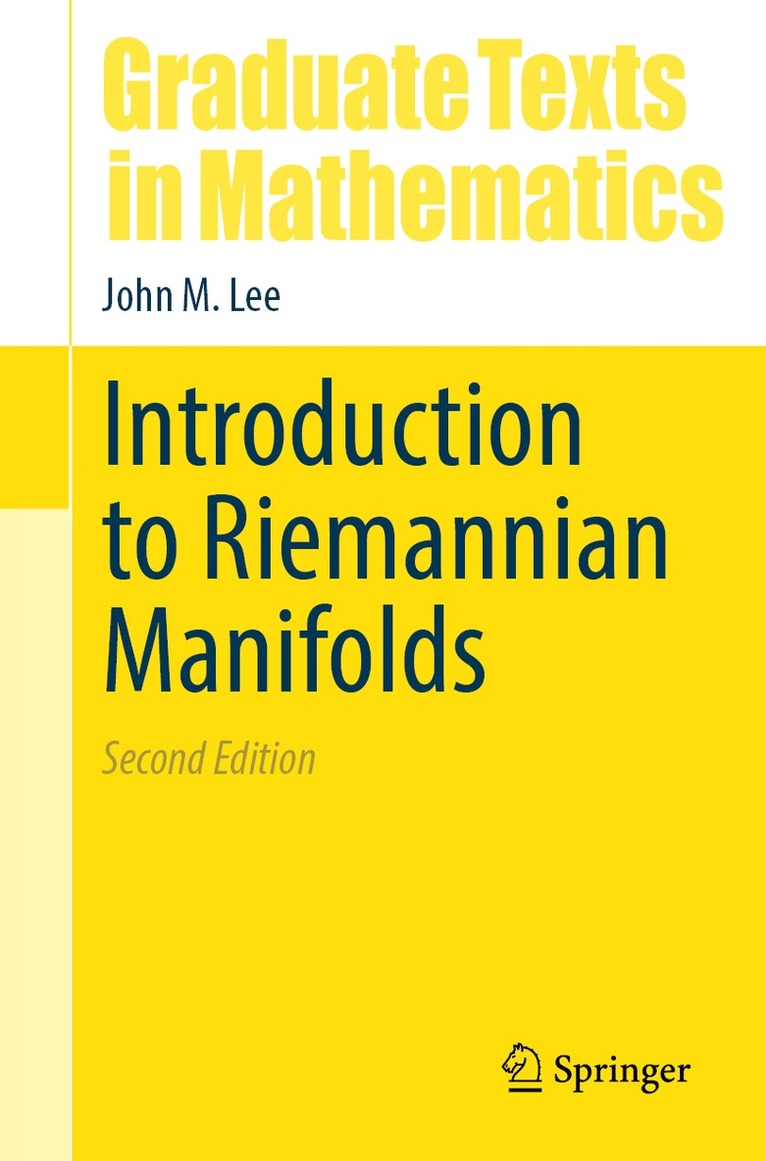
This textbook is designed for a one or two semester graduate course on Riemannian geometry for students who are familiar with topological and differentiable manifolds. The second edition has been adapted, expanded, and aptly retitled from Lee’s earlier book, Riemannian Manifolds: An Introduction to Curvature. Numerous exercises and problem sets provide the student with opportunities to practice and develop skills; appendices contain a brief review of essential background material.While demonstrating the uses of most of the main technical tools needed for a careful study of Riemannian manifolds, this text focuses on ensuring that the student develops an intimate acquaintance with the geometric meaning of curvature. The reasonably broad coverage begins with a treatment of indispensable tools for working with Riemannian metrics such as connections and geodesics. Several topics have been added, including an expanded treatment of pseudo-Riemannianmetrics, a more detailed treatment of homogeneous spaces and invariant metrics, a completely revamped treatment of comparison theory based on Riccati equations, and a handful of new local-to-global theorems, to name just a few highlights.Reviews of the first edition:Arguments and proofs are written down precisely and clearly. The expertise of the author is reflected in many valuable comments and remarks on the recent developments of the subjects. Serious readers would have the challenges of solving the exercises and problems. The book is probably one of the most easily accessible introductions to Riemannian geometry. (M.C. Leung, MathReview) The book’s aim is to develop tools and intuition for studying the central unifying theme in Riemannian geometry, which is the notion of curvature and its relation with topology. The main ideas of the subject, motivated as in the original papers, are introduced here in an intuitive and accessible way…The book is an excellent introduction designed for a one-semester graduate course, containing exercises and problems which encourage students to practice working with the new notions and develop skills for later use. By citing suitable references for detailed study, the reader is stimulated to inquire into further research. (C.-L. Bejan, zBMATH)
E-bok
PDF, Engelska, 20131 140 kr
Läs direkt efter köp
Manifolds are everywhere. These generalizations of curves and surfaces to arbitrarily many dimensions provide the mathematical context for under standing "space" in all of its manifestations. Today, the tools of manifold theory are indispensable in most major subfields of pure mathematics, and outside of pure mathematics they are becoming increasingly important to scientists in such diverse fields as genetics, robotics, econometrics, com puter graphics, biomedical imaging, and, of course, the undisputed leader among consumers (and inspirers) of mathematics-theoretical physics. No longer a specialized subject that is studied only by differential geometers, manifold theory is now one of the basic skills that all mathematics students should acquire as early as possible. Over the past few centuries, mathematicians have developed a wondrous collection of conceptual machines designed to enable us to peer ever more deeply into the invisible world of geometry in higher dimensions. Once their operation is mastered, these powerful machines enable us to think geometrically about the 6-dimensional zero set of a polynomial in four complex variables, or the lO-dimensional manifold of 5 x 5 orthogonal ma trices, as easily as we think about the familiar 2-dimensional sphere in ]R3.
E-bok
PDF, Engelska, 2006902 kr
Läs direkt efter köp
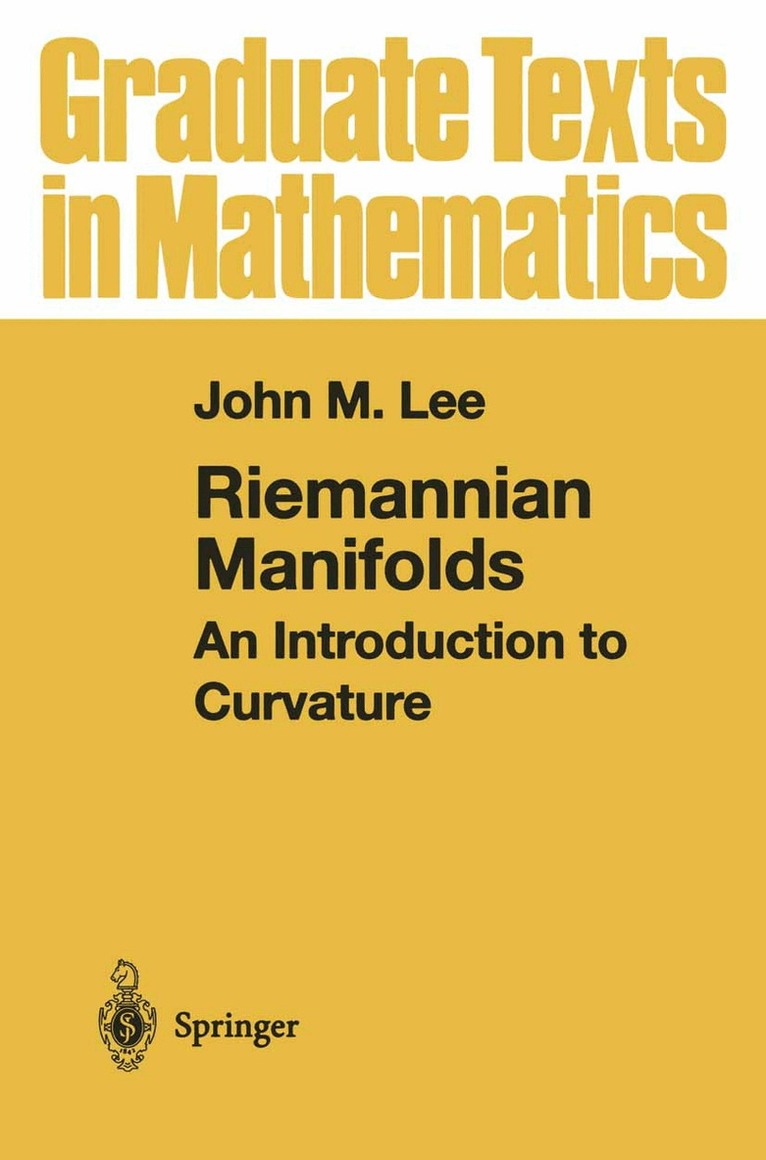
This book is designed as a textbook for a one-quarter or one-semester graduate course on Riemannian geometry, for students who are familiar with topological and differentiable manifolds. It focuses on developing an intimate acquaintance with the geometric meaning of curvature. In so doing, it introduces and demonstrates the uses of all the main technical tools needed for a careful study of Riemannian manifolds. The author has selected a set of topics that can reasonably be covered in ten to fifteen weeks, instead of making any attempt to provide an encyclopedic treatment of the subject. The book begins with a careful treatment of the machinery of metrics, connections, and geodesics,without which one cannot claim to be doing Riemannian geometry. It then introduces the Riemann curvature tensor, and quickly moves on to submanifold theory in order to give the curvature tensor a concrete quantitative interpretation. From then on, all efforts are bent toward proving the four most fundamental theorems relating curvature and topology: the Gauss–Bonnet theorem (expressing the total curvature of a surface in term so fits topological type), the Cartan–Hadamard theorem (restricting the topology of manifolds of nonpositive curvature), Bonnet’s theorem (giving analogous restrictions on manifolds of strictly positive curvature), and a special case of the Cartan–Ambrose–Hicks theorem (characterizing manifolds of constant curvature). Many other results and techniques might reasonably claim a place in an introductory Riemannian geometry course, but could not be included due to time constraints.
E-bok
PDF, Engelska, 20061 140 kr
Läs direkt efter köp
This book is an introduction to manifolds at the beginning graduate level. It contains the essential topological ideas that are needed for the further study of manifolds, particularly in the context of di?erential geometry, algebraic topology, and related ?elds. Its guiding philosophy is to develop these ideas rigorously but economically, with minimal prerequisites and plenty of geometric intuition. Here at the University of Washington, for example, this text is used for the ?rst third of a year-long course on the geometry and topology of manifolds; the remaining two-thirds focuses on smooth manifolds. Therearemanysuperbtextsongeneralandalgebraictopologyavailable. Why add another one to the catalog? The answer lies in my particular visionofgraduateeducation—itismy(admittedlybiased)beliefthatevery serious student of mathematics needs to know manifolds intimately, in the same way that most students come to know the integers, the real numbers, Euclidean spaces, groups, rings, and ?elds. Manifolds play a role in nearly every major branch of mathematics (as I illustrate in Chapter 1), and specialists in many ?elds ?nd themselves using concepts and terminology fromtopologyandmanifoldtheoryonadailybasis. Manifoldsarethuspart of the basic vocabulary of mathematics, and need to be part of the basic graduate education. The ?rst steps must be topological, and are embodied in this book; in most cases, they should be complemented by material on smooth manifolds, vector ?elds, di?erential forms, and the like. (After all, few of the really interesting applications of manifold theory are possible without using tools from calculus.
Inbunden, Engelska, 1997
917 kr
Skickas inom 5-8 vardagar
This book is designed as a textbook for a one-quarter or one-semester graduate course on Riemannian geometry, for students who are familiar with topological and differentiable manifolds. It focuses on developing an intimate acquaintance with the geometric meaning of curvature. In so doing, it introduces and demonstrates the uses of all the main technical tools needed for a careful study of Riemannian manifolds. The author has selected a set of topics that can reasonably be covered in ten to fifteen weeks, instead of making any attempt to provide an encyclopedic treatment of the subject. The book begins with a careful treatment of the machinery of metrics, connections, and geodesics,without which one cannot claim to be doing Riemannian geometry. It then introduces the Riemann curvature tensor, and quickly moves on to submanifold theory in order to give the curvature tensor a concrete quantitative interpretation. From then on, all efforts are bent toward proving the four most fundamental theorems relating curvature and topology: the Gauss–Bonnet theorem (expressing the total curvature of a surface in term so fits topological type), the Cartan–Hadamard theorem (restricting the topology of manifolds of nonpositive curvature), Bonnet’s theorem (giving analogous restrictions on manifolds of strictly positive curvature), and a special case of the Cartan–Ambrose–Hicks theorem (characterizing manifolds of constant curvature). Many other results and techniques might reasonably claim a place in an introductory Riemannian geometry course, but could not be included due to time constraints.
Häftad, Engelska, 2002
221 kr
Skickas inom 5-8 vardagar
Inbunden, Engelska, 2002
323 kr
Skickas inom 5-8 vardagar
Inbunden, Engelska, 2013
1 048 kr
Skickas inom 5-8 vardagar
The story of geometry is the story of mathematics itself: Euclidean geometry was the first branch of mathematics to be systematically studied and placed on a firm logical foundation, and it is the prototype for the axiomatic method that lies at the foundation of modern mathematics. It has been taught to students for more than two millennia as a model of logical thought.This book tells the story of how the axiomatic method has progressed from Euclid's time to ours, as a way of understanding what mathematics is, how we read and evaluate mathematical arguments, and why mathematics has achieved the level of certainty it has. It is designed primarily for advanced undergraduates who plan to teach secondary school geometry, but it should also provide something of interest to anyone who wishes to understand geometry and the axiomatic method better. It introduces a modern, rigorous, axiomatic treatment of Euclidean and (to a lesser extent) non-Euclidean geometries, offering students ample opportunities to practice reading and writing proofs while at the same time developing most of the concrete geometric relationships that secondary teachers will need to know in the classroom.
Häftad, Engelska, 2007
244 kr
Skickas inom 5-8 vardagar
Häftad, Engelska, 2024
1 134 kr
Skickas inom 11-20 vardagar
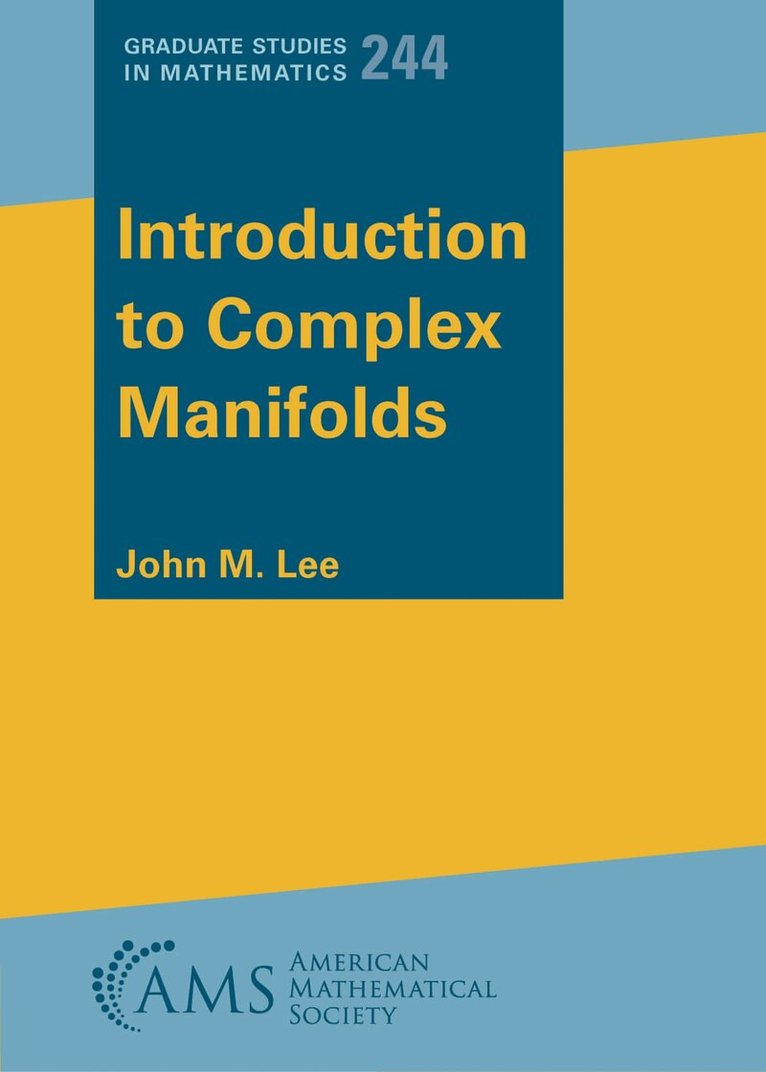
Complex manifolds are smooth manifolds endowed with coordinate charts that overlap holomorphically. They have deep and beautiful applications in many areas of mathematics. This book is an introduction to the concepts, techniques, and main results about complex manifolds (mainly compact ones), and it tells a story. Starting from familiarity with smooth manifolds and Riemannian geometry, it gradually explains what is different about complex manifolds and develops most of the main tools for working with them, using the Kodaira embedding theorem as a motivating project throughout.The approach and style will be familiar to readers of the author's previous graduate texts: new concepts are introduced gently, with as much intuition and motivation as possible, always relating new concepts to familiar old ones, with plenty of examples. The main prerequisite is familiarity with the basic results on topological, smooth, and Riemannian manifolds. The book is intended for graduate students and researchers in differential geometry, but it will also be appreciated by students of algebraic geometry who wish to understand the motivations, analogies, and analytic results that come from the world of differential geometry.
Del 176 - Graduate Texts in Mathematics
Introduction to Riemannian Manifolds
Inbunden, Engelska, 2019
707 kr
Skickas inom 10-15 vardagar
This textbook is designed for a one or two semester graduate course on Riemannian geometry for students who are familiar with topological and differentiable manifolds. The second edition has been adapted, expanded, and aptly retitled from Lee’s earlier book, Riemannian Manifolds: An Introduction to Curvature. Numerous exercises and problem sets provide the student with opportunities to practice and develop skills; appendices contain a brief review of essential background material.While demonstrating the uses of most of the main technical tools needed for a careful study of Riemannian manifolds, this text focuses on ensuring that the student develops an intimate acquaintance with the geometric meaning of curvature. The reasonably broad coverage begins with a treatment of indispensable tools for working with Riemannian metrics such as connections and geodesics. Several topics have been added, including an expanded treatment of pseudo-Riemannianmetrics, a more detailed treatment of homogeneous spaces and invariant metrics, a completely revamped treatment of comparison theory based on Riccati equations, and a handful of new local-to-global theorems, to name just a few highlights.Reviews of the first edition:Arguments and proofs are written down precisely and clearly. The expertise of the author is reflected in many valuable comments and remarks on the recent developments of the subjects. Serious readers would have the challenges of solving the exercises and problems. The book is probably one of the most easily accessible introductions to Riemannian geometry. (M.C. Leung, MathReview) The book’s aim is to develop tools and intuition for studying the central unifying theme in Riemannian geometry, which is the notion of curvature and its relation with topology. The main ideas of the subject, motivated as in the original papers, are introduced here in an intuitive and accessible way…The book is an excellent introduction designed for a one-semester graduate course, containing exercises and problems which encourage students to practice working with the new notions and develop skills for later use. By citing suitable references for detailed study, the reader is stimulated to inquire into further research. (C.-L. Bejan, zBMATH)
E-bok
Engelska, 2019712 kr
Läs direkt efter köp
This textbook is designed for a one or two semester graduate course on Riemannian geometry for students who are familiar with topological and differentiable manifolds. The second edition has been adapted, expanded, and aptly retitled from Lee’s earlier book, Riemannian Manifolds: An Introduction to Curvature. Numerous exercises and problem sets provide the student with opportunities to practice and develop skills; appendices contain a brief review of essential background material.While demonstrating the uses of most of the main technical tools needed for a careful study of Riemannian manifolds, this text focuses on ensuring that the student develops an intimate acquaintance with the geometric meaning of curvature. The reasonably broad coverage begins with a treatment of indispensable tools for working with Riemannian metrics such as connections and geodesics. Several topics have been added, including an expanded treatment of pseudo-Riemannianmetrics, a more detailed treatment of homogeneous spaces and invariant metrics, a completely revamped treatment of comparison theory based on Riccati equations, and a handful of new local-to-global theorems, to name just a few highlights.Reviews of the first edition:Arguments and proofs are written down precisely and clearly. The expertise of the author is reflected in many valuable comments and remarks on the recent developments of the subjects. Serious readers would have the challenges of solving the exercises and problems. The book is probably one of the most easily accessible introductions to Riemannian geometry. (M.C. Leung, MathReview) The book’s aim is to develop tools and intuition for studying the central unifying theme in Riemannian geometry, which is the notion of curvature and its relation with topology. The main ideas of the subject, motivated as in the original papers, are introduced here in an intuitive and accessible way…The book is an excellent introduction designed for a one-semester graduate course, containing exercises and problems which encourage students to practice working with the new notions and develop skills for later use. By citing suitable references for detailed study, the reader is stimulated to inquire into further research. (C.-L. Bejan, zBMATH)