John Michael Priest – författare
Visar alla böcker från författaren . Handla med fri frakt och snabb leverans.
4 produkter
4 produkter
Häftad, Engelska, 2025
324 kr
Skickas inom 3-6 vardagar
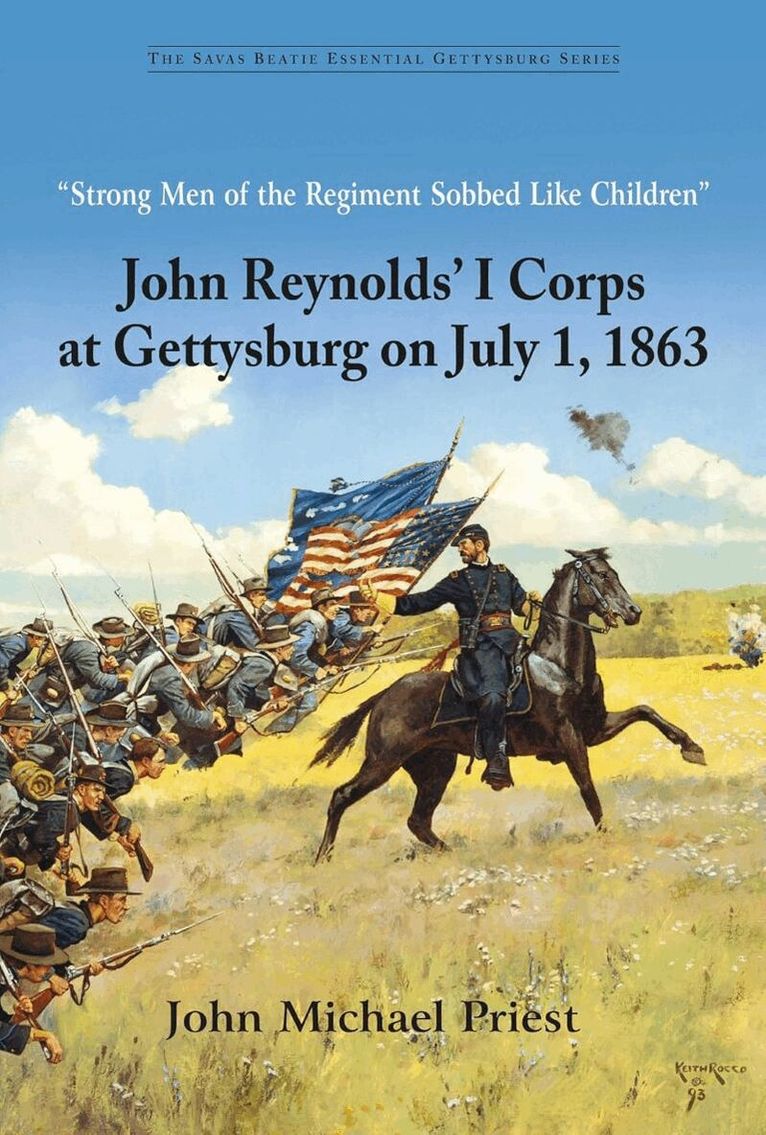
The fighting on the first day at Gettysburg on July 1, 1863, was unexpected, heavy, confusing, and in many ways, decisive. Much of it consisted of short and often separate simultaneous engagements or “firefights,” a term soldiers often use to describe close, vicious, and bloody combat. Several books have studied this important inaugural day of Gettysburg, but none have done so from the perspective of the rank and file of both armies. Now in paperback, John Michael Priest’s “Strong Men of the Regiment Sobbed Like Children”: John Reynolds’ I Corps at Gettysburg on July 1, 1863 rectifies this oversight in splendid style.When dawn broke on July 1, no one on either side could have conceived what was about to take place. Anticipating a fight and with a keen appreciation for terrain, Brig. Gen. John Buford deployed his Union cavalry in a giant arc north and west of Gettysburg to slow down any Confederate advance until Maj. Gen. John Reynolds could bring up his infantry. By the time the foot soldiers of the I Corps arrived, A. P. Hill’s heavy Confederate formations had pushed back the troopers from the west. Richard Ewell’s troops would soon arrive from the north, threatening the town and its key road network. Reynolds, who would die early in the fighting, poured his troops in as they arrived. The road system and undulating ground broke up command control, and the various ridges, tall ground cover, and powder smoke made target recognition difficult. Brigades and regiments often engaged on their own initiatives without the direction of a division or corps commander. The men of both armies fought with determination born of desperation, valor, and fear. By the time the fighting ended, the I Corps was in shambles and in pell-mell retreat for Cemetery Hill. Its bold stand, together with the XI Corps north of town, bought precious hours for the rest of the Army of the Potomac to arrive and occupy good defensive ground.Priest, who Edwin Bearss hailed as “the Ernie Pyle of the Civil War,” spent a decade researching this study and walking the ground to immerse readers into the uncertain world of the rank-and-file experience. He consulted more than 300 primary sources, including letters, diaries, memoirs, newspaper accounts, recollections, casualty lists, and drill manuals to present the battle from the ground up. Nineteen detailed regimental-level maps illustrate the ebb and flow of the battle. The result is a fast-paced narrative sure to please the most demanding students of the Civil War. The footnotes alone are worth the price of admission.Readers will close the book with a full understanding of why a veteran New Yorker spoke for the survivors of both armies when he wrote, “Strong men of the regiment sobbed like children.”
E-bok
Engelska, 2014228 kr
Läs direkt efter köp
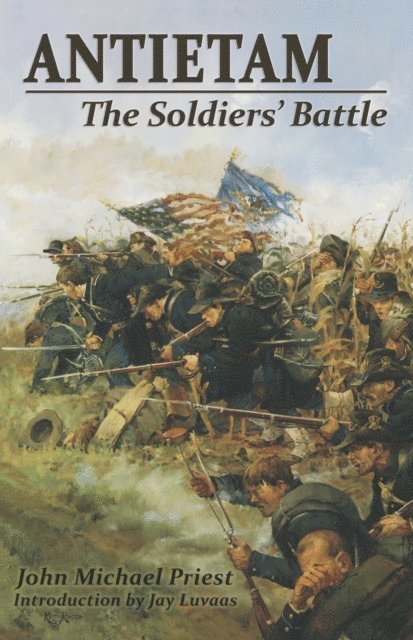
“The best battlefield first-person compilation I have read . . . Here it all is—the tactics, the movement, the truth about warfare.” —The Civil War TimesIn Antietam: The Soldiers’ Battle, historian John Michael Priest tells this brutal tale of slaughter from an entirely new point of view: that of the common enlisted man. Concentrating on the days of actual battle—September 16, 17, and 18, 1862—Priest vividly brings to life the fear, the horror, and the profound courage that soldiers displayed, from the first Federal cavalry probe of the Confederate lines to the last skirmish on the streets of Sharpsburg. Antietam is not a book about generals and their grand strategies, but rather concerns men such as the Pennsylvanian corporal who lied to receive the Medal of Honor; the Virginian who lay unattended on the battlefield through most of the second day of fighting, his arm shattered from a Union artillery shell; the Confederate surgeon who wrote to the sweetheart he left behind enemy lines in Harrisburg, Pennsylvania that he had seen so much death and suffering that his “head had whitened and my very soul turned to stone.”Besides being a gripping tale charged with the immediacy of firsthand accounts of the fighting, Antietam also dispels many misconceptions long held by historians and Civil War buffs alike. Seventy-two detailed maps—which describe the battle in the hourly and quarter-hourly formats established by the Cope Maps of 1904—together with rarely-seen photographs and his own intimate knowledge of the Antietam terrain, allow Priest to offer a substantially new interpretation of what actually happened.
E-bok
Engelska, 2014143 kr
Läs direkt efter köp
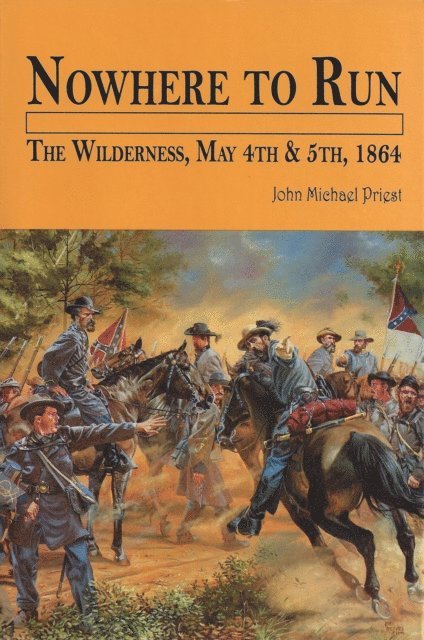
An immersive Civil War history, Nowhere to Run is a riveting account of the one of the most devasting battles between the Union and Confederate armies. At 12:00 a.m. on May 4, 1864, Ulysses S. Grant and George G. Meade''s Army of the Potomac began crossing the Rapidan River in an effort to turn the strategic right flank of Robert E. Lee''s Army of Northern Virginia. Confederate reaction was swift. Richard E. Ewell''s Second Corps and Ambrose P. Hill''s Third Corps moved to meet the advancing Union infantry, artillery, and cavalry in the heavy terrain known simply as "The Wilderness," a sprawling area of second growth scrub oak, brush, and gullies, interspersed with meandering creeks in Virginia. Inside this difficult terrain one of the largest and bloodiest battles would consume two days and thousands of men. Nowhere to Run is the story of the men and their officers who fought and died in the horrific fighting. With Civil War historian John Michael Priest''s customary thoroughness, specially drawn maps, and extensive documentation, readers will experience the battles just as the men themselves saw it, and wrote about it, from their own eyes and their own pens.
Häftad, Engelska, 2016
178 kr
Tillfälligt slut
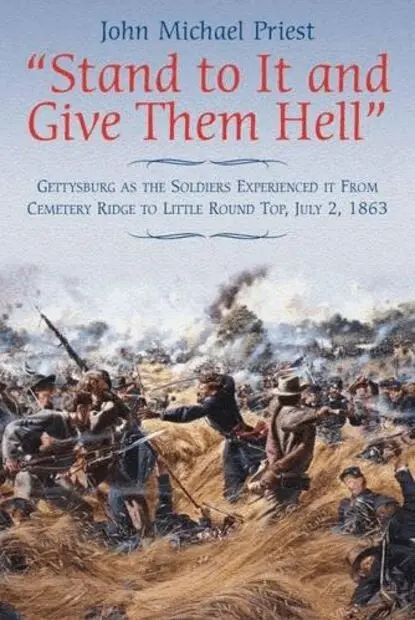
This is unlike any other Gettysburg book you will ever read. Instead of a dry recitation of the facts, “Stand to It and Give Them Hell”: Gettysburg as the Soldiers Experienced it from Cemetery Ridge to Little Round Top, July 2, 1863 chronicles the desperate marching, fighting, command decisions, and suffering as depicted in the letters, memoirs, diaries, and postwar recollections of the men from both armies who struggled to control that “hallowed ground.” This invaluable methodology uses the words of those who lived these events to paint a rich tapestry of personal courage, cowardice, failures, and triumphs.John Michael Priest, dubbed the “Ernie Pyle” of the Civil War soldier by legendary historian Edwin C. Bearss, wrote this book to help readers understand and experience, as closely as possible through the written word, the stress, exhaustion, suffering, and sheer terror of that fateful day in Pennsylvania. Readers of all interest levels will gain a deeper appreciation of the personal sacrifice made by privates and generals alike.The hundreds of word portraits are supported by 58 detailed original maps, most on the regimental level. In addition to illustrating the tremendous troop congestion in the Wheatfield, the Peach Orchard, and Devil’s Den, they accurately establish, by regiment or by company, the extent of the Federal skirmish line from Ziegler’s Grove to the Slyder farm, and portray the final Confederate push against the Codori farm and the center of Cemetery Ridge, against which three Confederate divisions (in what is popularly known as Pickett’s Charge) would unsuccessfully attack on the final day of fighting on July 3.“Stand to It and Give Them Hell” is a book about combat as seen through the eyes of those who waged it. There is no glamour here, and no adventure. Nor are there accusations, axes to grind, or second-guessing from the comfort of an easy chair. Instead, Priest’s most ambitious book offers the brutal, heart wrenching story of a slice of America’s greatest battle as described by those who marched, fought, bled, and died there. These are their stories, and ones you will long remember.