John N Kallianiotis – författare
Visar alla böcker från författaren . Handla med fri frakt och snabb leverans.
5 produkter
5 produkter
4 198 kr
Läs direkt efter köp
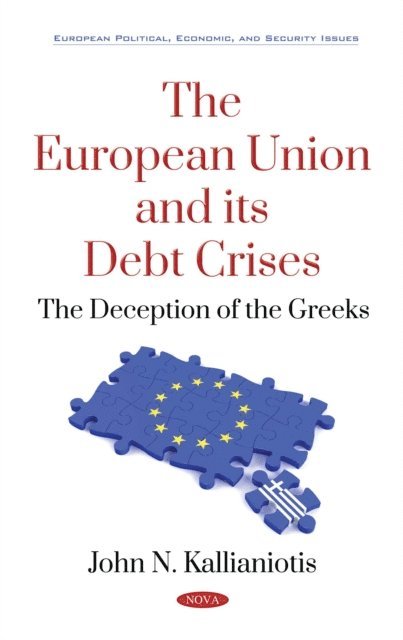
The latest global financial crisis has troubled the United States and caused very bad debt crises in many Eurozone member nations due to their integration, common currency, and public policies, but with different economic structures among themselves. The European Union and its Debt Crises: The Deception of the Greeks provides readers with in-depth historical, structural, political, and practical knowledge of the European Union, the Eurozone, and how to confront the latest financial, economic, and social problems. The literature has been enormous on this unique debt crisis for the last eight years, but this book goes beyond the theoretical arguments of different outsider technocrats and gives details concerning the role of the EU institutions, the role of the EU member governments (especially of Greece, which has been deceived so much and for so many years by three different political parties in its government), the role of the Troika (Eurogroup, ECB, IMF, and later the Quartet), and the effects of the crises on the poor European citizens. These crises have unfortunately continued and reanimated recently in Italy. This book also discusses the ineffectiveness of the common public policies, the loss of sovereignty, and the challenges for the future of these "e;structures"e;, the EU and EMU. It also outlines some policy suggestions and recommendations for the European - primarily Greek - citizens in this globalized world, which is becoming more strenuous each day.
E-bok
PDF, Engelska, 20194 400 kr
Läs direkt efter köp
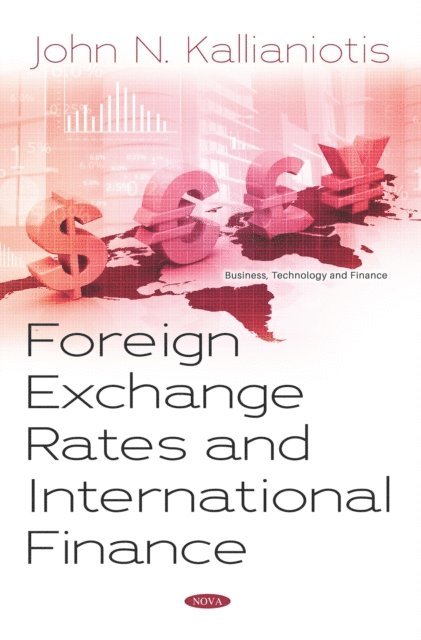
This book deals with international finance and the role of the foreign exchange rates in our economies. It is constituted from twelve chapters, from the history of our monetary system to the balance of payments and from the exchange rates to multinational businesses and their management. The internationalization of business, the interdependence and conflicts among nations, the enormous capital mobility, the foreign exchange market that provides the payments and instruments for all these international transactions, the risk that is involved among markets, economies, and businesses all require studies, instruments, insurance policies, management, correct public policies, and empirical work on international financial transactions, cultures, and the different value systems, so a finance or political science (undergraduate or graduate) student, a professional, a trader, or any other individual interested in international business could be able to deal with all these conflicts, challenges, and adversities, which their trend is incremental. Also, the role of the exchange rate and trade policies in improving the trade account and the social welfare of the country’s citizens are considered and examined in detail. Further, the determination and forecasting of the exchange rate are analyzed by using economic theories, mathematics and statistical models. The foreign exchange exposure (risk) is measured and managed by using hedging techniques. The multinational corporations and their cost of capital is covered extensively. The multinational capital budgeting of our MNCs is taking place and the criteria of evaluating the foreign projects are discussed, too. The foreign direct investments (FDI), which increase business, income, and employment in the host countries, the international portfolio theory and its effect on risk minimization from this global diversification are analyzed. The sources and instruments of financing international trade and multinational corporations are presented with the role of commercial banks, money market, and international transportation. Lastly, the political risk involved in different countries is covered and assessed. Thus, this book can be used by itself as a complete text on international finance or can be employed to supplement a reference book devoted to international finance, multinational business, or international financial economics.
E-bok
PDF, Engelska, 20201 548 kr
Läs direkt efter köp
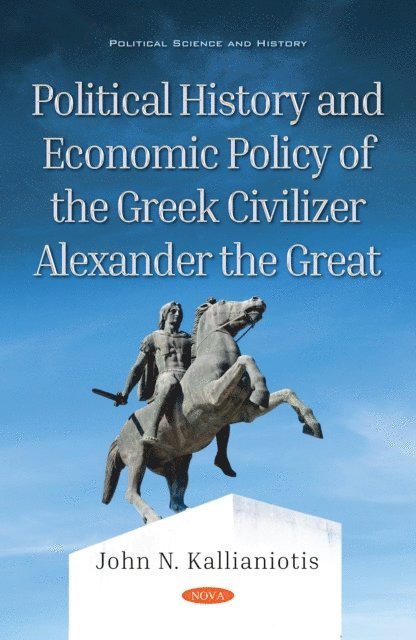
This book deals with Alexander’s the Great (Μέγας Ἀλέξανδρος; 356-323 B.C.) campaign in Asia and measures his revenues and expenses during these wars by taking information from different historians of his time and it uses the current value of gold to translate these measurements inτο U.S. dollar. Alexander had to exercise an efficient and effective public policy (revenue and spending) for his vast Empire and to satisfy all his citizens as a Hellenic civilizer and not as a conqueror. The book examines the Hellenic values, which made Alexander one of the most important people in human history. He was a student of the greatest of philosophers Aristotle (Ἀριστοτέλης) and for this reason he had shown outstanding management and military capabilities used even today my military schools. His efficiencies with rates of salaries, health and welfare, building projects, supplies, transports, reforms of the tax system, indirect taxes and donations, loans, minting of coins; even his dealing with financial scandals and other actions are information useful for our policy makers, today. The book presents also Alexander’s contribution to the world as the greatest civilizer and preparer of the ground for the expected “Unknown God”. Alexander’s political history and economic policy is very useful for our current leaders and scholars (historians, political scientist, economists, generals, and others). Further, the current politics of the region are covered to give to the reader a better idea of the true history of the glorious past and the strange (suspicious) conflicts of the present. Finally, some useful information on numismatics (currency, coins, and their values) from his time is given, so we can compare prices, wages, and exchange rates with respect of the U.S. dollar and the Greek drachma.
Inbunden, Engelska, 2026
3 476 kr
Skickas
E-bok
PDF, Engelska, 20264 807 kr
Läs direkt efter köp
Foreign Exchange Rates and International Finance (Second Edition) includes updated information on economic, financial, and global events that have taken place in the past six years. It can be used by international financial market traders and practitioners, global company executives, and policymakers as well as undergraduate and graduate students. This book aims to equip current and future leaders in business, banking, and finance with mathematics, statistics, econometrics and data sources that they need to analyze, measure, and forecast international variables. Readers will learn about the history of the monetary system and different currencies, the balance of payments and the problems of the trade deficits, and policies to improve imbalances. The analysis of foreign exchange markets, exchange rates and their determination as well as models to forecast the exchange rates are covered extensively, together with the efficiency of these markets. International parity conditions and exchange rate expectations provide important relations between countries, useful for traders, arbitragers, and speculators. Foreign currency derivatives and their use to manage (hedge) the exchange rate risk are described with practical applications for business managers. Furthermore, the management of multinational corporations (MNCs), their cost of capital, and capital structure are described and mathematically examined. A multinational capital budget is analyzed with its rules, criteria, and an empirical example from the point of view of the project. The foreign direct investment and the motives of a MNC to go abroad are evaluated together with the domestic and international portfolio theory. Finally, international trade instruments, finance and insurance are examined as well as the political risk that MNCs face by doing business in foreign countries and how to measure and manage this risk.