John P McCaskey - Böcker
Visar alla böcker från författaren John P McCaskey. Handla med fri frakt och snabb leverans.
4 produkter
4 produkter
1 762 kr
Kommande
Charts the historical development of induction and challenges contemporary understandings of the concept and its foundations.The problem of induction continues to vex and beguile. How can we reliably draw universal conclusions from limited observations? In Induction, John P. McCaskey steps back and rethinks long-held assumptions, tracing the ideas of Socrates and Aristotle in ancient Greece to those of Karl Popper in the twentieth century.This comprehensive account does not look at how people of the past answered the questions we ask today. Instead, it asks: How did they understand the very meaning of the words epagōgē in Greek, inductio in Latin, istiqrāʾ in Arabic, Induktion in German, and induction in English? McCaskey’s careful treatment of texts in their context dispels many long-standing myths, and importantly, he introduces us to a now-unfamiliar way to think about what induction is—a way in which there simply is no “problem of induction.” McCaskey reveals that the problem was one of our own making and that an accurate history may help us recover old ways—and thereby introduce new ways—to think about the whole idea. A must-read for philosophers, historians of ideas, and anyone interested in the scientific method.
629 kr
Kommande
Charts the historical development of induction and challenges contemporary understandings of the concept and its foundations.The problem of induction continues to vex and beguile. How can we reliably draw universal conclusions from limited observations? In Induction, John P. McCaskey steps back and rethinks long-held assumptions, tracing the ideas of Socrates and Aristotle in ancient Greece to those of Karl Popper in the twentieth century.This comprehensive account does not look at how people of the past answered the questions we ask today. Instead, it asks: How did they understand the very meaning of the words epagōgē in Greek, inductio in Latin, istiqrāʾ in Arabic, Induktion in German, and induction in English? McCaskey’s careful treatment of texts in their context dispels many long-standing myths, and importantly, he introduces us to a now-unfamiliar way to think about what induction is—a way in which there simply is no “problem of induction.” McCaskey reveals that the problem was one of our own making and that an accurate history may help us recover old ways—and thereby introduce new ways—to think about the whole idea. A must-read for philosophers, historians of ideas, and anyone interested in the scientific method.
282 kr
Skickas inom 7-10 vardagar
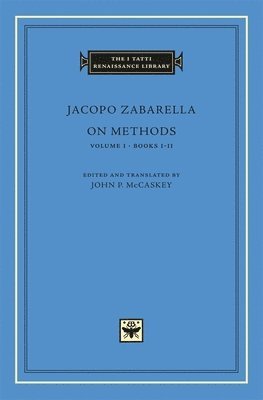
Jacopo Zabarella's two treatises On Methods and On Regressus (1578) are among the most important Renaissance discussions of how scientific knowledge should be acquired, arranged, and transmitted. They belong to a lively debate about the order in which sciences should be taught and the method to be followed in scientific demonstration that roiled the Late Renaissance world for decades. In these famous works Zabarella rejected the views of Ramists and modern Galenists in favor of the pure doctrine of Aristotle, freed from misunderstandings foisted upon it by medieval interpreters. The influence of these works on Galileo's scientific method and Descartes' famous Discourse on Method (1637) has long been debated. They are here translated into English for the first time, along with a new Latin text based on the corrected 1586 edition.Volume 1 contains On Methods, Books I-II. Volume 2 contains On Methods, Books III-IV, and On Regressus.
282 kr
Skickas inom 7-10 vardagar
Jacopo Zabarella's two treatises On Methods and On Regressus (1578) are among the most important Renaissance discussions of how scientific knowledge should be acquired, arranged, and transmitted. They belong to a lively debate about the order in which sciences should be taught and the method to be followed in scientific demonstration that roiled the Late Renaissance world for decades. In these famous works Zabarella rejected the views of Ramists and modern Galenists in favor of the pure doctrine of Aristotle, freed from misunderstandings foisted upon it by medieval interpreters. The influence of these works on Galileo's scientific method and Descartes' famous Discourse on Method (1637) has long been debated. They are here translated into English for the first time, along with a new Latin text based on the corrected 1586 edition.Volume 1 contains On Methods, Books I-II. Volume 2 contains On Methods, Books III-IV, and On Regressus.