John Protevi - Böcker
Visar alla böcker från författaren John Protevi. Handla med fri frakt och snabb leverans.
11 produkter
11 produkter
2 648 kr
Skickas inom 5-8 vardagar
Political Physics analyses the work of two of the most influential thinkers of our time - Jacques Derrida and Gilles Deleuze. The book takes the reader on a transversal journey, crossing the boundaries of philosophy and science.Political Physics explores the limits and strengths of Derridean and Deleuzean philosophical approaches. Focussing on their differing approaches to the question of the 'body politic' - in all its registers, from the physical-chemical body, to the economic, the social and the political body - the book reveals a profound difference in ontological commitment. The book argues that the straightforward materialism of Deleuzean philosophy can operate across the range of analysis whereas Derridean deconstruction effectively operates at the level of reason, consciousness and culture.Cross-cutting a Derridean analysis of the history of philosophy with a Deleuzian approach to creative dialogue and complexity theory, Political Physics illuminates the value of both approaches to the analysis of contemporary culture, politics and science and to the rereading of the history of ideas.
1 719 kr
Skickas inom 5-8 vardagar
Political Physics analyses the work of two of the most influential thinkers of our time - Jacques Derrida and Gilles Deleuze. The book takes the reader on a transversal journey, crossing the boundaries of philosophy and science.Political Physics explores the limits and strengths of Derridean and Deleuzean philosophical approaches. Focussing on their differing approaches to the question of the 'body politic' - in all its registers, from the physical-chemical body, to the economic, the social and the political body - the book reveals a profound difference in ontological commitment. The book argues that the straightforward materialism of Deleuzean philosophy can operate across the range of analysis whereas Derridean deconstruction effectively operates at the level of reason, consciousness and culture.Cross-cutting a Derridean analysis of the history of philosophy with a Deleuzian approach to creative dialogue and complexity theory, Political Physics illuminates the value of both approaches to the analysis of contemporary culture, politics and science and to the rereading of the history of ideas.
1 724 kr
Tillfälligt slut
The first ever dictionary of continental philosophy to be published.With over 450 clearly written definitions and articles by an international team of specialists, this authoritative dictionary covers the thinkers, topics and technical terms associated with the many fields known as 'continental' philosophy’. Special care has been taken to explain the complex terminology of many continental thinkers. Researchers, students and professional philosophers alike will find the dictionary an invaluable reference tool.Key features include:*in-depth entries on major figures and topics*over 190 shorter articles on other figures and topics*over 250 items on technical terms used by continental thinkers, from abjection [Kristeva] to worldhood [Heidegger]*coverage of related subjects that use continental terms and methods*extensive cross-referencing, allowing readers to relate and pursue ideas in depth.Entries include: Major Figures and Topics: Deleuze, Derrida, Foucault, Hegel, Heidegger, Husserl, Irigaray, Kant, NietzscheEpistemology, Feminism, German Idealism, Marxism, Phenomenology, Poststructuralism, Time, etc.Other figures and topics covered include: Adorno, Althusser, Arendt, Badiou, Barthes, Bergson, Butler, Haraway, Habermas, Kristeva, Merleau-Ponty, Sartre, Schelling, Schiller, Weber, Weil, Wittgenstein, Zizek, etc;African Philosophy, Cognitive Science, Death, Ecocriticism, Embodiment, Environmental Philosophy, Modernity, Philosophy of Nature, NeoThomism, Postcolonial Theory, Psychology, Race Theory, Sex / sexuality, Space, Speech Act Theory, Structuralism, Subject, ‘Young Hegelians’, etc.
472 kr
Skickas
The first ever dictionary of continental philosophy to be published.With over 450 clearly written definitions and articles by an international team of specialists, this authoritative dictionary covers the thinkers, topics and technical terms associated with the many fields known as 'continental' philosophy’. Special care has been taken to explain the complex terminology of many continental thinkers. Researchers, students and professional philosophers alike will find the dictionary an invaluable reference tool.Key features include:*in-depth entries on major figures and topics*over 190 shorter articles on other figures and topics*over 250 items on technical terms used by continental thinkers, from abjection [Kristeva] to worldhood [Heidegger]*coverage of related subjects that use continental terms and methods*extensive cross-referencing, allowing readers to relate and pursue ideas in depth.Entries include: Major Figures and Topics: Deleuze, Derrida, Foucault, Hegel, Heidegger, Husserl, Irigaray, Kant, NietzscheEpistemology, Feminism, German Idealism, Marxism, Phenomenology, Poststructuralism, Time, etc.Other figures and topics covered include: Adorno, Althusser, Arendt, Badiou, Barthes, Bergson, Butler, Haraway, Habermas, Kristeva, Merleau-Ponty, Sartre, Schelling, Schiller, Weber, Weil, Wittgenstein, Zizek, etc;African Philosophy, Cognitive Science, Death, Ecocriticism, Embodiment, Environmental Philosophy, Modernity, Philosophy of Nature, NeoThomism, Postcolonial Theory, Psychology, Race Theory, Sex / sexuality, Space, Speech Act Theory, Structuralism, Subject, ‘Young Hegelians’, etc.
705 kr
Skickas inom 3-6 vardagar
This is the first book to use complexity theory to open up the ‘geophilosophy’ developed by Gilles Deleuze and Félix Guattari in A Thousand Plateaus, Anti-Oedipus and What is Philosophy?. Written by a philosopher and a geographer in a clear style, with a practical orientation and interdisciplinary focus, the Guide enables readers to grasp the basics of complexity theory (the study of self-organisation and emergence in material systems), while the Glossary eases the difficulty of applying this science to Deleuze and Guattari’s often perplexing terminology. Deleuze and Geophilosophy is thoroughly pragmatic: it asks not what the earth means, but how it works. It provides a common conceptual framework within which physical and human geographers can work together alongside other social scientists, cultural studies practitioners, and philosophers in interdisciplinary teams to explore the entangled flows, lines, grids, and spaces of our world. The book will be of interest to all those working in disciplines at the intersections of culture, nature, space, and history: anthropology, art and architecture theory, communication studies, geography, Marxism and historical materialism, philosophy, postcolonial theory, urban studies, and many other disciplines.Key Features:*Explores a new aspect of Deleuzian thought - 'geophilosophy' (geography & philosophy) *The first part of the book explains the basics of complexity theory*Half of the book is a Glossary which helps readers with Deleuze and Guattari's perplexing terminology*Emphasis on ‘bodies politic’ in geophilosophy and complexity theory which has never before been linked in such a way
287 kr
Skickas inom 10-15 vardagar
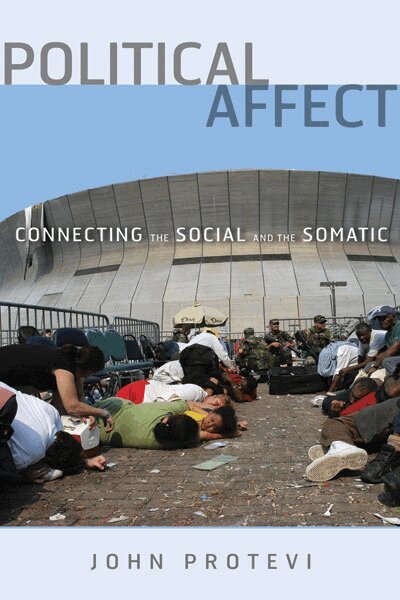
For many philosophers, the rational cognitive (Cartesian) subject defines the human, or at least defines what humans should be. Yet some recent cognitive science, as well as the philosophy of Deleuze and Guattari, has called into question such individuality and rationality and emphasized social and emotional subjectivity. Understanding such embodied and embedded subjectivity, John Protevi argues, demands the notion of bodies politic.In Political Affect, Protevi investigates the relationship between the social and the somatic: how our bodies, minds, and social settings are intricately and intimately linked. Bringing together concepts from science, philosophy, and politics, he develops a perspective he calls political physiology to indicate that subjectivity is socially conditioned and sometimes bypassed in favor of a direct connection of the social and the somatic, as with the politically triggered basic emotions of rage and panic. Protevi's treatment of affective cognition in social context breaks new theoretical ground, insisting that subjectivity be studied both in its embodied expression and in terms of the distribution of affective cognitive responses in a population.Moving beyond the theoretical, Protevi applies his concept of political affect to show how unconscious emotional valuing shaped three recent, emotionally charged events: the cold rage of the Columbine High School slayings, the racialized panic that delayed rescue efforts in Hurricane Katrina, and the twists and turns of empathy occasioned by the Terry Schiavo case. These powerful individual and collective political events require new philosophical understanding.
1 009 kr
Skickas inom 10-15 vardagar
Gilles Deleuze and Jacques Derrida are the two leading philosophers of French post-structuralism. Both theorists have been widely studied but very little has been done to examine the relation between them. Between Deleuze and Derrida is the first book to explore and compares their work. This is done via a number of key themes, including the philosophy of difference, language, memory, time, event, and love, as well as relating these themes to their respective approaches to Philosophy, Literature, Politics and Mathematics. Contributors: Eric Alliez, Branka Arsic, Gregg Lambert, Leonard Lawlor, Alphonso Lingis, Tamsin Lorraine, Jeff Nealon, Paul Patton, Arkady Plotnitsky, John Protevi, Daniel W. Smith
535 kr
Skickas inom 10-15 vardagar
This book argues that thinking is bounded by neither the brain nor the skin of an organism. Cognitive systems function through integration of neural and bodily functions with the functions of representational vehicles. The integrationist position offers a fresh contribution to the emerging embodied and embedded approach to the study of mind.
125 kr
Skickas inom 7-10 vardagar
Using philosophical and scientific work to engage the perennial question of human nature This book takes a look at the formation, and edges, of states: their breakdowns and attempts to repair them, and their encounters with non-state peoples. It draws upon anthropology, political philosophy, neuroscience, evolutionary biology, child developmental psychology, and other fields to look at states as projects of constructing “bodies politic,” where the civic and the somatic intersect. John Protevi asserts that humans are predisposed to “prosociality,” or being emotionally invested in social partners and patterns. With readings from Jean-Jacques Rousseau and James C. Scott; a critique of the assumption of widespread pre-state warfare as a selection pressure for the evolution of human prosociality and altruism; and an examination of the different “economies of violence” of state and non-state societies, Edges of the State sketches a notion of prosocial human nature and its attendant normative maxims.Forerunners: Ideas FirstShort books of thought-in-process scholarship, where intense analysis, questioning, and speculation take the lead
1 191 kr
Skickas inom 7-10 vardagar
A wide-ranging examination of the roots-and possible future-of violence in human societiesIs aggression inevitable among humans? In Regimes of Violence, John Protevi explores how human violence originates and exists in our societies. Taking humans as biocultural (that is, our social practices shape our bodies and minds), he shows how aggression does not arrive from any purely biological predisposition but rather occurs only in social regimes of violence that, by manipulating the ways in which culture can shape our biological inheritance of rage and aggression, condition the forms of violence able to be expressed at any one time. Offering detailed insights into human aggression throughout history, Protevi’s analysis ranges from evolutionary psychology to affective ideology and finally to an alternate politics of joy. He examines a wide range of seemingly disparate topics, such as cooperation between early nomadic foragers, organized sports, berserkers and blackout rages, the experiences of maroons escaping slavery, the January 6 invasion of the United States Capitol building, and responses to the Covid-19 pandemic. As he entwines the philosophical with the anthropological, he asks readers to consider why humans’ capacity for cooperation and sharing is so persistently overlooked by stories that focus on aggression and warfare. Regimes of Violence is an important contribution to studies of Deleuze and Guattari, uniquely combining cutting-edge investigations in psychology, history, evolutionary theory, cultural anthropology, and philosophy to examine the “political philosophy of the mind.” Presenting to readers a refreshingly optimistic perspective, Protevi demonstrates that we are not doomed to war and argues that humans can build a world based on antifascism, joy, and mutual empowerment.
283 kr
Skickas inom 7-10 vardagar
A wide-ranging examination of the roots-and possible future-of violence in human societiesIs aggression inevitable among humans? In Regimes of Violence, John Protevi explores how human violence originates and exists in our societies. Taking humans as biocultural (that is, our social practices shape our bodies and minds), he shows how aggression does not arrive from any purely biological predisposition but rather occurs only in social regimes of violence that, by manipulating the ways in which culture can shape our biological inheritance of rage and aggression, condition the forms of violence able to be expressed at any one time. Offering detailed insights into human aggression throughout history, Protevi’s analysis ranges from evolutionary psychology to affective ideology and finally to an alternate politics of joy. He examines a wide range of seemingly disparate topics, such as cooperation between early nomadic foragers, organized sports, berserkers and blackout rages, the experiences of maroons escaping slavery, the January 6 invasion of the United States Capitol building, and responses to the Covid-19 pandemic. As he entwines the philosophical with the anthropological, he asks readers to consider why humans’ capacity for cooperation and sharing is so persistently overlooked by stories that focus on aggression and warfare. Regimes of Violence is an important contribution to studies of Deleuze and Guattari, uniquely combining cutting-edge investigations in psychology, history, evolutionary theory, cultural anthropology, and philosophy to examine the “political philosophy of the mind.” Presenting to readers a refreshingly optimistic perspective, Protevi demonstrates that we are not doomed to war and argues that humans can build a world based on antifascism, joy, and mutual empowerment.