John R. Barker – författare
Visar alla böcker från författaren . Handla med fri frakt och snabb leverans.
5 produkter
5 produkter
Del 251 - NATO Science Series B:
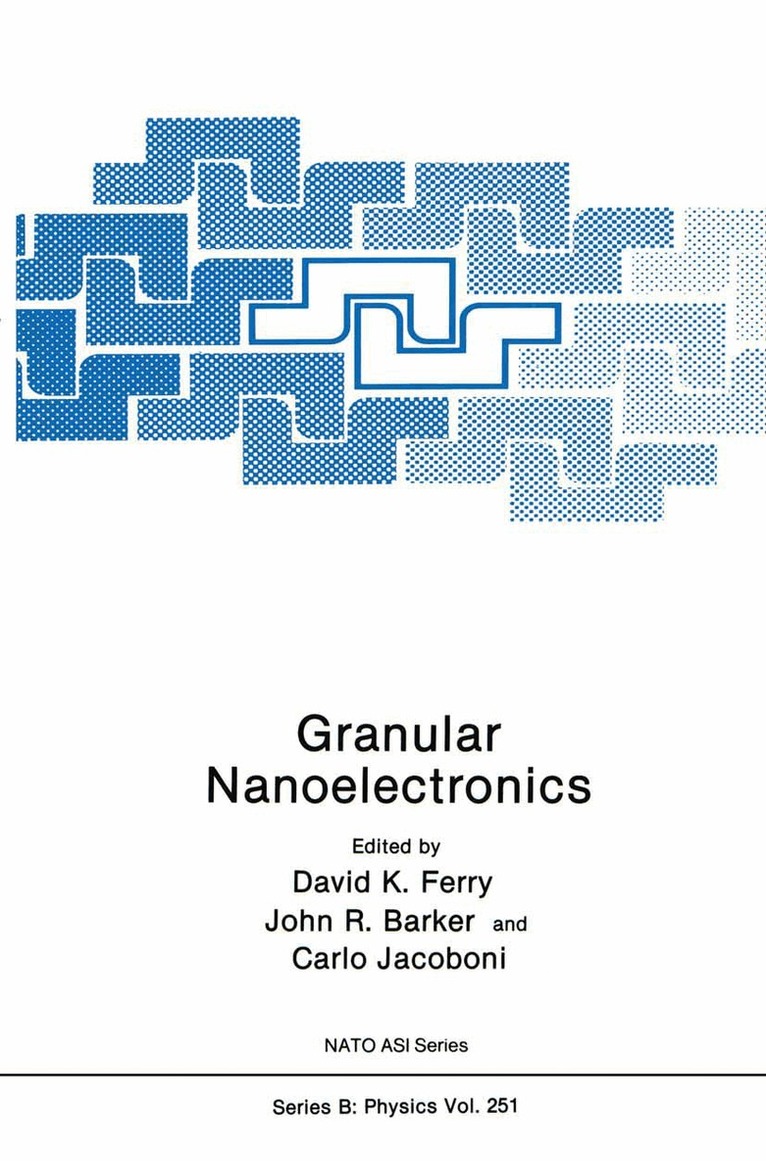
Granular Nanoelectronics
Inbunden, Engelska, 1991
2 166 kr
Skickas inom 10-15 vardagar
The technological means now exists for approaching the fundamentallimiting scales of solid state electronics in which a single carrier can, in principle, represent a single bit in an information flow. In this light, the prospect of chemically, or biologically, engineered molccular-scale structures which might support information processing functions has enticed workers for many years. The one common factor in all suggested molecular switches, ranging from the experimentally feasible proton-tunneling structure, to natural systems such as the micro-tubule, is that each proposed structure deals with individual information carrying entities. Whereas this future molecular electronics faces enormous technical challenges, the same Iimit is already appearing in existing semiconducting quantum wires and small tunneling structures, both superconducting and normal meta! devices, in which the motion of a single eh arge through the tunneling barrier can produce a sufficient voltage change to cut-off further tunneling current. We may compare the above situation with today's Si microelectronics, where each bit is encoded as a very !arge number, not necessarily fixed, of electrons within acharge pulse. The associated reservoirs and sinks of charge carriers may be profitably tapped and manipulated to proviele macro-currents which can be readily amplified or curtailed. On the other band, modern semiconductor ULSI has progressed by adopting a linear scaling principle to the down-sizing of individual semiconductor devices.
E-bok
PDF, Engelska, 20132 833 kr
Läs direkt efter köp
The technological means now exists for approaching the fundamentallimiting scales of solid state electronics in which a single carrier can, in principle, represent a single bit in an information flow. In this light, the prospect of chemically, or biologically, engineered molccular-scale structures which might support information processing functions has enticed workers for many years. The one common factor in all suggested molecular switches, ranging from the experimentally feasible proton-tunneling structure, to natural systems such as the micro-tubule, is that each proposed structure deals with individual information carrying entities. Whereas this future molecular electronics faces enormous technical challenges, the same Iimit is already appearing in existing semiconducting quantum wires and small tunneling structures, both superconducting and normal meta! devices, in which the motion of a single eh arge through the tunneling barrier can produce a sufficient voltage change to cut-off further tunneling current. We may compare the above situation with today''s Si microelectronics, where each bit is encoded as a very !arge number, not necessarily fixed, of electrons within acharge pulse. The associated reservoirs and sinks of charge carriers may be profitably tapped and manipulated to proviele macro-currents which can be readily amplified or curtailed. On the other band, modern semiconductor ULSI has progressed by adopting a linear scaling principle to the down-sizing of individual semiconductor devices.
Del 251 - NATO Science Series B:
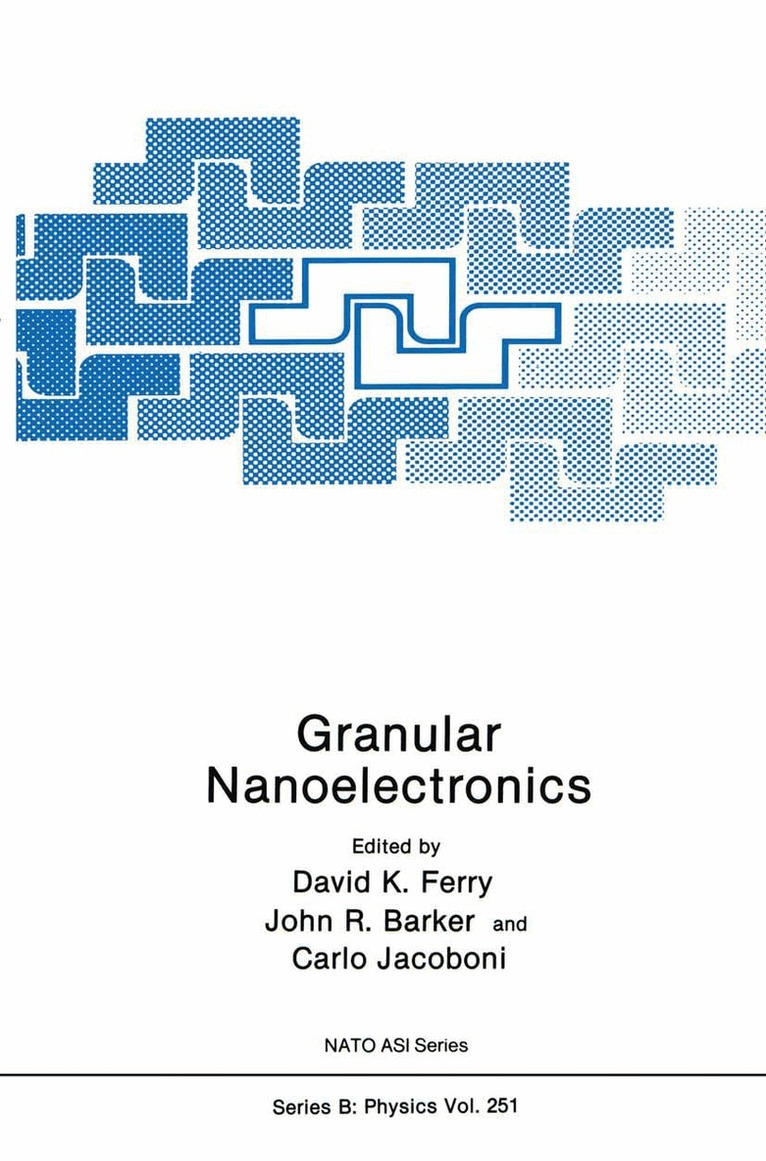
Granular Nanoelectronics
Häftad, Engelska, 2014
2 157 kr
Skickas inom 10-15 vardagar
The technological means now exists for approaching the fundamentallimiting scales of solid state electronics in which a single carrier can, in principle, represent a single bit in an information flow. In this light, the prospect of chemically, or biologically, engineered molccular-scale structures which might support information processing functions has enticed workers for many years. The one common factor in all suggested molecular switches, ranging from the experimentally feasible proton-tunneling structure, to natural systems such as the micro-tubule, is that each proposed structure deals with individual information carrying entities. Whereas this future molecular electronics faces enormous technical challenges, the same Iimit is already appearing in existing semiconducting quantum wires and small tunneling structures, both superconducting and normal meta! devices, in which the motion of a single eh arge through the tunneling barrier can produce a sufficient voltage change to cut-off further tunneling current. We may compare the above situation with today's Si microelectronics, where each bit is encoded as a very !arge number, not necessarily fixed, of electrons within acharge pulse. The associated reservoirs and sinks of charge carriers may be profitably tapped and manipulated to proviele macro-currents which can be readily amplified or curtailed. On the other band, modern semiconductor ULSI has progressed by adopting a linear scaling principle to the down-sizing of individual semiconductor devices.
Del 3 - ADVANCED SERIES IN PHYSICAL CHEMISTRY
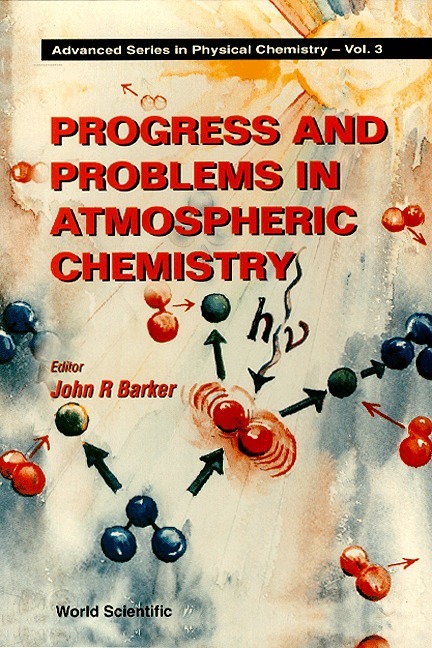
PROGRESS AND PROBLEMS IN ATMOSPHERIC CHEMISTRY
Inbunden, Engelska, 1995
5 368 kr
Tillfälligt slut
Atmospheric chemistry is central to understanding global changes — ozone depletion, appearance of the polar ozone holes, and compositional changes which worsen the greenhouse effect. Because of its importance, work is progressing on many fronts.This volume emphasizes the troposhere and stratosphere and has chapters on gas phase, condensed phase, and heterogeneous chemistry. Present progress is emphasized, and important future directions are also described.This book fills a need not satisfied by any others and will be popular for some years to come. It informs students and newcomers to the field of the many facets of atmospheric chemistry and can be used as a text for advanced students. It is also a valuable desk reference summarizing activities by quite a number of the most active research groups.Chapter 18 by Kolb et al. on heterogeneous chemistry is especially noteworthy because it represents a unique joint effort by several groups working on a very timely subject; they describe a conceptual framework and establish conventions which will be standard in future papers on this subject.
Del 3 - Advanced Series In Physical Chemistry
Progress And Problems In Atmospheric Chemistry
Häftad, Engelska, 1995
2 262 kr
Tillfälligt slut
Atmospheric chemistry is central to understanding global changes — ozone depletion, appearance of the polar ozone holes, and compositional changes which worsen the greenhouse effect. Because of its importance, work is progressing on many fronts.This volume emphasizes the troposhere and stratosphere and has chapters on gas phase, condensed phase, and heterogeneous chemistry. Present progress is emphasized, and important future directions are also described.This book fills a need not satisfied by any others and will be popular for some years to come. It informs students and newcomers to the field of the many facets of atmospheric chemistry and can be used as a text for advanced students. It is also a valuable desk reference summarizing activities by quite a number of the most active research groups.Chapter 18 by Kolb et al. on heterogeneous chemistry is especially noteworthy because it represents a unique joint effort by several groups working on a very timely subject; they describe a conceptual framework and establish conventions which will be standard in future papers on this subject.