John Starkey - Böcker
Visar alla böcker från författaren John Starkey. Handla med fri frakt och snabb leverans.
15 produkter
15 produkter
178 kr
Skickas
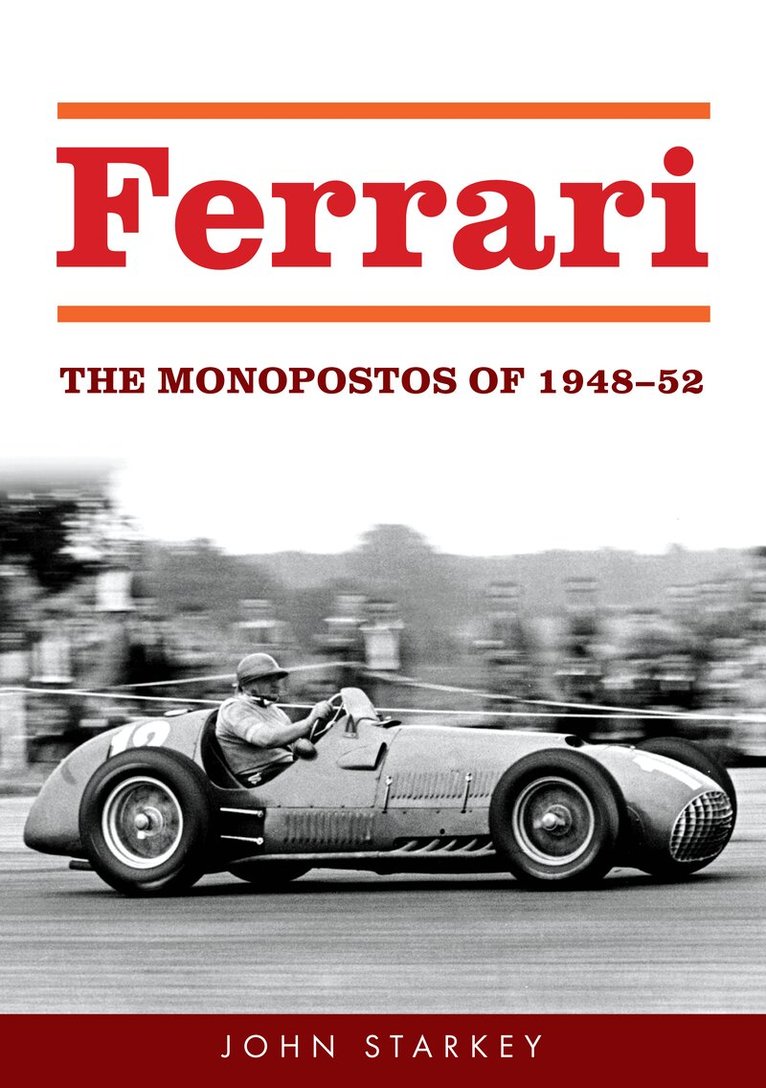
Ferrari have the distinction of being the only manufacturer to have competed throughout the history of Formula 1. The company’s early Formula 1 and Formula 2 cars first appeared at the Italian Grand Prix in September 1948. It was these cars, particularly in 1950 and 1951, that really brought the name Ferrari to the attention of the general public by competing at the very pinnacle of motor racing, the Formula 1 World Championship. During the Second World War, Enzo Ferrari had a factory in Maranello making grinding machines, but he had a burning ambition – to dominate international motor racing. Within two years, his workforce had produced the company’s first sports car and in 1948 Ferrari presented his first single-seater F1 cars to the world. By 1951, his new 4.5-litre F1 cars were beating his old nemesis, Alfa Romeo, on their way to winning the World Championship in 1952 and 1953.John Starkey tells the story of those early years as Ferrari struggled to overcome many obstacles to win the new World Championship. Featuring rare archive photographs, this is an indispensable guide to Ferrari’s first racing cars and the emergence of motor racing as an elite sports phenomenon.
Hitler's Motorcars
The Fuhrer's Vehicles From the Birth of the Nazi Party to the Fall of the Third Reich
Inbunden, Engelska, 2023
274 kr
Skickas
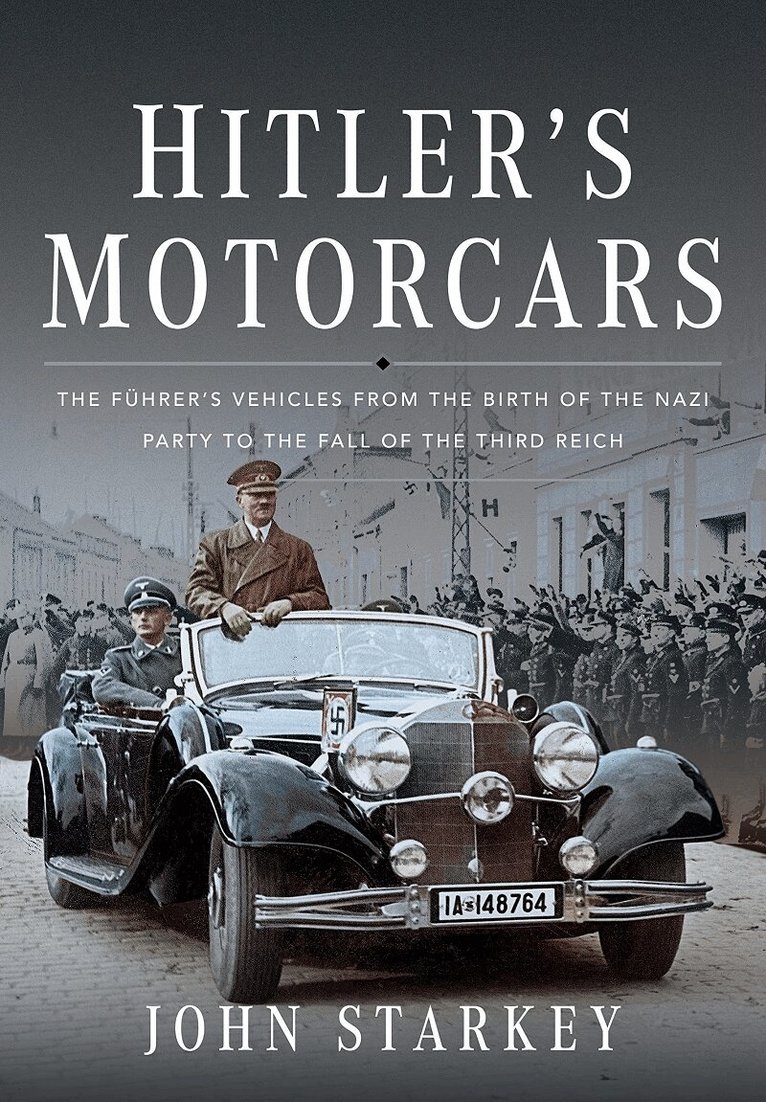
Many are the photographs of Hitler standing proudly in the passenger seat of a midnight blue Mercedes, arm outstretched in his famous salute to the adoring German crowds. Hitler loved cars and loved to be seen in and next to the special automobiles he purchased or was presented with through friends and Nazi Party funds.His first car was a 1920 green Selve 8/30, purchased in 1922, which was soon disposed of in favour of a Daimler-built Mercedes 15/70/100 - and from that moment on every car in which Hitler was chauffeured around the Third Reich and occupied countries would be a Mercedes. Indeed, even while in Landsberg prison following his failed putsch in 1923, he was writing to a Mercedes-Benz car salesman in Munich about his next car, concerning the merits of the Benz 11/40 versus the larger 16/50\. It was a grey 11/40 in which Hitler was driven away from Landsberg on his release in 1924.It was in his next car - a super-charged Mercedes-Benz 15/70/100 - that Hitler was involved in an accident with a large truck in March 1930. The truck was completely wrecked while the large Mercedes suffered only minor damage. This prompted Hitler to remark: It was then I decided to use only a Mercedes for the rest of my life.'From 1930 onwards, Hitler was driven around in a Mercedes-Benz 770, also known as the Grosser Mercedes. Only 205 of these huge, luxury cars were manufactured with many of those being used by top-ranking Nazis.Such was Hitler's interest in cars, he arranged state sponsorship for Mercedes and Porsche (Auto Union) to participate in Grand Prix racing (today's F1). So strong was the resulting financial support that German teams swept all before them between 1935 and 1939.Security was always a great concern of Hitler and his entourage and his 770 was protected with bullet-proof windows and steel armour-plate built into all metal work. Wartime brought increased security fears, resulting in another Mercedes entering the German leader's car collection. This was the heavily armoured, six-wheel G4, the first off-road Mercedes, in which Hitler could safely parade through the streets of conquered lands.As well as providing photographs of Hitler's cars and the men who became his chauffeur, John Starkey lists the technical specifications of those cars, and describes many of the journeys undertaken by the German leader over the course of two dramatic decades.
RAF's Cross-Channel Offensive
Circuses, Ramrods, Rhubarbs and Rodeos 1941-1942
Inbunden, Engelska, 2022
266 kr
Skickas
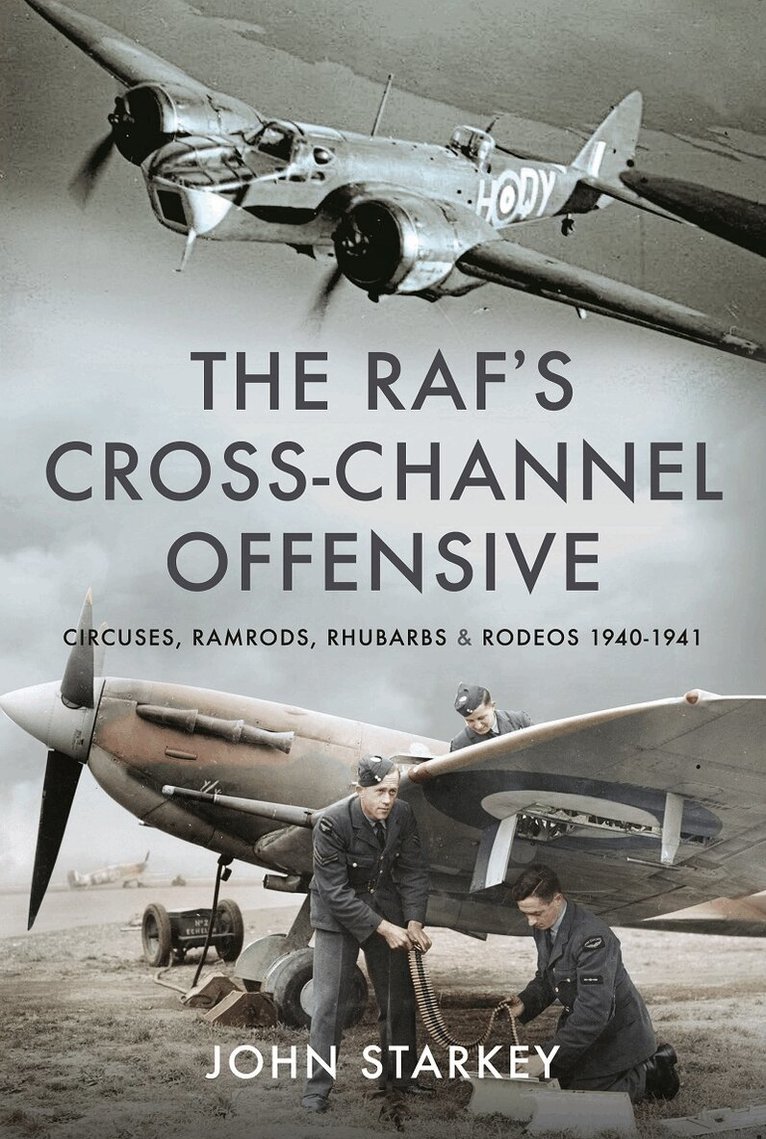
The story of the RAF, and in particular Fighter Command, during the Battle of Britain has been told many times. It is a tale of the gallant pilots of The Few', in their Hurricanes and Spitfires, with the nation's back to the wall, fighting off the Luftwaffe's airborne assault against enormous odds. But the story of Fighter Command's operations immediately after the Battle of Britain is less well known.Marshal of the Royal Air Force Hugh Montague Trenchard commanded the Royal Flying Corps in the First World War. His policy then had been for his aircraft and men to be continually on the offensive, always over the German lines taking the fight to the enemy. After being promoted to command the RAF, Trenchard retired in 1930.In November 1940, Trenchard showed up again at the Air Ministry and proposed that the RAF should Lean Towards France' - that it should go on the offensive. The RAF would, claimed Trenchard, win the resulting battle of attrition.One of the main outcomes of the RAF's new offensive stance was the introduction of the Circus sorties. These were attacks undertaken by a small force of bombers with a powerful fighter escort. They were intended to lure enemy fighters into the air so that they could be engaged by RAF fighters, the primary objective being the destruction of Luftwaffe fighters, followed by the protection of the bombers from attack.A further development of the Circus missions were Ramrods, Rhubarbs and Rodeos, all of which were variations on the same theme. A Ramrod was similar to a Circus, though in this instance the primary objective was the destruction of the target, the main role of the accompanying fighters being to protect the bombers from attack. A Rhubarb was a small-scale attack by fighters using cloud cover and/or surprise, the object of which was to destroy German aircraft in the air and/or striking at ground targets, whilst a Rodeo consisted of a fighter sweep over enemy territory with no bombers.Drawing on official documents and archive material, as well as accounts by many of those involved, James Starkey reveals just how Trenchard's views won through and the RAF went on the offensive from late 1940 into 1941. Was it a failed strategy? If so, why was it not halted once the results began to be seen?
Lola T70 – the Racing History & Individual Chassis Record
Classic Reprint of 4th Edition in Paperback
Häftad, Engelska, 2016
626 kr
Skickas inom 3-6 vardagar
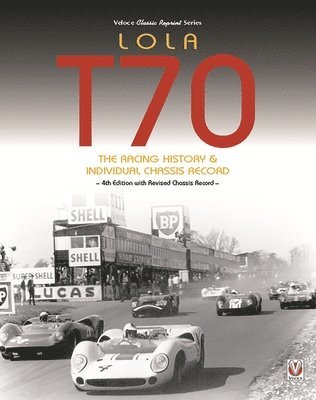
Reprinted in paperback after a long absence! The Lola T70 was the car that Eric Broadley wanted to build for Ford instead of the GT40. He thought the GT40 too conservative in specification for a state-of-the-art sports racing car, so he split with the giant corporation to build the T70 under the aegis of his own company: Lola.Immediately successful, the T70 carried John Surtees to the Championship in the 1966 Can-Am series. The cars were also very successful in Group 7 races until the series ended in 1966, by which time the likes of Denny Hulme, David Hobbs and Brian Redman had all driven T70s to victory.Under continuous development until the Mk IIIb Coupé of 1969, the T70 was never a great endurance racer but achieved major successes in shorter events such as the TT and Martini races. Today, the T70 is a leading force in historic racing.Over many years, John Starkey – T70 owner and ex-Curator of the famous Donington racing car collection – has compiled a huge amount of information on the cars and interviewed many past and present owners and drivers about their experiences with the T70. Uniquely, this book contains the history and specification – where known – of each individual T70 chassis. Available again after an absence of several years, this book is the definitive development and racing history of the Lola T70.
239 kr
Skickas inom 7-10 vardagar
Back after a long absence! The Ferrari GT Berlinettas are undeniably beautiful and, arguably, the greatest Ferrari racing cars ever built. The 250 GT Competizione Berlinetta – now popularly known as the Tour de France Berlinetta, in honour of the model’s domination of the great French event with four outright victories – was the true forerunner of the series of cars which established Ferrari as a major force in sports car racing.Here is the story of the development, building and racing of the Tour de France Ferraris. Importantly, the book also contains individual histories of the Ferrari TdF Berlinettas.Out of print for many years, this classic edition has been reissued in paperback format, due to popular demand.
328 kr
Skickas
Back after a long absence! The illustrated record of all Lola cars from 1978 to 1997. Acknowledged Lola experts Esa Illoinen and John Starkey pool their knowledge to provide full detail on all the different types of Lola of this period – single-seaters and sports racing cars. A companion volume covers the 1957-1977 models.A Lola T70 owner/racer himself, John Starkey is also the author of the much acclaimed Lola T70 (published by Veloce).
378 kr
Skickas inom 7-10 vardagar
This revised reprint of a classic title covers the history and development of the racing Corvettes, from the car’s beginnings in the 1950s with just 250 horsepower, through the Corvette GTP of the 1980s, with over 1000 horsepower, and on to 1996, when 4th generation cars give way to the 5th generation.Included are many interviews with the drivers who raced these exciting, weighty and always fast cars, including John Greenwood, Dick Gulstrand, Jerry Grant and ‘Fast’ Phil Curring, amongst others.The book is illustrated with many quality photographs, supplied by General Motors and well-known motoring photographers; it also contains detailed specifications of the production cars, and road test reports.
274 kr
Skickas
This revised reprint of a classic title covers the history and development of the racing Corvettes, from the car’s beginnings in the 1950s with just 250 horsepower, through the Corvette GTP of the 1980s, with over 1000 horsepower, and on to 1996, when 4th generation cars give way to the 5th generation.Included are many interviews with the drivers who raced these exciting, weighty and always fast cars, including John Greenwood, Dick Gulstrand, Jerry Grant and ‘Fast’ Phil Curring, amongst others.The book is illustrated with many quality photographs, supplied by General Motors and well-known motoring photographers; it also contains detailed specifications of the production cars, and road test reports.
445 kr
Skickas inom 3-6 vardagar
An in-depth study of the Sauber-Mercedes racecars that dominated the Group C racing scene during the late 1980s and early 1990s.When Peter Sauber started using Mercedes V8 engines in his Group C sports cars in 1985 the result was World Championship wins in 1989 and 1990. Utterly dominant, the three-pointed star of Mercedes beat the TWR Jaguars and Nissans, and introduced a certain M Schumacher into the factory team in 1990.This book features interviews with many of the personalities who raced with the Sauber-Mercedes team, including Jochen Mass, Mauro Baldi, Kenny Acheson, David Price, Bobby Bell and Leo Ress. A host of magnificent colour photographs backs up the history and development of the cars. Also included is a chassis-by-chassis history of each individual car.
445 kr
Skickas inom 3-6 vardagar
When Don Devendorf and John Knepp got together to form Electramotive Engineering of El Segundo, California, little did they realise that they were setting in motion a train of events which would sooner, rather than later, bring to them and the mighty Nissan GTP cars that they promoted, developed and raced, no less than four IMSA Camel GT Championships.Here, for the first time, is the story of Nissan in racing from 1984 to 1993, the GTP era. The full story of Electramotive and NPTI is told, with interviews with Don Devendorf, John Knepp, Geoff Brabham, Trevor Harris, Kas Kastner, Ashley Page, and many other members of the crew that won the IMSA Camel GT Championship from 1988 to 1991.The story of the European Group C Nissans, using chassis from March and Lola, from 1985 to 1992 is also told, along with interviews from many of the drivers and technicians involved, such as Mark Blundell, Julian Bailey, Dave Price and Bob Bell.
156 kr
Skickas inom 7-10 vardagar
What happened when America's richest car company, producing many thousands of cars per year, went head-to-head with Ferrari of Italy in the mid ‘60s? This is the story of an unstoppable force coming up against the stubbornness of an immovable object – that is, Ford against Ferrari. Enzo Ferrari, whose company produced fewer than four hundred cars per year in 1963, wasn’t going to bow to Ford after he had turned down its offer to buy his company. The only place left to duke it out was on the racetracks of the world … and one in particular: Le Mans ‘66.
626 kr
Skickas inom 3-6 vardagar
Now in paperback! In 1974, to rave reviews, Porsche produced the 930/911 Turbo to the public and set off on a new road. At the same time, the governing body of motorsport introduced a new ‘silhouette’ formula to sports car racing. Thus the immortal 934 and 935 were born.This book tells the story of the 911 Turbo and its racing cousins, from the 1974 2.1-litre RSR Turbo Carrera to the tube-framed 750 horsepower final variants of the 935. These are the cars which still bring a gleam of pleasure to any of the drivers lucky enough to have sampled their enormous power and, sometimes, their wayward handling!
347 kr
Tillfälligt slut
The 1963 Lola Mk VI GT was the car that inspired the Ford GT40 and then the Lola T70, both of which are today seen as true classic racecars. This book describes how all that happened, concentrating particularly on Allen Grant’s Lola Mk VI, one of just three built, which he bought in 1965 and still possesses. The book also contains never before seen photos from the Ford Archives.John Starkey, an established automotive author and racecar consultant, has previously authored books about the history of the marque and the famous T70 racing sports cars, one of which he used to race himself.
355 kr
Kommande
Long before the Hollywood lights – this is the true, full-throttle story behind the Ford–Ferrari war that defined a racing era.Ford versus Ferrari goes far beyond the dramatized 2019 film to deliver the definitive, richly detailed account of the personalities, machines, politics, and motivations that clashed at the 24 Hours of Le Mans in 1966. With an insider’s grasp and a historian’s eye, John Starkey uncovers the real drama behind the corporate rivalry that reshaped motorsport.From Henry Ford II’s failed bid to buy Ferrari to the last-minute technical fixes and pitlane tensions, this book unpacks how the GT40 emerged as both a symbol and a weapon in Ford’s quest to dominate endurance racing. Along the way, readers will meet the figures at the heart of the story – Ken Miles, Carroll Shelby, Enzo Ferrari, and many more – in all their complexity.
Six Voyages of John Baptista Tavernier
through Turkey into Persia and the East-Indies finished in the Year, giving an Account of the State of those Countries
Häftad, Engelska, 2020
701 kr
Skickas inom 5-8 vardagar