John T. Kearns - Böcker
Visar alla böcker från författaren John T. Kearns. Handla med fri frakt och snabb leverans.
3 produkter
3 produkter
416 kr
Tillfälligt slut
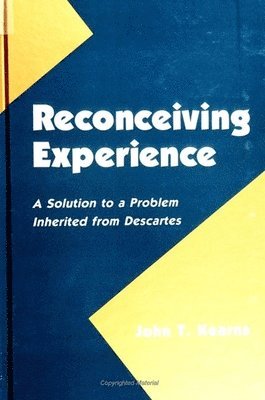
Presents a new framework for understanding language, thought, and experience, and for carrying out research.Kearns investigates representation and intentional activity to determine how experience contributes to propositional thought and belief, and how experience is based on neural states and events. This speech-act theory shows using language to be intentional (purposive) activity which cannot be explained computationally or causally. Learning language makes propositional thinking possible and provides conceptual structure to experience.The account of language and its acquisition sheds light on further issues such as reference and proper names, the difference between syllogistic and modern logic, and the paradoxes of self-reference. As for experience, the nonrelational analysis of representing explains our awareness of the world, which doesn't give us access to the world, and our access, which isn't provided by awareness. Reconceiving Experience presents a new framework for understanding language, thought, and experience, and for carrying out research.
428 kr
Tillfälligt slut
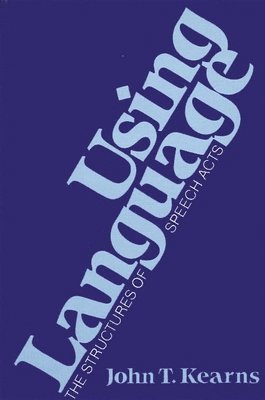
In a pioneer study of how language is actually used, Dr. Kearns combines the rigor of formal logic with a detailed analysis of natural language patterns. Through this double focus, he develops artificial languages that are syntactically more similar to the spoken word than first-order language itself. Numerous diagrams illustrate the evolution of these artificial languages, which represent a significant contribution to both the fields of linguistics and logic.The book begins by delineating a theory of the structures of intentional acts and then applies this to the special case of linguistic acts. Given an understanding of the meanings of component expressions, we can use our knowledge of linguistic structure to determine the meaning of a complex expression. An innovative discussion of semantics is subdivided into theories of three "semantic dimensions": representational meaning, inferential meaning, and truth conditions. Drawing upon these analyses the speech act theory of this book purposes that the meaning of a sentence (sentential act) is to be explained wholly in terms of the meanings of component expressions (acts) and the structure of the sentence.
608 kr
Skickas inom 3-6 vardagar
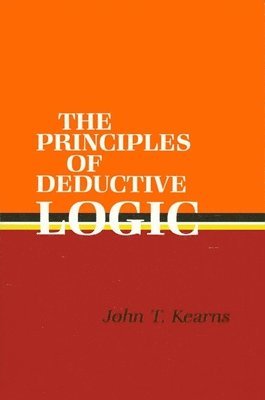
Clear focus on its application of formal logic to ordinary English is the most distinctive feature of this textbook for the introductory course in deductive logic. Great care is taken with the appropriate translation into logical languages of ordinary English sentences. Evaluation of these translations promotes a more effective use of ordinary language.The Principles of Deductive Logic presents symbolic logic in a fuller and more leisurely fashion than other introductory textbooks. Early chapters cover informal material, including definition and informal fallacies. The remainder of the text is devoted to the treatment of four distinct artificial languages. The Categorical language is the language of syllogistic logic. The Extended Categorical language enriches this first language with the symbolic connectives for conjunction and negation. The Propositional Connective language and the First-Order language (with identity) are the two basic languages of modern logic. Each language is accompanied by a deductive system, and is used as an instrument for exploring ordinary language, including ordinary argumentsThe book contains a large number of exercises whose answers are supplied in the back of the book, and many more that can be assigned as homework. A solution's manual is available to instructors upon their request. The request must be written on college or university letterhead.