John Terning - Böcker
Visar alla böcker från författaren John Terning. Handla med fri frakt och snabb leverans.
7 produkter
7 produkter
Del 132 - International Series of Monographs on Physics
Modern Supersymmetry
Dynamics and Duality
Inbunden, Engelska, 2005
1 667 kr
Skickas inom 7-10 vardagar
The book begins with a brief review of supersymmetry, and the construction of the minimal supersymmetric standard model and approaches to supersymmetry breaking. General non-perturbative methods are also reviewed leading to the development of holomorphy and the Affleck-Dine-Seiberg superpotential as powerful tools for analysing supersymmetric theories. Seiberg duality is discussed in detail, with many example applications provided, with special attention paid to its use in understanding dynamical supersymmetry breaking. The Seiberg-Witten theory of monopoles is introduced through the analysis of simpler N=1 analogues. Superconformal field theories are described along with the most recent development known as "a-maximization". Supergravity theories are examined in 4, 10, and 11 dimensions, allowing for a discussion of anomaly and gaugino mediation, and setting the stage for the anti-de Sitter/conformal field theory correspondence. This book is unique in containing an overview of the important developments in supersymmetry since the publication of "Supersymmetry and Supergravity" by Wess and Bagger. It also strives to cover topics that are of interest to both formal and phenomenological theorists.
Del 132 - International Series of Monographs on Physics
Modern Supersymmetry
Dynamics and Duality
Häftad, Engelska, 2009
1 000 kr
Skickas inom 7-10 vardagar
The book begins with a brief review of supersymmetry, and the construction of the minimal supersymmetric standard model and approaches to supersymmetry breaking. General non-perturbative methods are also reviewed leading to the development of holomorphy and the Affleck-Dine-Seiberg superpotential as powerful tools for analysing supersymmetric theories. Seiberg duality is discussed in detail, with many example applications provided, with special attention paid to its use in understanding dynamical supersysmmetry breaking. The Seiberg-Witten theory of monopoles is introduced through the analysis of simpler N=1 analogues. Superconformal field theories are described along with the most recent development known as "amaximization". Supergravity theories are examined in 4, 10, and 11 dimensions, allowing for a discussion of anomaly and gaugino mediation, and setting the stage for the anti- de Sitter/conformal field theory correspondence. This book is unique in containing an overview of the important developments in supersymmetry since the publication of "Suppersymmetry and Supergravity" by Wess and Bagger. It also strives to cover topics that are of interest to both formal and phenomenological theorists.
1 795 kr
Skickas inom 10-15 vardagar
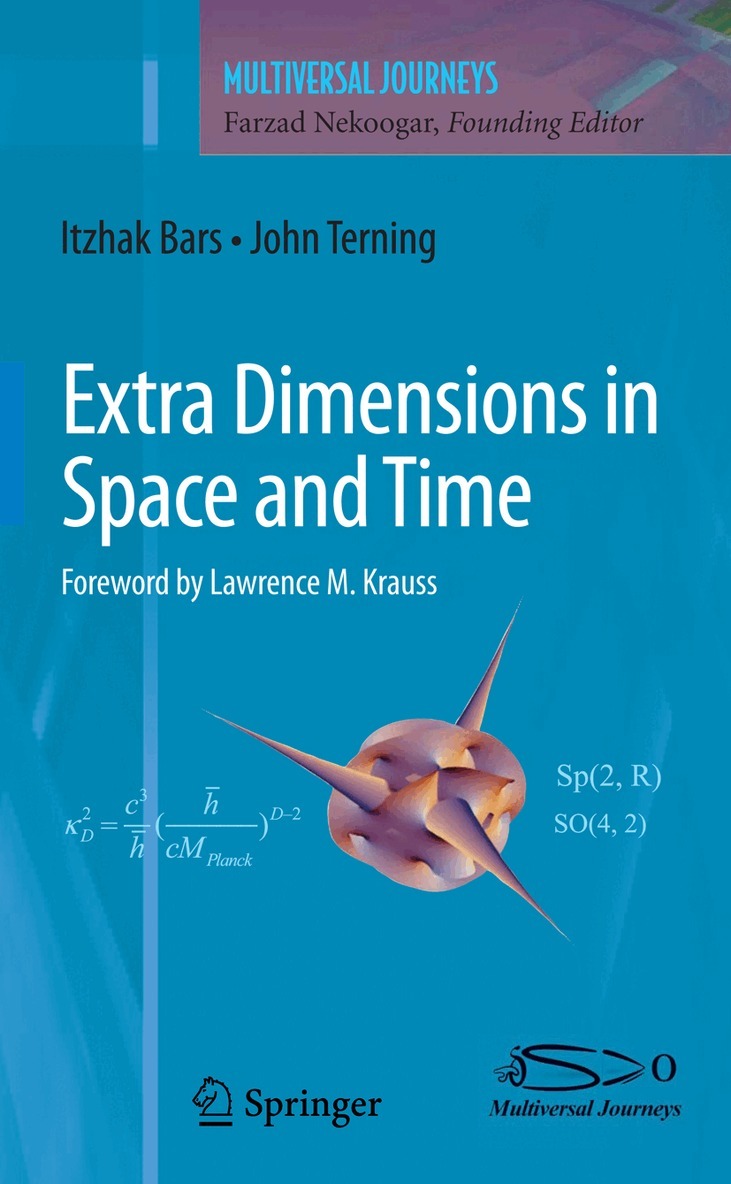
In physics, the idea of extra spatial dimensions originates from Nordstöm’s 5-dimensional vector theory in 1914, followed by Kaluza-Klein theory in 1921, in an effort to unify general relativity and electromagnetism in a 5 dimensional space-time (4 dimensions for space and 1 for time). Kaluza–Klein theory didn’t generate enough interest with physicist for the next five decades, due to its problems with inconsistencies. With the advent of supergravity theory (the theory that unifies general relativity and supersymmetry theories) in late 1970’s and eventually, string theories (1980s) and M-theory (1990s), the dimensions of space-time increased to 11 (10-space and 1-time dimension).There are two main features in this book that differentiates it from other books written about extra dimensions: The first feature is the coverage of extra dimensions in time (Two Time physics), which has not been covered in earlier books about extra dimensions. All other books mainly cover extra spatial dimensions. The second feature deals with level of presentation. The material is presented in a non-technical language followed by additional sections (in the form of appendices or footnotes) that explain the basic equations and formulas in the theories. This feature is very attractive to readers who want to find out more about the theories involved beyond the basic description for a layperson. The text is designed for scientifically literate non-specialists who want to know the latest discoveries in theoretical physics in a non-technical language. Readers with basic undergraduate background in modern physics and quantum mechanics can easily understand the technical sections.Part I starts with an overview of the Standard Model of particles and forces, notions of Einstein’s special and general relativity, and the overall view of the universe from the Big Bang to the present epoch, and covers Two-Time physics. 2T-physics has worked correctly at all scales ofphysics, both macroscopic and microscopic, for which there is experimental data so far. In addition to revealing hidden information even in familiar "everyday" physics, it also makes testable predictions in lesser known physics regimes that could be analyzed at the energy scales of the Large Hadron Collider at CERN or in cosmological observations."Part II of the book is focused on extra dimensions of space. It covers the following topics: The Popular View of Extra Dimensions, Einstein and the Fourth Dimension, Traditional Extra Dimensions, Einstein's Gravity, The Theory Formerly Known as String, Warped Extra Dimensions, and How Do We Look For Extra Dimensions?
1 795 kr
Skickas inom 10-15 vardagar
In physics, the idea of extra spatial dimensions originates from Nordstöm’s 5-dimensional vector theory in 1914, followed by Kaluza-Klein theory in 1921, in an effort to unify general relativity and electromagnetism in a 5 dimensional space-time (4 dimensions for space and 1 for time). Kaluza–Klein theory didn’t generate enough interest with physicist for the next five decades, due to its problems with inconsistencies. With the advent of supergravity theory (the theory that unifies general relativity and supersymmetry theories) in late 1970’s and eventually, string theories (1980s) and M-theory (1990s), the dimensions of space-time increased to 11 (10-space and 1-time dimension).There are two main features in this book that differentiates it from other books written about extra dimensions: The first feature is the coverage of extra dimensions in time (Two Time physics), which has not been covered in earlier books about extra dimensions. All other books mainly cover extra spatial dimensions. The second feature deals with level of presentation. The material is presented in a non-technical language followed by additional sections (in the form of appendices or footnotes) that explain the basic equations and formulas in the theories. This feature is very attractive to readers who want to find out more about the theories involved beyond the basic description for a layperson. The text is designed for scientifically literate non-specialists who want to know the latest discoveries in theoretical physics in a non-technical language. Readers with basic undergraduate background in modern physics and quantum mechanics can easily understand the technical sections.Part I starts with an overview of the Standard Model of particles and forces, notions of Einstein’s special and general relativity, and the overall view of the universe from the Big Bang to the present epoch, and covers Two-Time physics. 2T-physics has worked correctly at all scales ofphysics, both macroscopic and microscopic, for which there is experimental data so far. In addition to revealing hidden information even in familiar "everyday" physics, it also makes testable predictions in lesser known physics regimes that could be analyzed at the energy scales of the Large Hadron Collider at CERN or in cosmological observations."Part II of the book is focused on extra dimensions of space. It covers the following topics: The Popular View of Extra Dimensions, Einstein and the Fourth Dimension, Traditional Extra Dimensions, Einstein's Gravity, The Theory Formerly Known as String, Warped Extra Dimensions, and How Do We Look For Extra Dimensions?
Quantum Physics, Mini Black Holes, and the Multiverse
Debunking Common Misconceptions in Theoretical Physics
Häftad, Engelska, 2019
494 kr
Skickas inom 10-15 vardagar
Carroll "The Multiversal book series is equally unique, providing book-length extensions of the lectures with enough additional depth for those who truly want to explore these fields, while also providing the kind of clarity that is appropriate for interested lay people to grasp the general principles involved.
Quantum Physics, Mini Black Holes, and the Multiverse
Debunking Common Misconceptions in Theoretical Physics
Inbunden, Engelska, 2018
494 kr
Skickas inom 10-15 vardagar
Carroll "The Multiversal book series is equally unique, providing book-length extensions of the lectures with enough additional depth for those who truly want to explore these fields, while also providing the kind of clarity that is appropriate for interested lay people to grasp the general principles involved.
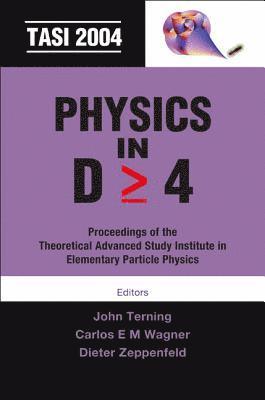
Physics In D>=4: Tasi 2004 - Proceedings Of The Theoretical Advanced Study Institute In Elementary Particle Physics
Inbunden, Engelska, 2006
3 593 kr
Tillfälligt slut
This book contains write-ups of lectures from a summer school for advanced graduate students in elementary particle physics. In the first lecture, Scott Willenbrock gives an overview of the standard model of particle physics. This is followed by reviews of specific areas of standard model physics: precision electroweak analysis by James Wells, quantum chromodynamics and jets by George Sterman, and heavy quark effective field by Matthias Neubert. Developments in neutrino physics are discussed by André de Gouvea and the theory behind the Higgs boson is addressed by Laura Reina. Collider phenomenology from both experimental and theoretical perspectives are highlighted by Heidi Schellman and Tao Han. A brief survey of dynamical electroweak symmetry breaking is provided by R Sekhar Chivukula and Elizabeth H Simmons. Martin Schmaltz covers the recent proposals for “little” Higgs theories. Markus Luty describes what is needed to make supersymmetric theories realistic by breaking supersymmetry. There is an entire series of lectures by Raman Sundrum, Graham Kribs, and Csaba Csáki on extra dimensions. Finally, Keith Olive completes the book with a review of astrophysics.