John W. Bull - Böcker
Visar alla böcker från författaren John W. Bull. Handla med fri frakt och snabb leverans.
7 produkter
7 produkter
950 kr
Skickas inom 10-15 vardagar
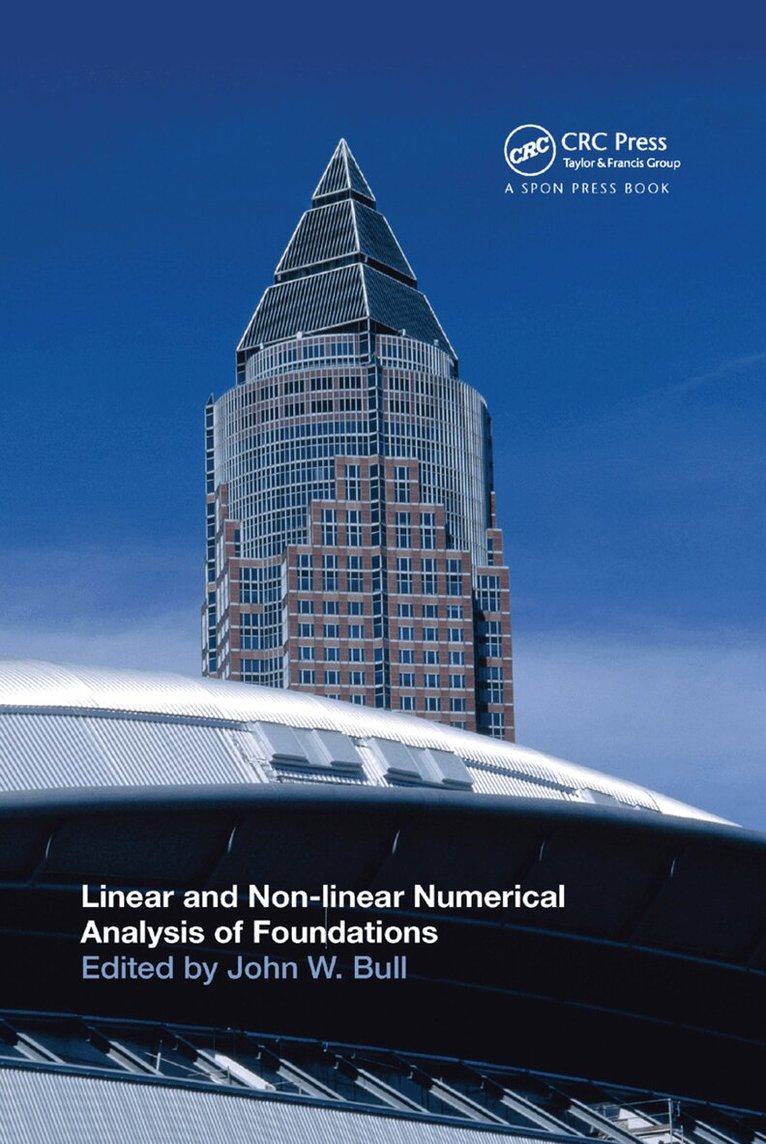
Correctly understanding, designing and analyzing the foundations that support structures is fundamental to their safety. This book by a range of academic, design and contracting world experts provides a review of the state-of-the-art techniques for modelling foundations using both linear and non linear numerical analysis. It applies to a range of infrastructure, civil engineering and structural engineering projects and allows designers, engineers, architects, researchers and clients to understand some of the advanced numerical techniques used in the analysis and design of foundations.Topics include:Ground vibrations caused by trainsPile-group effectsBearing capacity of shallow foundations under static and seismic conditionsBucket foundation technology for offshore oilfields Seismically induced liquefaction in earth embankment foundations and in pile foundations Free vibrations of industrial chimneys and TV towers with flexibility of the soil Settlements of high rise structures Seepage, stress fields and dynamic responses in dams Site investigation
950 kr
Skickas inom 10-15 vardagar
In geomechanics, existing design methods are very much dependent upon sophisticated on-site techniques to assess ground conditions. This book describes numerical analysis, computer simulation and modelling that can be used to answer some highly complex questions associated with geomechanics. The contributors, who are all international experts in the field, also give insights into the future directions of these methods.Numerical Analysis and Modelling in Geomechanics will appeal to professional engineers involved in designing and building both onshore and offshore structures, where geomechanical considerations may well be outside the usual codes of practice, and therefore specialist advice is required. Postgraduate researchers, degree students carrying out project work in this area will also find the book an invaluable resource.
991 kr
Skickas inom 10-15 vardagar
This book describes current developments in the finite element analysis and design of certain types of thin-walled structures, and concentrates on the finite elements' use. It shows how the finite element method is used to assist in the solution of the thin-walled structures.
3 713 kr
Skickas inom 10-15 vardagar
In geomechanics, existing design methods are very much dependent upon sophisticated on-site techniques to assess ground conditions. This book describes numerical analysis, computer simulation and modelling that can be used to answer some highly complex questions associated with geomechanics. The contributors, who are all international experts in the field, also give insights into the future directions of these methods.Numerical Analysis and Modelling in Geomechanics will appeal to professional engineers involved in designing and building both onshore and offshore structures, where geomechanical considerations may well be outside the usual codes of practice, and therefore specialist advice is required. Postgraduate researchers, degree students carrying out project work in this area will also find the book an invaluable resource.
3 174 kr
Skickas inom 10-15 vardagar
Correctly understanding, designing and analyzing the foundations that support structures is fundamental to their safety. This book by a range of academic, design and contracting world experts provides a review of the state-of-the-art techniques for modelling foundations using both linear and non linear numerical analysis. It applies to a range of infrastructure, civil engineering and structural engineering projects and allows designers, engineers, architects, researchers and clients to understand some of the advanced numerical techniques used in the analysis and design of foundations.Topics include:Ground vibrations caused by trainsPile-group effectsBearing capacity of shallow foundations under static and seismic conditionsBucket foundation technology for offshore oilfields Seismically induced liquefaction in earth embankment foundations and in pile foundations Free vibrations of industrial chimneys and TV towers with flexibility of the soil Settlements of high rise structures Seepage, stress fields and dynamic responses in dams Site investigation
Life Cycle Costing
For the Analysis, Management and Maintenance of Civil Engineering Infrastructure
Inbunden, Engelska, 2015
971 kr
Tillfälligt slut
The key areas of life cycle cost analysis (LCCA) and whole life costing (WLC) are exemplified in this volume with accounts of their application to housing stock, a community hydroelectric power system, various aspects of highway infrastructure, and corrosion protective coatings. Sustainable construction and design requires more than compliance with safety requirements and economic constraints, there is also the impact on the environment, the surrounding population and users of the infrastructure. This requires a multidimensional perspective of sustainability to be considered in life cycle costing (LCC) combining current design criteria with these other aspects. It has become increasingly important to understand the full costs of civil engineering infrastructure, and the main sources of cost, along the whole supply chain and to identify cost reduction opportunities. The conventional procurement approach without the integration of probabilistic life-cycle cost modelling induces substantial long term maintenance costs.Once deterioration and life-cycle cost models have been established, appropriate partnership procurement strategies, associated financing methods and determination of the project period can be developed.LCC includes the cost of planning, design, acquisition, operation, maintenance and disposal of buildings and other construction assets, while WLC additionally includes incomes and other costs such as non-construction costs and externalities. In whole life costing, social, environmental or business costs or benefits are considered as externalities and care must be taken not to double-count the impacts when WLC is used together with LCCA. The international examples included here illustrate practically the methodology of life cycle costing and the application of life-cycle cost analysis to identify the most appropriate method for assessing the relative merits of competing project implementation alternatives. As such it will provide a valuable tool for practising engineers, researchers and advanced students in civil and structural engineering.
3 848 kr
Skickas inom 10-15 vardagar
This book describes current developments in the finite element analysis and design of certain types of thin-walled structures, and concentrates on the finite elements' use. It shows how the finite element method is used to assist in the solution of the thin-walled structures.