John W. Lloyd – författare
Visar alla böcker från författaren John W. Lloyd. Handla med fri frakt och snabb leverans.
6 produkter
6 produkter
Inbunden, Engelska, 2003
562 kr
Skickas inom 10-15 vardagar
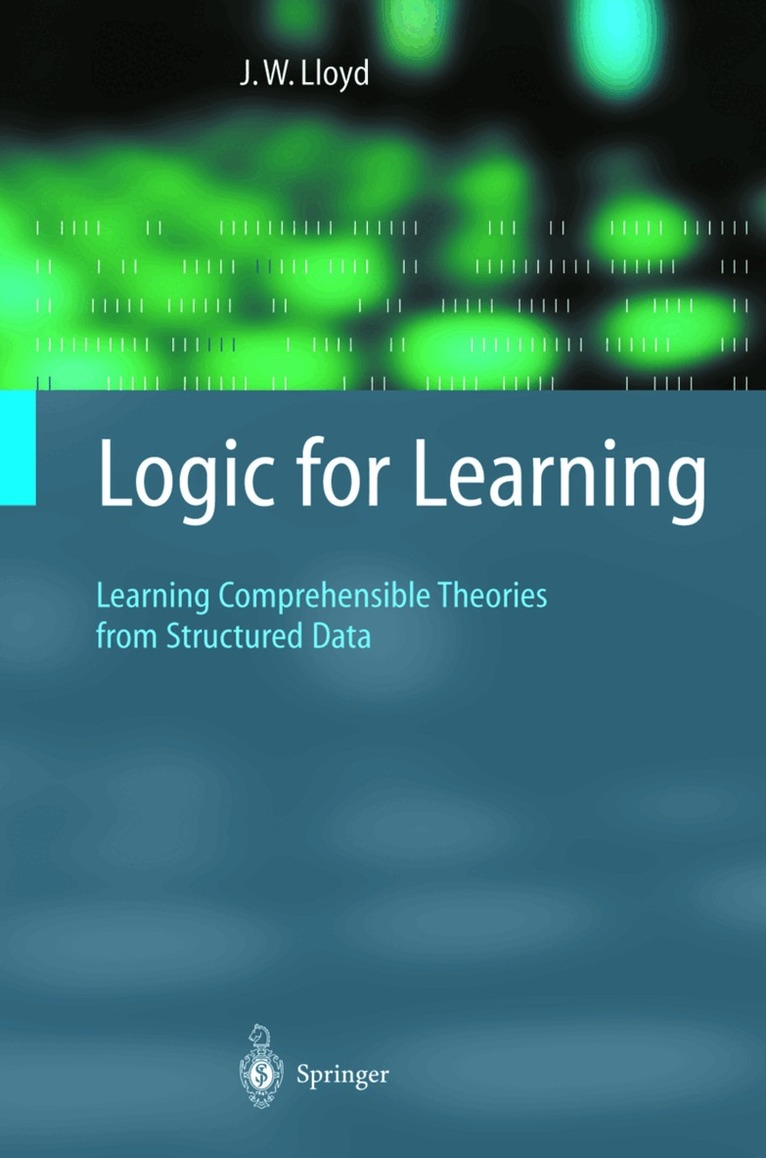
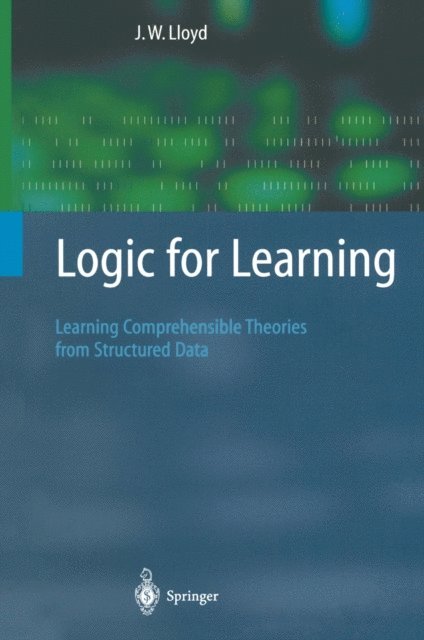
This book is concerned with the rich and fruitful interplay between the fields of computational logic and machine learning. The intended audience is senior undergraduates, graduate students, and researchers in either of those fields. For those in computational logic, no previous knowledge of machine learning is assumed and, for those in machine learning, no previous knowledge of computational logic is assumed. The logic used throughout the book is a higher-order one. Higher-order logic is already heavily used in some parts of computer science, for example, theoretical computer science, functional programming, and hardware verifica tion, mainly because of its great expressive power. Similar motivations apply here as well: higher-order functions can have other functions as arguments and this capability can be exploited to provide abstractions for knowledge representation, methods for constructing predicates, and a foundation for logic-based computation. The book should be of interest to researchers in machine learning, espe cially those who study learning methods for structured data. Machine learn ing applications are becoming increasingly concerned with applications for which the individuals that are the subject of learning have complex struc ture. Typical applications include text learning for the World Wide Web and bioinformatics. Traditional methods for such applications usually involve the extraction of features to reduce the problem to one of attribute-value learning.
Häftad, Engelska, 2010
562 kr
Skickas inom 10-15 vardagar
This book is concerned with the rich and fruitful interplay between the fields of computational logic and machine learning. The intended audience is senior undergraduates, graduate students, and researchers in either of those fields. For those in computational logic, no previous knowledge of machine learning is assumed and, for those in machine learning, no previous knowledge of computational logic is assumed. The logic used throughout the book is a higher-order one. Higher-order logic is already heavily used in some parts of computer science, for example, theoretical computer science, functional programming, and hardware verifica tion, mainly because of its great expressive power. Similar motivations apply here as well: higher-order functions can have other functions as arguments and this capability can be exploited to provide abstractions for knowledge representation, methods for constructing predicates, and a foundation for logic-based computation. The book should be of interest to researchers in machine learning, espe cially those who study learning methods for structured data. Machine learn ing applications are becoming increasingly concerned with applications for which the individuals that are the subject of learning have complex struc ture. Typical applications include text learning for the World Wide Web and bioinformatics. Traditional methods for such applications usually involve the extraction of features to reduce the problem to one of attribute-value learning.
E-bok
PDF, Engelska, 20121 785 kr
Läs direkt efter köp
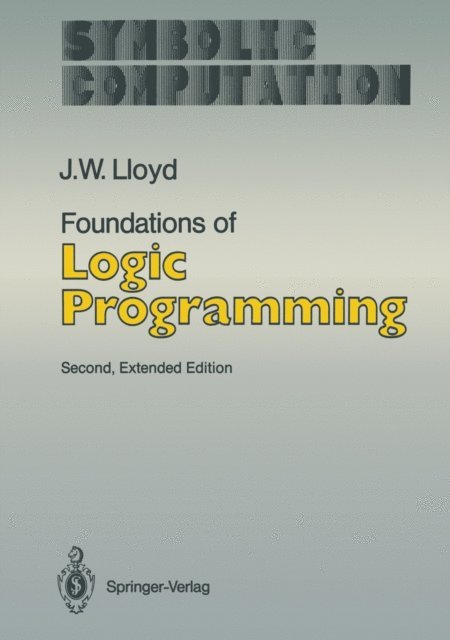
In the two and a half years since the frrst edition of this book was published, the field of logic programming has grown rapidly. Consequently, it seemed advisable to try to expand the subject matter covered in the first edition. The new material in the second edition has a strong database flavour, which reflects my own research interests over the last three years. However, despite the fact that the second edition has about 70% more material than the first edition, many worthwhile topic!! are still missing. I can only plead that the field is now too big to expect one author to cover everything. In the second edition, I discuss a larger class of programs than that discussed in the first edition. Related to this, I have also taken the opportunity to try to improve some of the earlier terminology. Firstly, I introduce "program statements", which are formulas of the form A+-W, where the head A is an atom and the body W is an arbitrary formula. A "program" is a finite set of program statements. There are various restrictions of this class. "Normal" programs are ones where the body of each program statement is a conjunction of literals. (The terminology "general", used in the first edition, is obviously now inappropriate).
Häftad, Engelska, 2011
1 338 kr
Skickas inom 10-15 vardagar
In the two and a half years since the frrst edition of this book was published, the field of logic programming has grown rapidly. Consequently, it seemed advisable to try to expand the subject matter covered in the first edition. The new material in the second edition has a strong database flavour, which reflects my own research interests over the last three years. However, despite the fact that the second edition has about 70% more material than the first edition, many worthwhile topic!! are still missing. I can only plead that the field is now too big to expect one author to cover everything. In the second edition, I discuss a larger class of programs than that discussed in the first edition. Related to this, I have also taken the opportunity to try to improve some of the earlier terminology. Firstly, I introduce "program statements", which are formulas of the form A+-W, where the head A is an atom and the body W is an arbitrary formula. A "program" is a finite set of program statements. There are various restrictions of this class. "Normal" programs are ones where the body of each program statement is a conjunction of literals. (The terminology "general", used in the first edition, is obviously now inappropriate).
E-bok
PDF, Engelska, 2013734 kr
Läs direkt efter köp
This book is concerned with the rich and fruitful interplay between the fields of computational logic and machine learning. The intended audience is senior undergraduates, graduate students, and researchers in either of those fields. For those in computational logic, no previous knowledge of machine learning is assumed and, for those in machine learning, no previous knowledge of computational logic is assumed. The logic used throughout the book is a higher-order one. Higher-order logic is already heavily used in some parts of computer science, for example, theoretical computer science, functional programming, and hardware verifica tion, mainly because of its great expressive power. Similar motivations apply here as well: higher-order functions can have other functions as arguments and this capability can be exploited to provide abstractions for knowledge representation, methods for constructing predicates, and a foundation for logic-based computation. The book should be of interest to researchers in machine learning, espe cially those who study learning methods for structured data. Machine learn ing applications are becoming increasingly concerned with applications for which the individuals that are the subject of learning have complex struc ture. Typical applications include text learning for the World Wide Web and bioinformatics. Traditional methods for such applications usually involve the extraction of features to reduce the problem to one of attribute-value learning.
Häftad, Engelska, 1994
602 kr
Tillfälligt slut