Jon Kolko – författare
Visar alla böcker från författaren Jon Kolko. Handla med fri frakt och snabb leverans.
8 produkter
8 produkter
E-bok
Engelska, 2010252 kr
Läs direkt efter köp
Thoughts on Interaction Design explores the theory behind the field of Interaction Design in a new way. It aims to provide a better definition of Interaction Design that encompasses the intellectual facets of the field and the particular methods used by practitioners in their day-to-day experiences. It also attempts to provide Interaction Designers with the vocabulary necessary to justify their existence to other team members. The book positions Interaction Design in a way that emphasizes the intellectual facets of the discipline. It discusses the role of language, argument, and rhetoric in the design of products, services, and systems. It examines various academic approaches to thinking about Design, and concludes that the Designer is a liberal artist left to infuse empathy in technologically driven products. The book also examines the tools and techniques used by practitioners. These include methods for structuring large quantities of data, ways of thinking about users, and approaches for thinking about human behavior as it unfolds over time. Finally, it introduces the idea of Interaction Design as an integral facet of the business development process.*First book to provide a solid definition and framework for the booming field of interaction design, finally giving designers the justification needed to prove their essential role on every development team*Provides designers with tools they need to operate effectively in the workplace without compromising their goals: making useable, useful, and desirable products*Outlines process, theory, practice, and challenges of interaction design – intertwined with real world stories from a variety of perspectives
E-bok
Engelska, 2011265 kr
Läs direkt efter köp
Thoughts on Interaction Design, Second Edition, contemplates and contributes to the theory of Interaction Design by exploring the semantic connections that live between technology and form that are brought to life when someone uses a product. It defines Interaction Design in a way that emphasizes the intellectual and cultural facets of the discipline.This edition explores how changes in the economic climate, increased connectivity, and international adoption of technology affect designing for behavior and the nature of design itself. Ultimately, the text exists to provide a definition that encompasses the intellectual facets of the field, the conceptual underpinnings of interaction design as a legitimate human-centered field, and the particular methods used by practitioners in their day-to-day experiences.This text is recommended for practicing designers: interaction designers, industrial designers, UX practitioners, graphic designers, interface designers, and managers.- Provides new and fresh insights on designing for behavior in a world of increased connectivity and mobility and how design education has evolved over the decades- Maintains the informal-yet-informative voice that made the first edition so popular
Häftad, Engelska, 2015
486 kr
Skickas inom 5-8 vardagar
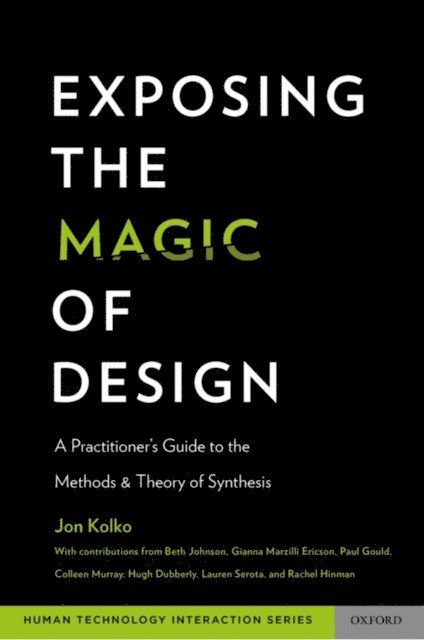
As the world grows increasingly complex--in issues of sustainability, culture, and technology--businesses and governments are searching for a form of problem solving that can effectively respond to unprecedented levels of ambiguity and disorder. Traditional "linear thinking" has been disparaged by the popular media as being inadequate for dealing with the global economic crisis. Traditional forms of marketing and product development have been rejected by businesses that need to find new ways of staying competitive in a global economy. Yet little has been offered as an alternative. It is not enough to demand that someone "be more innovative" without offering the tools to succeed.This book offers a way of thinking about complicated, multifaceted problems with a repeatable degree of success. Design synthesis methods can be applied in business to produce new and compelling products and services, or these methods can be applied in government with the goal of changing culture and bettering society. In both contexts, there is a need for timely and aggressive action. This text is intended to act as a practitioner's guide to using the magic of design to solve complex problems.
Inbunden, Engelska, 2011
966 kr
Skickas inom 5-8 vardagar
As the world deals with increasing complexity -- in issues of sustainability, finance, culture and technology -- business and governments are searching for a form of problem solving that can deal with the unprecedented levels of ambiguity and chaos. Traditional "linear thinking" has been disparaged by the popular media as being inadequate for dealing with the global economic crisis. Standard forms of marketing and product development have been rejected by businesses who need to find a way to stay competitive in a global economy. Yet little has been offered as an alternative. It is not enough to demand that someone "be more innovative" without giving him the tools to succeed.Design synthesis is a way of thinking about complicated, multifaceted problems of this scale with a repeatable degree of success. Design synthesis methods can be applied in business, with the goal of producing new and compelling products and services, and they can be applied in government, with the goal of changing culture and bettering society. In both contexts, however, there is a need for speed and for aggressive action. This text is immediately relevant, and is more relevant than ever, as we acknowledge and continually reference a feeling of an impending and massive change. Simply, this text is intended to act as a practitioner's guide to exposing the magic of design.There are three simple goals for this text.The first goal is to present a theory of design synthesis in a simple and concise manner. This theory is based on academic research and discourse, but presented in a way that is clear and valuable to a practicing design manager, designer or design researcher. This theory of design synthesis can then be used to substantiate single methods of synthesis.The second goal is to offer a rationalization of why design synthesis is important, both in a general sense ("why should I care about this at all?") as well as in a more immediate sense ("why should I care about this right now?").The final goal is to present a set of actionable, learnable methods for design synthesis that can be applied to any design problem. Practicing industrial designers, interaction designers, interface designers, and designers of other disciplines can use these methods to make sense of complicated design problems and to move seamlessly from various forms of research to design. The methods can add a systematic sense of rigor to an otherwise subjective, often introspective process.
E-bok
PDF, Engelska, 2011415 kr
Läs direkt efter köp
Design synthesis is a way of thinking about complicated, multifaceted problems of a large scale with a repeatable degree of success. Design synthesis methods can be applied in business, with the goal of producing new and compelling products and services, and they can be applied in government, with the goal of changing culture and bettering society. In both contexts, however, there is a need for speed and for aggressive action. This text is immediately relevant, and is more relevant than ever, as we acknowledge and continually reference a feeling of an impending and massive change. Simply, this text is intended to act as a practitioner''s guide to exposing the magic of design.
Häftad, Engelska, 2017
242 kr
Skickas inom 3-6 vardagar
Inbunden, Engelska, 2014
338 kr
Skickas
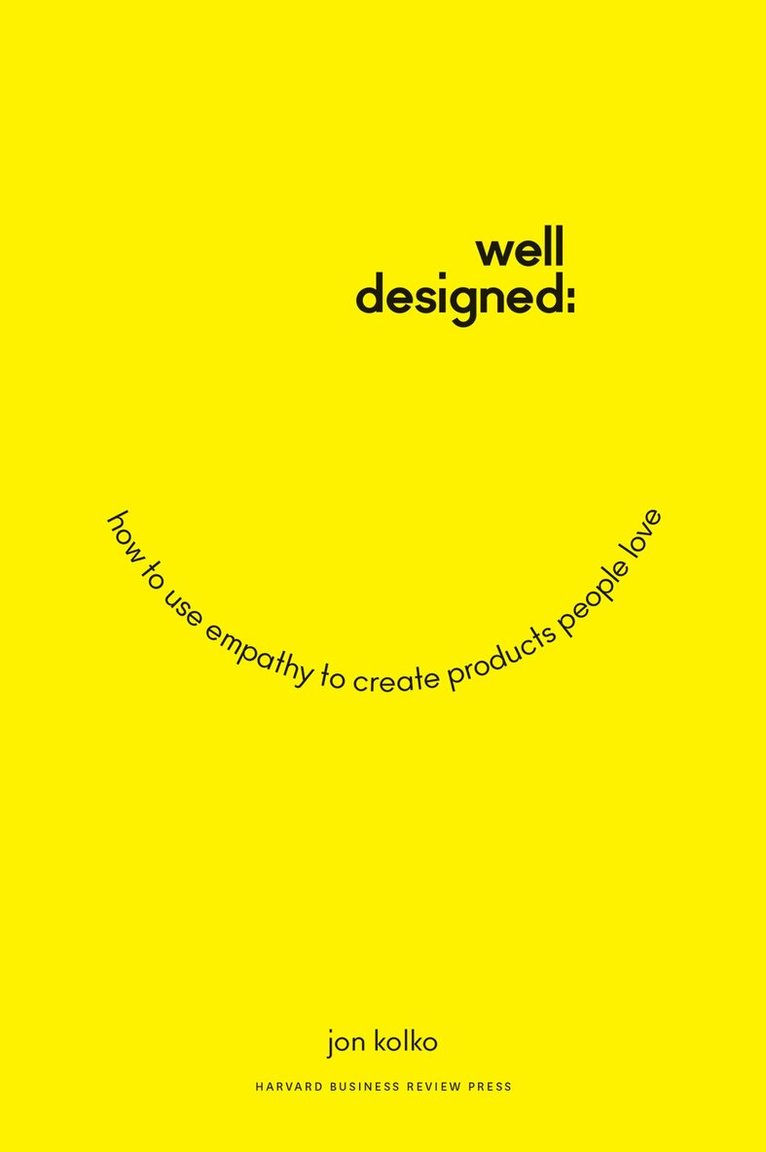
From Design Thinking to Design Doing Innovators today are told to run loose and think lean in order to fail fast and succeed sooner. But in a world obsessed with the new, where cool added features often trump actual customer needs, it's the consumer who suffers. In our quest to be more agile, we end up creating products that underwhelm. So how does a company like Nest, creator of the mundane thermostat, earn accolades like "beautiful" and "revolutionary" and a $3.2 billion Google buyout? What did Nest do differently to create a household product that people speak of with love? Nest, and companies like it, understand that emotional connection is critical to product development. And they use a clear, repeatable design process that focuses squarely on consumer engagement rather than piling on features for features' sake. In this refreshingly jargon-free and practical book, product design expert Jon Kolko maps out this process, demonstrating how it will help you and your team conceive and build successful, emotionally resonant products again and again. The key, says Kolko, is empathy.You need to deeply understand customer needs and feelings, and this understanding must be reflected in the product. In successive chapters of the book, we see how leading companies use a design process of storytelling and iteration that evokes positive emotions, changes behavior, and creates deep engagement. Here are the four key steps: 1. Determine a product-market fit by seeking signals from communities of users. 2. Identify behavioral insights by conducting ethnographic research. 3. Sketch a product strategy by synthesizing complex research data into simple insights. 4. Polish the product details using visual representations to simplify complex ideas. Kolko walks the reader through each step, sharing eye-opening insights from his fifteen-year career in product design along the way. Whether you're a designer, a product developer, or a marketer thinking about your company's next offering, this book will forever change the way you think about--and create--successful products.
E-bok
Engelska, 2014464 kr
Läs direkt efter köp
From Design Thinking to Design DoingInnovators today are told to run loose and think lean in order to fail fast and succeed sooner. But in a world obsessed with the new, where cool added features often trump actual customer needs, it’s the consumer who suffers. In our quest to be more agile, we end up creating products that underwhelm. So how does a company like Nest, creator of the mundane thermostat, earn accolades like “beautiful” and “revolutionary” and a $3.2 billion Google buyout? What did Nest do differently to create a household product that people speak of with love?Nest, and companies like it, understand that emotional connection is critical to product development. And they use a clear, repeatable design process that focuses squarely on consumer engagement rather than piling on features for features’ sake.In this refreshingly jargon-free and practical book, product design expert Jon Kolko maps out this process, demonstrating how it will help you and your team conceive and build successful, emotionally resonant products again and again. The key, says Kolko, is empathy. You need to deeply understand customer needs and feelings, and this understanding must be reflected in the product. In successive chapters of the book, we see how leading companies use a design process of storytelling and iteration that evokes positive emotions, changes behavior, and creates deep engagement. Here are the four key steps:1.Determine a product-market fit by seeking signals from communities of users.2.Identify behavioral insights by conducting ethnographic research. 3.Sketch a product strategy by synthesizing complex research data into simple insights.4.Polish the product details using visual representations to simplify complex ideas.Kolko walks the reader through each step, sharing eye-opening insights from his fifteen-year career in product design along the way. Whether you’re a designer, a product developer, or a marketer thinking about your company’s next offering, this book will forever change the way you think about—and create—successful products.