Jonathan Bauerschmidt – författare
Visar alla böcker från författaren . Handla med fri frakt och snabb leverans.
3 produkter
3 produkter
Inbunden, Engelska, 2026
2 166 kr
Skickas inom 5-8 vardagar
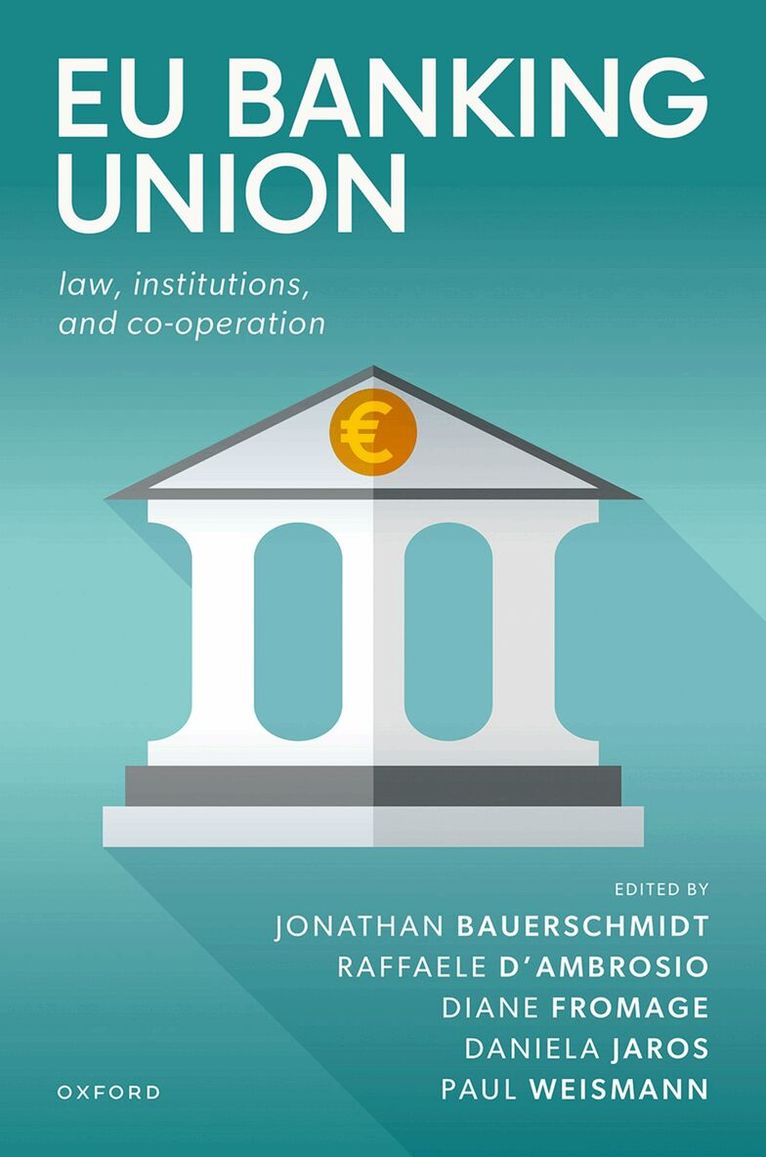
Over the past decade, the Banking Union has reshaped the European Union's approach to banking oversight, creating a stronger and more resilient financial system. At its core, this landmark initiative established the European Central Bank (ECB) as the primary supervisor for Banking Union bank areas, introduced a robust resolution regime, and enhanced stability across the sector.This edited volume offers a comprehensive examination of the Banking Union's legal framework and its ongoing evolution. It addresses pressing questions about governance, accountability, and reform through a multi-dimensional lens, exploring six key areas: horizontal, substantive, institutional, cooperative, review, and external dimensions. The horizontal aspect addresses EU competences, soft law, fundamental rights, and inter-institutional relations. The substantive dimension focuses on the application of national law by the ECB, deposit guarantee schemes, and prudential supervision. Structural considerations focus on new frameworks and their powers, including the European Stability Mechanism and the emerging Anti-Money Laundering Authority. Cooperation is highlighted through EU-national collaboration, composite procedures, and state aid in banking. Oversight is examined via accountability mechanisms, judicial review, and litigation before the Court of Justice of the EU. Finally, external aspects explore the Banking Union's ties with non-eurozone members, EEA countries and Switzerland,By combining theoretical insights with practical analysis, EU Banking Union provides an original and in-depth understanding of the Banking Union's development, its complex legal architecture, and the challenges that lie ahead.
Inbunden, Engelska, 2026
2 166 kr
Kommande
The rapid expansion of EU financial agencies over the past decade reflects a broader transformation in the Union's system of governance toward increased agencification. Beginning with the establishment of the European System of Financial Supervision and followed by the creation of the Single Resolution Board, this development has fundamentally reshaped the EU's approach to financial market supervision.This edited volume offers a structured and systematic analysis of EU financial agencies. It examines the institutional rationale and legal foundations of this governance model, as well as key issues relating to delegation of powers, accountability, judicial review, and inter-agency cooperation. Particular attention is given to the Anti-Money Laundering Authority (AMLA), established in 2025 as the EU's newest financial agency. The volume explores the AMLA's governance design, powers, and practical operation, and critically assesses its capacity to address structural weaknesses in the EU's anti-money laundering framework.Combining doctrinal analysis with practical and policy-oriented perspectives, The Anti-Money Laundering Authority and EU Financial Agencies provides a timely and authoritative account of the evolution of EU financial governance.
Del 16 - Verfassungsentwicklung in Europa
Die Rechtsperson der Europäischen Union im Wandel
Auswirkungen differenzierter Integration durch Völkerrecht auf die Europäische Union
Inbunden, Tyska, 2019
2 048 kr
Tillfälligt slut
Die Europäische Union befindet sich noch immer im Wandel. Kurz nach der Konsolidierung im Vertrag von Lissabon zeigt sich in der Euro-Krise eine neuartige Form differenzierter Integration: Völkerrechtliche Verträge einiger Mitgliedstaaten fordern die Europäische Union in ihrer Verfasstheit heraus. Wie können diese Entwicklungen nicht nur beschrieben, sondern in den Prozess der Konstitutionalisierung eingeordnet werden? Auf diese aktuellen Fragen will Jonathan Bauerschmidt Antworten geben und wird dabei von einer doppelten These angeleitet. Einerseits stellen die völkerrechtlichen Verträge eine neuartige Form der Integration dar, die zu einem bemerkenswerten Wandel in der Rechtsperson der Europäischen Union geführt haben. Andererseits ermöglicht erst ein grundlegendes Verständnis vom Begriff der Rechtsperson selbst, diesen Wandel aufzudecken.Die Arbeit wurde mit dem Konrad Redeker-Preis 2018 der Humboldt-Universität Berlin ausgezeichnet.