Jonathan Impett - Böcker
Visar alla böcker från författaren Jonathan Impett. Handla med fri frakt och snabb leverans.
3 produkter
3 produkter
701 kr
Skickas inom 10-15 vardagar
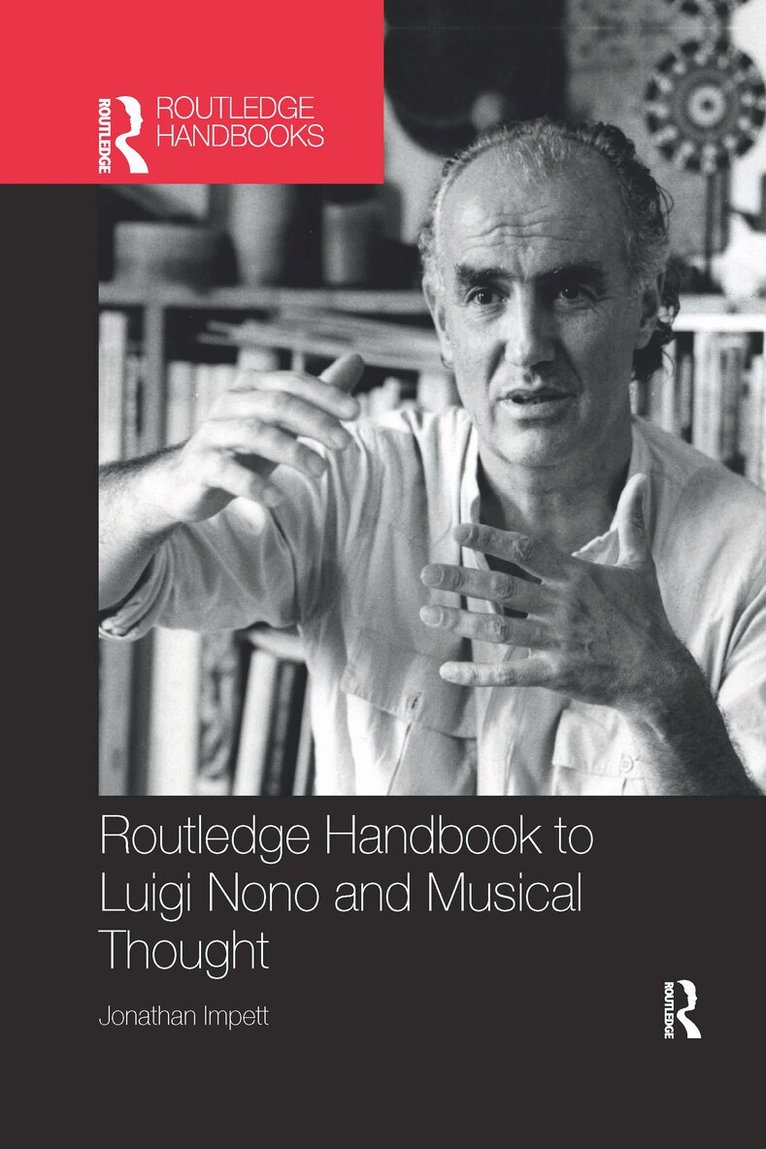
Of the post-war, post-serialist generation of European composers, it was Luigi Nono who succeeded not only in identifying and addressing aesthetic and technical questions of his time, but in showing a way ahead to a new condition of music in the twenty-first century. His music has found a listenership beyond the ageing constituency of ‘contemporary music’. In Nono’s work, the audiences of sound art, improvisation, electronic, experimental and radical musics of many kinds find common cause with those concerned with the renewal of Western art music. His work explores the individually and socially transformative role of music; its relationship with history and with language; the nature of the musical work as distributed through text, time, technology and individuals; the nature and performativity of the act of composition; and, above all, the role and nature of listening as a cultural activity. In many respects his music anticipates the new technological state of culture of the twenty-first century while radically reconnecting with our past. His work is itself a case study in the evolution of musical activity and the musical object: from the period of an apparently stable place for art music in Western culture to its manifold new states in our century. Routledge Handbook to Luigi Nono and Musical Thought seeks to trace the evolution of Nono’s musical thought through detailed examination of the vast body of sketches, and to situate this narrative in its personal, cultural and political contexts.
3 408 kr
Skickas inom 10-15 vardagar
Of the post-war, post-serialist generation of European composers, it was Luigi Nono who succeeded not only in identifying and addressing aesthetic and technical questions of his time, but in showing a way ahead to a new condition of music in the twenty-first century. His music has found a listenership beyond the ageing constituency of ‘contemporary music’. In Nono’s work, the audiences of sound art, improvisation, electronic, experimental and radical musics of many kinds find common cause with those concerned with the renewal of Western art music. His work explores the individually and socially transformative role of music; its relationship with history and with language; the nature of the musical work as distributed through text, time, technology and individuals; the nature and performativity of the act of composition; and, above all, the role and nature of listening as a cultural activity. In many respects his music anticipates the new technological state of culture of the twenty-first century while radically reconnecting with our past. His work is itself a case study in the evolution of musical activity and the musical object: from the period of an apparently stable place for art music in Western culture to its manifold new states in our century. Routledge Handbook to Luigi Nono and Musical Thought seeks to trace the evolution of Nono’s musical thought through detailed examination of the vast body of sketches, and to situate this narrative in its personal, cultural and political contexts.
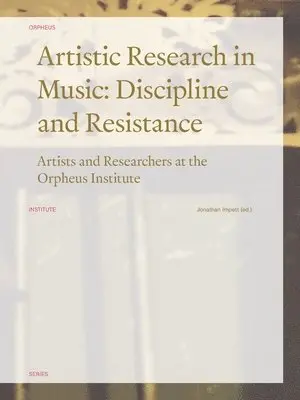
Artistic Research in Music: Discipline and Resistance
Artists and Researchers at the Orpheus Institute
Häftad, Engelska, 2017
621 kr
Skickas inom 5-8 vardagar
Artistic research in music is now at a generational stage of development. How should it deal with its own maturing? From a kaleidoscope of individual pursuits, ethos and methodologies have emerged to encompass more distributed approaches. This transformation has taken place in parallel with changes in the dynamics and structures of culture, its institutions and constituencies. Artistic research maintains a productive dialectic between its potential status as discipline or as practice. It has developed topoi, tropes, and its own canon of cases, texts, and figures. How does it negotiate relationships with institutions, disciplines and bodies of theory while retaining the critical perspective of the artist? Twenty years ago the Orpheus Institute was founded in Ghent to pursue research through the practice of musicians; thus the Orpheus Institute is of the same generation as the field it was established to explore. This festive volume in honor of twenty years of the Orpheus Institute reviews the initial trajectory and looks ahead to the institute's new position.Contributors Tom Beghin (Orpheus Institute, Ghent), Paulo de Assis (Orpheus Institute, Ghent), Leonella Grasso Caprioli (Conservatorio di Vicenza), Jonathan Impett (Orpheus Institute, Ghent), Esa Kirkkopelto (University of the Arts, Helsinki), Kari Kurkela (University of the Arts, Helsinki), Susan Melrose (Middlesex University, London), Stefan Ostersjo (Orpheus Institute, Ghent), Gertrud Sandqvist (Malmo Art Academy), Huib Schippers, Vanessa Tomlinson, Paul Draper (Queensland Conservatorium Research Centre, Griffith University), Luk Vaes (Orpheus Institute, Ghent), Janneke Wesseling, Kitty Zijlmans (Leiden University)