
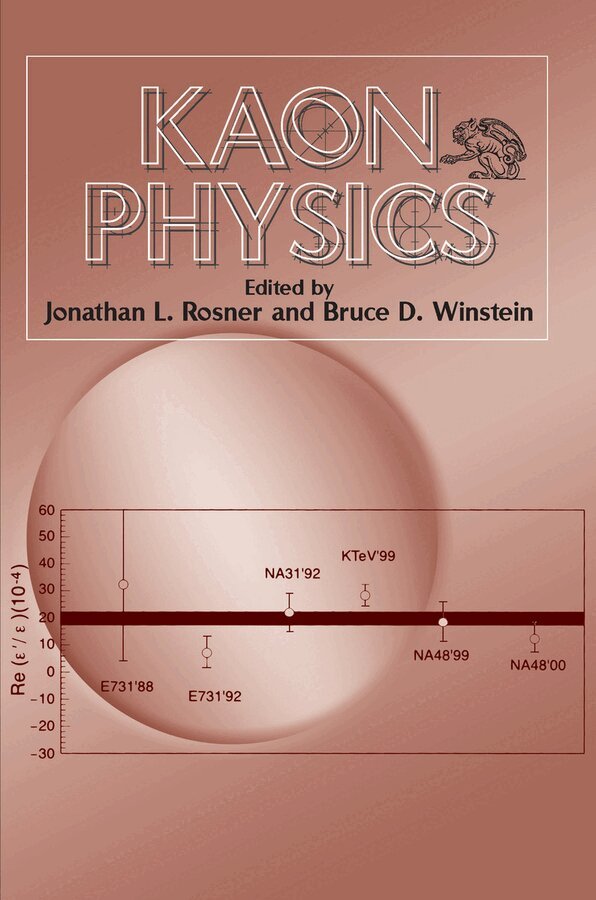
In 1947, the first of what have come to be known as "strange particles" were detected. As the number and variety of these particles proliferated, physicists began to try to make sense of them. Some seemed to have masses about 900 times that of the electron, and existed in both charged and neutral varieties. These particles are now called kaons (or K mesons), and they have become the subject of some of the most exciting research in particle physics. "Kaon Physics" presents cutting-edge papers by leading theorists and experimentalists that synthesize the current state of the field and suggest promising new directions for the future study of kaons. Topics covered include the history of kaon physics, direct CP violation in kaon decays, time reversal violation, CPT studies, theoretical aspects of kaon physics, rare kaon decays, hyperon physics, charm: CP violation and mixing, the physics of B mesons and future opportunities for kaon physics in the 21st century.
This book is devoted to the broad subject of flavor physics, embracing the question of what distinguishes one type of elementary particles from another. The articles range from the forefront of formal theory (treating the physics of extra dimensions) to details of particle detectors. Although special emphasis is placed on the physics of kaons, charmed and beauty particles, top quarks, and neutrinos, the articles also dealing with electroweak physics, quantum chromodynamics, supersymmetry, and dynamical electroweak symmetry breaking. Violations of fundamental symmetries such as time reversal invariance are discussed in the context of neutral kaons, beauty particles, electric dipole moments, and parity violation in atoms. The physics of the Cabibbo–Kobayashi–Maskawa matrix and of quark masses are described in some detail, both from the standpoint of present and future experimental knowledge and from a more fundamental viewpoint, where physicists are still searching for the correct theory.
In 1947, the first of what have come to be known as "strange particles" were detected. As the number and variety of these particles proliferated, physicists began to try to make sense of them. Some seemed to have masses about 900 times that of the electron, and existed in both charged and neutral varieties. These particles are now called kaons (or K mesons), and they have become the subject of some of the most exciting research in particle physics. "Kaon Physics" presents cutting-edge papers by leading theorists and experimentalists that synthesize the current state of the field and suggest promising new directions for the future study of kaons. Topics covered include the history of kaon physics, direct CP violation in kaon decays, time reversal violation, CPT studies, theoretical aspects of kaon physics, rare kaon decays, hyperon physics, charm: CP violation and mixing, the physics of B mesons and future opportunities for kaon physics in the 21st century.
This book is devoted to the broad subject of flavor physics, embracing the question of what distinguishes one type of elementary particles from another. The articles range from the forefront of formal theory (treating the physics of extra dimensions) to details of particle detectors. Although special emphasis is placed on the physics of kaons, charmed and beauty particles, top quarks, and neutrinos, the articles also dealing with electroweak physics, quantum chromodynamics, supersymmetry, and dynamical electroweak symmetry breaking. Violations of fundamental symmetries such as time reversal invariance are discussed in the context of neutral kaons, beauty particles, electric dipole moments, and parity violation in atoms. The physics of the Cabibbo–Kobayashi–Maskawa matrix and of quark masses are described in some detail, both from the standpoint of present and future experimental knowledge and from a more fundamental viewpoint, where physicists are still searching for the correct theory.