1 179 kr
Skickas inom 5-8 vardagar
1 179 kr
Skickas inom 5-8 vardagar
606 kr
Läs direkt efter köp
606 kr
Läs direkt efter köp
3 742 kr
Skickas inom 10-15 vardagar
3 024 kr
Skickas inom 10-15 vardagar
865 kr
Skickas inom 10-15 vardagar
2 478 kr
Skickas inom 10-15 vardagar
3 024 kr
Skickas inom 10-15 vardagar
983 kr
Skickas inom 5-8 vardagar
3 253 kr
Skickas inom 10-15 vardagar
2 478 kr
Skickas inom 10-15 vardagar
783 kr
Skickas inom 10-15 vardagar
3 024 kr
Skickas inom 10-15 vardagar
926 kr
Skickas inom 10-15 vardagar
639 kr
Skickas inom 10-15 vardagar
2 478 kr
Skickas inom 10-15 vardagar
639 kr
Skickas inom 10-15 vardagar
596 kr
Skickas inom 10-15 vardagar
797 kr
Skickas inom 5-8 vardagar
337 kr
Skickas inom 5-8 vardagar
813 kr
Läs direkt efter köp
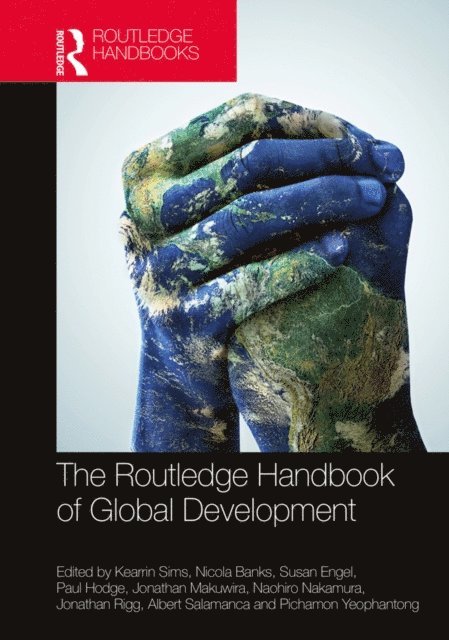
This Handbook provides a comprehensive analysis of some of the world’s most pressing global development challenges – including how they may be better understood and addressed through innovative practices and approaches to learning and teaching.
Featuring 61 contributions from leading and emerging academics and practitioners, this multidisciplinary volume is organized into five thematic parts exploring: changes in global development financing, ideologies, norms and partnerships; interrelationships between development, natural environments and inequality; shifts in critical development challenges, and; new possibilities for positive change. Collectively, the handbook demonstrates that global development challenges are becoming increasingly complex and multi-faceted and are to be found in the Global ‘North’ as much as the ‘South’. It draws attention to structural inequality and disadvantage alongside possibilities for positive change.
The Handbook will serve as a valuable resource for students and scholars across multiple disciplines including Development Studies, Anthropology, Geography, Global Studies, Indigenous and Postcolonial Studies, Political Science, and Urban Studies.
The Introduction of this book is freely available as a downloadable Open Access PDF at http://www.taylorfrancis.com under a Creative Commons Attribution-Non Commercial-No Derivatives (CC-BY-NC-ND) 4.0 license.
813 kr
Läs direkt efter köp
This Handbook provides a comprehensive analysis of some of the world’s most pressing global development challenges – including how they may be better understood and addressed through innovative practices and approaches to learning and teaching.
Featuring 61 contributions from leading and emerging academics and practitioners, this multidisciplinary volume is organized into five thematic parts exploring: changes in global development financing, ideologies, norms and partnerships; interrelationships between development, natural environments and inequality; shifts in critical development challenges, and; new possibilities for positive change. Collectively, the handbook demonstrates that global development challenges are becoming increasingly complex and multi-faceted and are to be found in the Global ‘North’ as much as the ‘South’. It draws attention to structural inequality and disadvantage alongside possibilities for positive change.
The Handbook will serve as a valuable resource for students and scholars across multiple disciplines including Development Studies, Anthropology, Geography, Global Studies, Indigenous and Postcolonial Studies, Political Science, and Urban Studies.
The Introduction of this book is freely available as a downloadable Open Access PDF at http://www.taylorfrancis.com under a Creative Commons Attribution-Non Commercial-No Derivatives (CC-BY-NC-ND) 4.0 license.
725 kr
Skickas inom 10-15 vardagar
805 kr
Läs direkt efter köp
805 kr
Läs direkt efter köp
697 kr
Skickas inom 10-15 vardagar
287 kr
Läs direkt efter köp
287 kr
Läs direkt efter köp
302 kr
Skickas inom 5-8 vardagar
915 kr
Läs direkt efter köp
Taking a broad perspective of livelihoods, this book draws on more than ninety case studies from thirty-six countries across Asia, Africa and Latin America to examine how people are engaging and living with modernity. This extends from changes in the ways that households operate, to how and why people take on new work and acquire new skills, how migration and mobility have become increasingly common features of existence, and how aspirations and expectations are being reworked under the influence of modernization.
To date, this is the only book which takes such an approach to building an understanding of the global South. By using the experience of the non-Western world to illuminate and inform mainstream debates in geography, and in beginning from the lived experiences of ‘ordinary’ people, this book provides an alternative insight into a range of geographical debates. The clarity of argument and its use of detailed case studies makes this book an invaluable resource for students.