Jo�o Paulo Bassin - Böcker
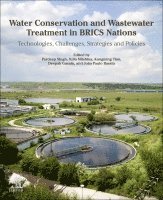
Water Conservation and Wastewater Treatment in BRICS Nations
Technologies, Challenges, Strategies and Policies
1 446 kr
Skickas inom 7-10 vardagar
Water Conservation and Wastewater Treatment in BRICS Nations: Technologies, Challenges, Strategies, and Policies addresses issues of water resources-including combined sewer system overflows-assessing effects on water quality standards and protecting surface and sub-surface potable water from the intrusion of saline water due to sea level rise. The book's chapters incorporate both policies and practical aspects and serve as baseline information for future adaption plans in BRICS nations. Users will find detailed important information that is ideal for policymakers, water management specialists, BRICS nation undergraduate or university students, teachers and researchers.
Presents tools and techniques that can be used to preserve water resources, including groundwater and surface water Provides geophysical methods to quantitatively monitor physical earth processes associated with water resources, such as contaminant transport and ecological and climate change investigations and monitoring Includes desalination techniques which can solve the issue of scarce drinking waterEnvironmental Sustainability and Industries
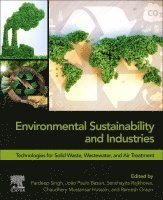
Technologies for Solid Waste, Wastewater, and Air Treatment
2 203 kr
Skickas inom 7-10 vardagar
Environmental Sustainability and Industries identifies and discusses critical areas related to environmentally conscious industrial development of products and services that may support more sustainable and equitable societies.
This book addresses pollution prevention by referring to the use of processes, practices, and materials that reduce or eliminate the generation of pollutants at the source of production, more efficient use of raw materials, energy, water or other resources, or by conserving natural resources by maintaining clean production. It explains industrial energy efficiency as the most cost-effective use of energy in manufacturing processes, reducing its wastage as well as the total consumption of primary energy resources.
Life cycle assessment is used as an analytical method to quantify environmental impacts, focusing on environmental considerations concerning process design and optimization, and including various sustainable manufacturing parameters in the context of industrial processes and proposes a classification of identified parameters to evaluate and optimize the manufacturing performances. The book also dives into industrial ecology, investigating how, where, and why environmental improvements can be made to develop a sustainable industry, meeting the needs of current generations without sacrificing the needs of the future ones.
This book analyzes a company's environmental, social, and economic performance and their interrelationships, emphasizing the importance of identifying and understanding causal relationships between alternative approaches to action and their impact on financial and nonfinancial performance. It concludes with a view on the future of sustainable industrial systems stressing change as a joint effort of scientists, governments, people in business, and academicians.
Offers compiled information on the environmental sustainability for industry Provides principles and advanced trends and approaches for environmental sustainability for the industrial sector Discusses established and emerging technologies and processes for sustainable approaches for industry Presents the development in the use of the assessment models as a tool to support the research and applications of different sustainable technologies and processes