Jordi Corominas – författare
Visar alla böcker från författaren Jordi Corominas. Handla med fri frakt och snabb leverans.
3 produkter
3 produkter
6 228 kr
Skickas inom 10-15 vardagar
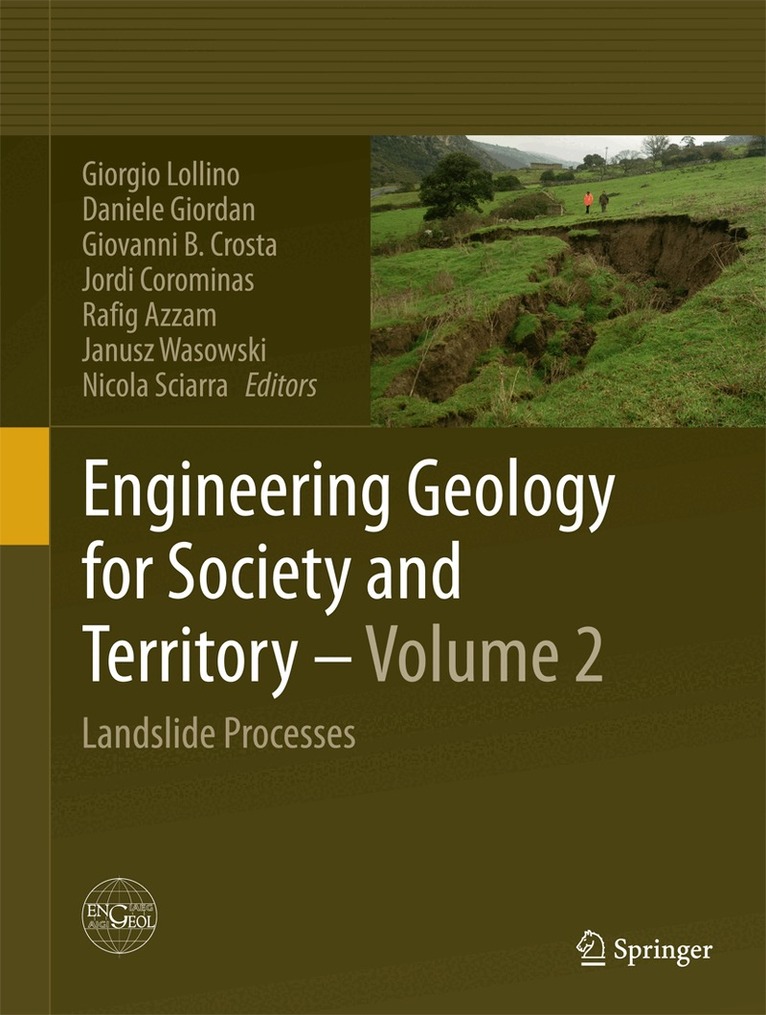
This book is one out of 8 IAEG XII Congress volumes, and deals with Landslide processes, including: field data and monitoring techniques, prediction and forecasting of landslide occurrence, regional landslide inventories and dating studies, modeling of slope instabilities and secondary hazards (e.g. impulse waves and landslide-induced tsunamis, landslide dam failures and breaching), hazard and risk assessment, earthquake and rainfall induced landslides, instabilities of volcanic edifices, remedial works and mitigation measures, development of innovative stabilization techniques and applicability to specific engineering geological conditions, use of geophysical techniques for landslide characterization and investigation of triggering mechanisms. Focuses is given to innovative techniques, well documented case studies in different environments, critical components of engineering geological and geotechnical investigations, hydrological and hydrogeological investigations, remote sensing and geophysical techniques, modeling of triggering, collapse, run out and landslide reactivation, geotechnical design and construction procedures in landslide zones, interaction of landslides with structures and infrastructures and possibility of domino effects. The Engineering Geology for Society and Territory volumes of the IAEG XII Congress held in Torino from September 15-19, 2014, analyze the dynamic role of engineering geology in our changing world and build on the four main themes of the congress: environment, processes, issues, and approaches. The congress topics and subject areas of the 8 IAEG XII Congress volumes are: Climate Change and Engineering Geology. Landslide Processes. River Basins, Reservoir Sedimentation and Water Resources. Marine and Coastal Processes. Urban Geology, Sustainable Planning and Landscape Exploitation. Applied Geology for Major Engineering Projects. Education, Professional Ethics and Public Recognition of Engineering Geology. Preservation ofCultural Heritage.
Del 34 - Advances in Natural and Technological Hazards Research
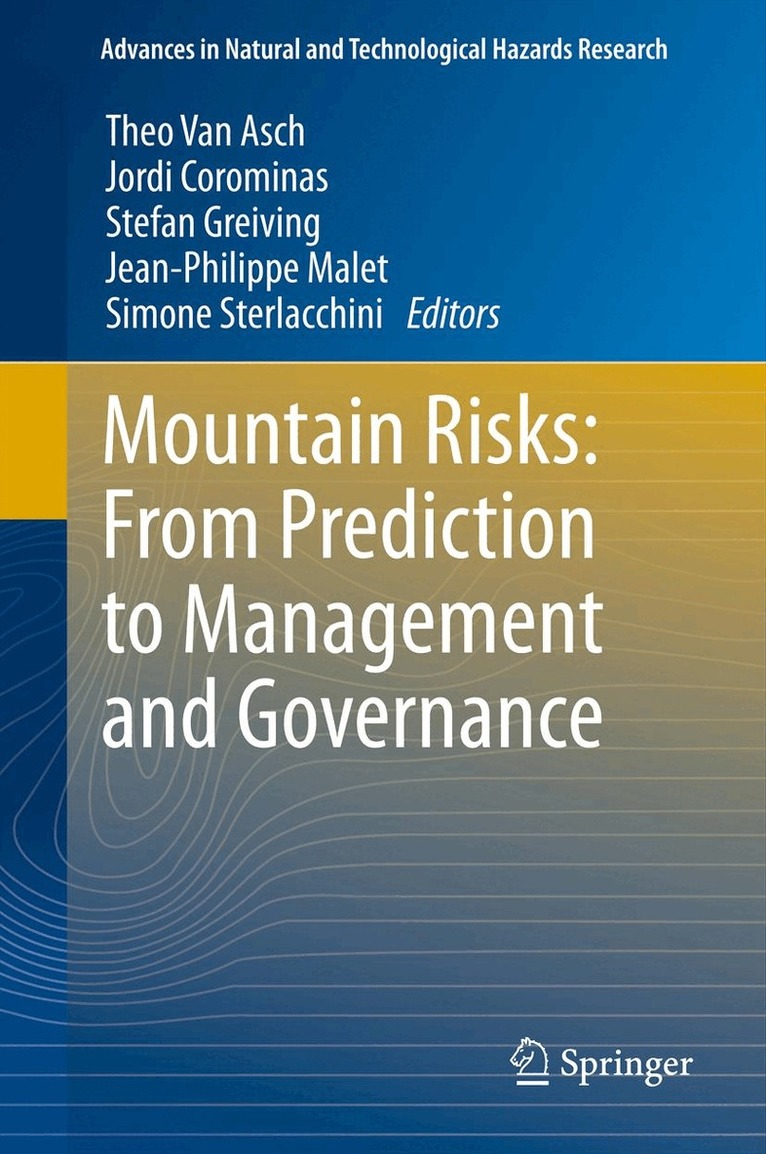
Mountain Risks: From Prediction to Management and Governance
Inbunden, Engelska, 2013
1 062 kr
Skickas inom 10-15 vardagar
This book offers a cross disciplinary treatment of the rapidly growing field of integrated approaches in risk assessment in mountainous areas. All major aspects related to hazard and risk assessment, risk management, and governance are illustrated with a wide range of case studies. The first part of the book focuses on new techniques for assessing the natural hazards of different types of mass movements. State-of-the-art techniques for morphological characterization and monitoring of displacements are described. Computational advances are covered to explain the process systems and to quantify the hazards of fast and slow-moving landslides. In the second part of the book methodologies are included for assessing the impact of these natural hazards on the society in terms of risks. In this part, methodologies for defining the vulnerability of the elements at risk are shown and the use of run-out models for risk assessment of the dangerous rapid mass movements are evaluated. The third part of the book focuses on the response of society towards the problems of hazard and risk. It highlights the role of spatial planning, early warning systems and evacuation plans for risk management. It establishes practical thresholds for acceptable and tolerable risks and emphasizes the importance of education and communication to society. Audience The book is of interest to a wide range of experts from related disciplines, practitioners and stakeholders to demonstrate the importance of an integrated approach for all aspects of risks in mountainous areas.
Del 34 - Advances in Natural and Technological Hazards Research
Mountain Risks: From Prediction to Management and Governance
Häftad, Engelska, 2016
1 062 kr
Skickas inom 10-15 vardagar
This book offers a cross disciplinary treatment of the rapidly growing field of integrated approaches in risk assessment in mountainous areas. All major aspects related to hazard and risk assessment, risk management, and governance are illustrated with a wide range of case studies. The first part of the book focuses on new techniques for assessing the natural hazards of different types of mass movements. State-of-the-art techniques for morphological characterization and monitoring of displacements are described. Computational advances are covered to explain the process systems and to quantify the hazards of fast and slow-moving landslides. In the second part of the book methodologies are included for assessing the impact of these natural hazards on the society in terms of risks. In this part, methodologies for defining the vulnerability of the elements at risk are shown and the use of run-out models for risk assessment of the dangerous rapid mass movements are evaluated. The third part of the book focuses on the response of society towards the problems of hazard and risk. It highlights the role of spatial planning, early warning systems and evacuation plans for risk management. It establishes practical thresholds for acceptable and tolerable risks and emphasizes the importance of education and communication to society. Audience The book is of interest to a wide range of experts from related disciplines, practitioners and stakeholders to demonstrate the importance of an integrated approach for all aspects of risks in mountainous areas.