Jorge Cañizares-Esguerra - Böcker
Visar alla böcker från författaren Jorge Cañizares-Esguerra. Handla med fri frakt och snabb leverans.
12 produkter
12 produkter
290 kr
Skickas inom 7-10 vardagar
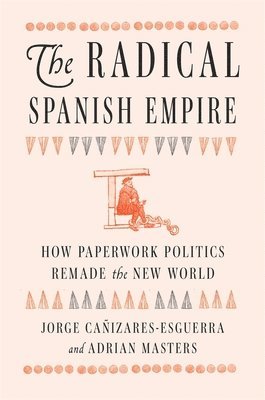
A groundbreaking history of political struggle in the Spanish New World, where commoners and elites alike challenged the social order through the remarkable power of paperwork.As Spanish conquistadors swept through the New World, the Crown envisioned that a rigidly hierarchical aristocratic order would flourish in their wake. At first, this vision seemed to be within reach: the great conquistadors ruled as noblemen over millions. Yet contrary to all expectations, the Spanish empire in the New World quickly became a hotbed of radical efforts to overturn the emerging order. With the conquistadors in retreat, new enclaves controlled by powerful friars and native lords arose. But they too collapsed, again to the surprise of many.As Jorge Cañizares-Esguerra and Adrian Masters show, these social orders broke down thanks to the challenges mounted by countless individuals across the Spanish Americas—including non-elite Spanish and Indigenous people, women, and the enslaved. To achieve their goals, they turned not only to outright violence but also to massive amounts of paperwork: petitions, complaints, lawsuits, and secret testimonies. Through this grassroots “lawfare,” vassals undercut the emerging seigneurial dynasties of the conquistadors, stripped the friars of theocratic authority, and curtailed the might of native lords. Collectively, they spearheaded movements against tyranny and slavery, proposed and challenged laws, produced new types of knowledge, created archives and historical accounts, and questioned the nature of truth itself. In the process, however, these actors also gradually co-created a lasting new society of orders—one that would solidify in the 1570s with viceroys, bishops, and inquisitors at its apex.Dramatically recasting a pivotal era in colonial history, The Radical Spanish Empire illuminates how the power of paperwork forever transformed the New World.
321 kr
Skickas inom 7-10 vardagar
This book argues that the striking resemblances in Spanish and Puritan discourses of colonization as "exorcism" and as spiritual gardening point to a common Atlantic history. These resemblances suggest that we are better off if we simply consider the Puritan colonization of New England as a continuation of Iberian models rather than a radically different colonizing experience. The book demonstrates that a wider Pan-American perspective can upset the most cherished national narratives of the United States, for it maintains that the Puritan colonization of New England was as much a chivalric, crusading act of Reconquista (against the Devil) as was the Spanish conquest.
How to Write the History of the New World
Histories, Epistemologies, and Identities in the Eighteenth-Century Atlantic World
Häftad, Engelska, 2002
425 kr
Skickas inom 7-10 vardagar
In the mid-eighteenth century, the French naturalist Buffon contended that the New World was in fact geologically new—that it had recently emerged from the waters—and that dangerous miasmas had caused all organic life on the continents to degenerate. In the "dispute of the New World" many historians, naturalists, and moral philosophers from Europe and the Americas (including Thomas Jefferson) sought either to confirm or refute Buffon's views. This book maintains that the "dispute" was also a debate over historical authority: upon whose sources and facts should naturalists and historians reconstruct the history of the continent and its peoples?The author traces the cultural processes that led early-modern intellectuals on both sides of the Atlantic to question primary sources that had long been considered authoritative: Mesoamerican codices, early colonial Spanish chronicles, and travel accounts. In the process, he demonstrates how the writings of these critics led to the rise of the genre of conjectural history. The book also adds to the literature on nation formation by exploring the creation of specific identities in Spain and Spanish America by means of particular historical narratives and institutions. Finally, it demonstrates that colonial intellectuals went beyond mirroring or contesting European ideas and put forth daring and original critiques of European epistemologies that resulted in substantially new historiographical concepts.
Nature, Empire, and Nation
Explorations of the History of Science in the Iberian World
Inbunden, Engelska, 2006
1 389 kr
Skickas inom 10-15 vardagar
This collection of essays explores two traditions of interpreting and manipulating nature in the early-modern and nineteenth-century Iberian world: one instrumental and imperial, the other patriotic and national. Imperial representations laid the ground for the epistemological transformations of the so-called Scientific Revolutions. The patriotic narratives lie at the core of the first modern representations of the racialized body, Humboldtian theories of biodistribution, and views of the landscape as a historical text representing different layers of historical memory.
Nature, Empire, and Nation
Explorations of the History of Science in the Iberian World
Häftad, Engelska, 2006
321 kr
Skickas inom 7-10 vardagar
This collection of essays explores two traditions of interpreting and manipulating nature in the early-modern and nineteenth-century Iberian world: one instrumental and imperial, the other patriotic and national. Imperial representations laid the ground for the epistemological transformations of the so-called Scientific Revolutions. The patriotic narratives lie at the core of the first modern representations of the racialized body, Humboldtian theories of biodistribution, and views of the landscape as a historical text representing different layers of historical memory.
377 kr
Skickas inom 10-15 vardagar
During the era of the Atlantic slave trade, vibrant port cities became home to thousands of Africans in transit. Free and enslaved blacks alike crafted the necessary materials to support transoceanic commerce and labored as stevedores, carters, sex workers, and boarding-house keepers. Even though Africans continued to be exchanged as chattel, urban frontiers allowed a number of enslaved blacks to negotiate the right to hire out their own time, often greatly enhancing their autonomy within the Atlantic commercial system.In The Black Urban Atlantic in the Age of the Slave Trade, eleven original essays by leading scholars from the United States, Europe, and Latin America chronicle the black experience in Atlantic ports, providing a rich and diverse portrait of the ways in which Africans experienced urban life during the era of plantation slavery. Describing life in Portugal, Brazil, Mexico, the Caribbean, and Africa, this volume illuminates the historical identity, agency, and autonomy of the African experience as well as the crucial role Atlantic cities played in the formation of diasporic cultures. By shifting focus away from plantations, this volume poses new questions about the nature of slavery in the sixteenth to nineteenth centuries, illustrating early modern urban spaces as multiethnic sites of social connectivity, cultural incubation, and political negotiation.Contributors: Trevor Burnard, Mariza de Carvalho Soares, Matt D. Childs, Kevin Dawson, Roquinaldo Ferreira, David Geggus, Jane Landers, Robin Law, David Northrup, JoÃo JosÉ Reis, James H. Sweet, Nicole von Germeten.
719 kr
Skickas inom 10-15 vardagar
According to conventional wisdom, in the sixteenth century, Spain and Portugal served as a model to the English for how to go about establishing colonies in the New World and Africa. By the eighteenth century, however, it was Spain and Portugal that aspired to imitate the British. Editor Jorge CaÑizares-Esguerra and the contributors to Entangled Empires challenge these long-standing assumptions, exploring how Spain, Britain, and Portugal shaped one another throughout the entire period, from the sixteenth to the nineteenth centuries. They argue that these empires were interconnected from the very outset in their production and sharing of knowledge as well as in their economic activities. Willingly or unwillingly, African slaves, Amerindians, converso traders, smugglers, missionaries, diplomats, settlers, soldiers, and pirates crossed geographical, linguistic, and political boundaries and cocreated not only local but also imperial histories. Contributors reveal that entanglement was not merely a process that influenced events in the colonies after their founding; it was constitutive of European empire from the beginning.The essays in Entangled Empires seek to clarify the processes that rendered the intertwined histories of these colonial worlds invisible, including practices of archival erasure as well as selective memorialization. Bringing together a large geography and chronology, Entangled Empires emphasizes the importance of understanding connections, both intellectual and practical, between the English and Iberian imperial projects. The colonial history of the United States ought to be considered part of the history of colonial Latino-America just as Latin-American history should be understood as fundamental to the formation of the United States.Contributors: Ernesto Bassi, Benjamin Breen, Jorge CaÑizares-Esguerra, Bradley Dixon, Kristie Flannery, Eliga Gould, Michael Guasco, April Hatfield, Christopher Heaney, Christopher Schmidt-Nowara, Mark Sheaves, Holly Snyder, Cameron Strang.
563 kr
Skickas inom 10-15 vardagar
The Invention of Humboldt is a game-changing volume of essays by leading scholars of the Hispanic world that explodes many myths about Alexander von Humboldt and his world.Rather than ‘follow in Humboldt’s footsteps,’ this book outlines the new critical horizon of post-Humboldtian Humboldt studies: the archaeology of all that lies buried under the Baron’s epistemological footprint. Contrary to the popular image of Humboldt as a solitary ‘adventurer’ and ‘hero of science’ surrounded by New World nature, The Invention of Humboldt demonstrates that the Baron’s opus and practice was largely derivative of the knowledge communities and archives of the Hispanic world. Although Humboldtian writing has invented a powerful cult that has served to erase the sources of his knowledge and practice, in truth Humboldt did not ‘invent nature,’ nor did he pioneer global science: he was the beneficiary of Iberian natural science and globalization. Nor was Humboldt a pioneering, ‘postcolonial’ cultural relativist. Instead, his anthropological views of the Americas were Orientalist and historicist and, in most ways, were less enlightened than those of his Creole contemporaries. This book will reshape the landscape of Humboldt scholarship. It is essential reading for all those interested in Alexander von Humboldt, the Hispanic American enlightenment, and the global history of science and knowledge.
1 954 kr
Skickas inom 10-15 vardagar
The Invention of Humboldt is a game-changing volume of essays by leading scholars of the Hispanic world that explodes many myths about Alexander von Humboldt and his world.Rather than ‘follow in Humboldt’s footsteps,’ this book outlines the new critical horizon of post-Humboldtian Humboldt studies: the archaeology of all that lies buried under the Baron’s epistemological footprint. Contrary to the popular image of Humboldt as a solitary ‘adventurer’ and ‘hero of science’ surrounded by New World nature, The Invention of Humboldt demonstrates that the Baron’s opus and practice was largely derivative of the knowledge communities and archives of the Hispanic world. Although Humboldtian writing has invented a powerful cult that has served to erase the sources of his knowledge and practice, in truth Humboldt did not ‘invent nature,’ nor did he pioneer global science: he was the beneficiary of Iberian natural science and globalization. Nor was Humboldt a pioneering, ‘postcolonial’ cultural relativist. Instead, his anthropological views of the Americas were Orientalist and historicist and, in most ways, were less enlightened than those of his Creole contemporaries. This book will reshape the landscape of Humboldt scholarship. It is essential reading for all those interested in Alexander von Humboldt, the Hispanic American enlightenment, and the global history of science and knowledge.
2 718 kr
Skickas inom 10-15 vardagar
The Atlantic in Global History is a collection of original essays by leading authors that both introduce the main themes of Atlantic history and expand the category of the Atlantic chronologically, spatially, and methodologically. Moving away from the nation-state focused model of Atlantic history, this book emphasizes the comparisons among national experiences of the Atlantic. Meanwhile, by extending beyond the early modern period and into the nineteenth and twentieth centuries, it presents the continued analytical value of the Atlantic paradigm. Each chapter explores the events that formed the nations and cultures of the Atlantic region and examines the Atlantic’s relationship with non-Atlantic communities. This second edition is updated with a new introduction, which includes a section dedicated to developments in the field since the publication of the previous edition, and a new guide for instructors, with suggestions for classroom use. The volume’s broad global and chronological coverage makes it an ideal book for students and lecturers of Atlantic History.
702 kr
Skickas inom 10-15 vardagar
The Atlantic in Global History is a collection of original essays by leading authors that both introduce the main themes of Atlantic history and expand the category of the Atlantic chronologically, spatially, and methodologically. Moving away from the nation-state focused model of Atlantic history, this book emphasizes the comparisons among national experiences of the Atlantic. Meanwhile, by extending beyond the early modern period and into the nineteenth and twentieth centuries, it presents the continued analytical value of the Atlantic paradigm. Each chapter explores the events that formed the nations and cultures of the Atlantic region and examines the Atlantic’s relationship with non-Atlantic communities. This second edition is updated with a new introduction, which includes a section dedicated to developments in the field since the publication of the previous edition, and a new guide for instructors, with suggestions for classroom use. The volume’s broad global and chronological coverage makes it an ideal book for students and lecturers of Atlantic History.
Del 14 - Jesuit Studies
Encounters between Jesuits and Protestants in Asia and the Americas
Inbunden, Engelska, 2018
2 431 kr
Skickas inom 5-8 vardagar
The present volume is a result of an international symposium on the encounters between Jesuits and Protestants in Asia and the Americas, which was organized by Boston College’s Institute for Advanced Jesuit Studies at Boston College in June 2017.In Asia, Protestants encountered a mixed Jesuit legacy: in South Asia, they benefited from pioneering Jesuit ethnographers while contesting their conversions; in Japan, all Christian missionaries who returned after 1853 faced the equation of Japanese nationalism with anti-Jesuit persecution; and in China, Protestants scrambled to catch up to the cultural legacy bequeathed by the earlier Jesuit mission.In the Americas, Protestants presented Jesuits as enemies of liberal modernity, supporters of medieval absolutism yet master manipulators of modern self-fashioning and the printing press. The evidence suggests a far more complicated relationship of both Protestants and Jesuits as co-creators of the bright and dark sides of modernity, including the public sphere, public education, plantation slavery, and colonialism.