Jorge E. ViA±uales – författare
Visar alla böcker från författaren Jorge E. ViA±uales. Handla med fri frakt och snabb leverans.
6 produkter
6 produkter
E-bok
PDF, Engelska, 20141 470 kr
Läs direkt efter köp
International investment law is one of the fastest growing areas of international law. It has led to the signing of thousands of agreements, mostly in the form of investment contracts and bilateral investment treaties. Also, in the last two decades, there has been an exponential growth in the number of disputes being resolved by investment arbitration tribunals. Yet the legal principles at the basis of international investment law and arbitration remain in a state offlux. Perhaps the best illustration of this phenomenon is the wide disagreement among investment tribunals on some of the core concepts underpinning the regime, such as investment, property, regulatory powers, scope of jurisdiction, applicable law, or the interactions with other areas ofinternational law.The purpose of this book is to revisit these conceptual foundations in order to shed light on the practice of international investment law. It is an attempt to bridge the growing gap between the theory and the practice of this thriving area of international law. The first part of the book focuses on the ''infrastructure'' of the investment regime or, more specifically, on the structural arrangements that have been developed to manage foreign investment transactions and the potential disputesarising from them. The second part of the book identifies the common conceptual bases of an array of seemingly unconnected practical problems in order to clarify the main stakes and offer balanced solutions. The third part addresses the main sources of ''regime stress'' as well as the main legalmechanisms available to manage such challenges to the operation of the regime.Overall, the book offers a thorough investigation of the conflicting theoretical positions underlying international investment law, testing their worth by reference to concrete issues that have arisen in the jurisprudence. It demonstrates that many of the most important practical questions arising in practice can be addressed by a carefully dosed resort to theory.
E-bok
Engelska, 20141 470 kr
Läs direkt efter köp
International investment law is one of the fastest growing areas of international law. It has led to the signing of thousands of agreements, mostly in the form of investment contracts and bilateral investment treaties. Also, in the last two decades, there has been an exponential growth in the number of disputes being resolved by investment arbitration tribunals. Yet the legal principles at the basis of international investment law and arbitration remain in a state offlux. Perhaps the best illustration of this phenomenon is the wide disagreement among investment tribunals on some of the core concepts underpinning the regime, such as investment, property, regulatory powers, scope of jurisdiction, applicable law, or the interactions with other areas ofinternational law.The purpose of this book is to revisit these conceptual foundations in order to shed light on the practice of international investment law. It is an attempt to bridge the growing gap between the theory and the practice of this thriving area of international law. The first part of the book focuses on the ''infrastructure'' of the investment regime or, more specifically, on the structural arrangements that have been developed to manage foreign investment transactions and the potential disputesarising from them. The second part of the book identifies the common conceptual bases of an array of seemingly unconnected practical problems in order to clarify the main stakes and offer balanced solutions. The third part addresses the main sources of ''regime stress'' as well as the main legalmechanisms available to manage such challenges to the operation of the regime.Overall, the book offers a thorough investigation of the conflicting theoretical positions underlying international investment law, testing their worth by reference to concrete issues that have arisen in the jurisprudence. It demonstrates that many of the most important practical questions arising in practice can be addressed by a carefully dosed resort to theory.
E-bok
PDF, Engelska, 20151 627 kr
Läs direkt efter köp
The international community has long grappled with the issue of safeguarding the environment and encouraging sustainable development, often with little result. The 1992 Rio Declaration on Environment and Development was an emphatic attempt to address this issue, setting down 27 key principles for the international community to follow. These principles define the rights of people to sustainable development, and the responsibilities of states to safeguard the common environment. The Rio Declaration established that long term economic progress required a connection to environmental protection. It was designed as an authoritative and comprehensive statement of the principles of sustainable development law, an instrument to take stock of the past international and domestic practice, a guide for the design of new multilateral environmental regimes, and as a reference for litigation. This commentary provides an authoritative and comprehensive overview of the principles of the Declaration, written by over thirty inter-disciplinary contributors, including both leading practitioners and academics. Each principle is analysed in light of its origins and rationale. The book investigates each principle''s travaux préparatoires setting out the main points of controversy and the position of different countries or groups. It analyses the scope and dimensions of each principle, providing an in-depth understanding of its legal effects, including whether it can be relied before a domestic or international court. It also assesses the impact of the principles on subsequent soft law and treaty development, as well as domestic and international jurisprudence. The authors demonstrate the ways in which the principles interact with each other, and finally provide a detailed analysis of the shortcomings and future potential of each principle. This book will be of vital importance to practitioners, scholars, and students of international environomental law and sustainable development.
E-bok
PDF, Engelska, 20192 184 kr
Läs direkt efter köp
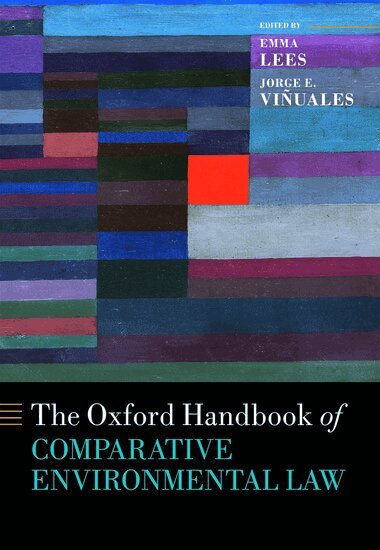
This Handbook is the first comprehensive account of comparative environmental law. It examines in detail the methodological foundations of the discipline as well as the substance of environmental law across countries from four vantage points: country studies from all continents, responses to common problems (including air pollution, water management, nature conservation, genetically modified organisms, climate change and energy, chemicals, waste), foundational components of environmental law systems (including principles, property rights, administrative and judicial organisation, command-and-control regulation, market mechanisms, informational techniques and liability mechanisms), and common interactions of environmental protection with the broader public, private, and criminal law contexts. The volume brings together the foremost authorities in this field from around the world to provide a concise, self-contained, and technically rigorous account of environmental law as a single overall system.
E-bok
Engelska, 20192 165 kr
Läs direkt efter köp
This Handbook is the first comprehensive account of comparative environmental law. It examines in detail the methodological foundations of the discipline as well as the substance of environmental law across countries from four vantage points: country studies from all continents, responses to common problems (including air pollution, water management, nature conservation, genetically modified organisms, climate change and energy, chemicals, waste), foundational components of environmental law systems (including principles, property rights, administrative and judicial organisation, command-and-control regulation, market mechanisms, informational techniques and liability mechanisms), and common interactions of environmental protection with the broader public, private, and criminal law contexts. The volume brings together the foremost authorities in this field from around the world to provide a concise, self-contained, and technically rigorous account of environmental law as a single overall system.
Inbunden, Engelska, 2019
3 096 kr
Skickas inom 5-8 vardagar
This Handbook is the first comprehensive account of comparative environmental law. It examines in detail the methodological foundations of the discipline as well as the substance of environmental law across countries from four vantage points: country studies from all continents, responses to common problems (including air pollution, water management, nature conservation, genetically modified organisms, climate change and energy, chemicals, waste), foundational components of environmental law systems (including principles, property rights, administrative and judicial organisation, command-and-control regulation, market mechanisms, informational techniques and liability mechanisms), and common interactions of environmental protection with the broader public, private, and criminal law contexts. The volume brings together the foremost authorities in this field from around the world to provide a concise, self-contained, and technically rigorous account of environmental law as a single overall system.