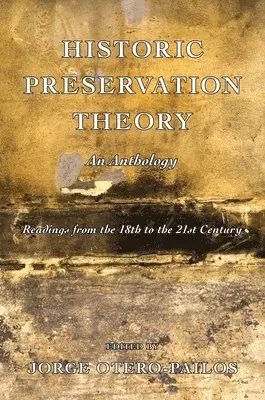
Jorge Otero-Pailos – författare
Visar alla böcker från författaren Jorge Otero-Pailos. Handla med fri frakt och snabb leverans.
5 produkter
5 produkter
Häftad, Engelska, 2022
587 kr
Skickas inom 5-8 vardagar
Häftad, Engelska, 2010
303 kr
Skickas inom 5-8 vardagar
Architecture’s Historical Turn traces the hidden history of architectural phenomenology, a movement that reflected a key turning point in the early phases of postmodernism and a legitimating source for those architects who first dared to confront history as an intellectual problem and not merely as a stylistic question. Jorge Otero-Pailos shows how architectural phenomenology radically transformed how architects engaged, theorized, and produced history. In the first critical intellectual account of the movement, Otero-Pailos discusses the contributions of leading members, including Jean Labatut, Charles Moore, Christian Norberg-Schulz, and Kenneth Frampton. For architects maturing after World War II, Otero-Pailos contends, architectural history was a problem rather than a given. Paradoxically, their awareness of modernism’s historicity led some of them to search for an ahistorical experiential constant that might underpin all architectural expression. They drew from phenomenology, exploring the work of Bachelard, Merleau-Ponty, Heidegger, and Ricoeur, which they translated for architectural audiences. Initially, the concept that experience could be a timeless architectural language provided a unifying intellectual basis for the stylistic pluralism that characterized postmodernism. It helped give theory-especially the theory of architectural history-a new importance over practice. However, as Otero-Pailos makes clear, architectural phenomenologists could not accept the idea of theory as an end in itself. In the mid-1980s they were caught in the contradictory and untenable position of having to formulate their own demotion of theory. Otero-Pailos reveals how, ultimately, the rise of architectural phenomenology played a crucial double role in the rise of postmodernism, creating the antimodern specter of a historical consciousness and offering the modern notion of essential experience as the means to defeat it.
Häftad, Engelska, 2025
233 kr
Skickas inom 5-8 vardagar
Future Anterior approaches historic preservation from a position of critical inquiry, rigorous scholarship, and theoretical analysis. The journal is an important international forum for the critical examination of historic preservation, spurring challenges of its assumptions, goals, methods, and results. As the first journal in American academia devoted to the study and advancement of historic preservation, it provides a much-needed bridge between architecture and history. The journal also features provocative theoretical reflections on historic preservation from the point of view of art, philosophy, law, geography, archeology, planning materials science, cultural anthropology, and conservation. Future Anterior is essential reading for anyone interested in historic preservation and its role in current cultural debates.
Häftad, Engelska
420 kr
Tillfälligt slut
Häftad, Engelska, 2014
230 kr
Tillfälligt slut
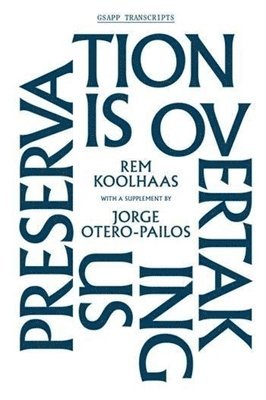
Preservation is Overtaking Us brings together two lectures given by Rem Koolhaas at Columbia University's Graduate School of Architecture, Planning and Preservation, along with a response (framed as a supplement to the original lectures) by Jorge Otero-Pailos. In the first essay Koolhaas describes alternative strategies for preserving Beijing, China. The second talk marks the inaugural Paul Spencer Byard lecture, named in celebration of the longtime professor of Historic Preservation at GSAPP. These two lectures trace key moments of Koolhaas' thinking on preservation, including his practice's entry into China and the commission to redevelop the State Hermitage Museum in St. Petersburg, Russia. In a format well known to Koolhaas' readers, Otero-Pailos reworks the lectures into a working manifesto, using it to interrogate OMA's work from within the discipline of preservation.